blog test now

Evidence of the end of globalisation is building up.
According to Satyajit Das, growth in trade and cross border investment, which has underpinned prosperity and development, is being reversed in a major historical shift.

 (more…)

Customer trust may be the single most important asset any business can have, and two conditions must be met before a customer will trust you:

  1. Intent. The customer has to perceive that you have the right motive – that is, that you intend to act in the customer’s own interest, and that you won’t sell the customer’s interest short when that advances your own business goals.
  2. Competence. You must be capable of carrying out that good intent in a reasonably competent manner.

Both these conditions must be met for a customer to trust a business. Either one, by itself, will not be sufficient. It does a customer no good to deal with the best-meaning company in the world if that company doesn’t have enough competence to deliver on their good intentions. The problem is that customer trust is too often overlooked by busy executives, under pressure to show immediate financial results in their operations. It’s easy to overlook the central role of customer trust in the success of a business, because trustability is not something we normally measure and report to shareholders on any regular basis. If you want to begin to understand your own company’s attitude toward customer trust, these are the kinds of questions you should ask yourself:

  • Do you ever find the need to have one story for the company
    but another for the client?
  • Do you remind customers when their warranties or service
    agreements are almost up?
  • Would you rather sell to knowledgeable and informed customers,
    or to uninformed customers?
  • Do your salespeople make more money by selling products?
    Or by building relationships?

from Strategy Speaks: a Peppers and Rogers Blog

Journal of Management Excellence: Creating Value

 Creating value is the most important objective of every organisation, but it is also the hardest to define.
Oracle takes a look at the many different ways to create value.

Inside:

  • Connect Enterprise Performance Management Processes to Drive Business Value (Ivo Bauermann)
  • Commentary: If You Are Ready, Now Is the Time! (John Kopcke)
  • The Need for Profitability Management (VJ Lal)
  • Commentary: The Complete Value of an Enterprise Performance Management System (Thomas Oestreich)
  • Centraal Boekhuis: Creating Value by Delivering Business Intelligence as a Service (Emiel van Bockel)
  • Commentary: The Overinstrumented Enterprise (James Taylor)
  • True Value Index: A Measure for Sustainable Business Success (Frank Buytendijk)
  • Industry Insights (Mark Conway)

DOWNLOAD>


  seo data . ip info

Journal of Management Excellence: Creating Value, Part II

Creating value is the most important objective of every organization, but it is also the hardest to define. In part two of this series, Oracle‘s newsletter takes another look at the many different ways to create value.

Inside:

  • World-Class EPM Drives More Than Twice The Shareholder Return (Tom Willman)
  • Commentary: Creating Value By Doing More With Less (Thomas Oestreich)
  • The First Oracle Enterprise Performance Management Index Reveals Modest (Steve Walker)
  • Achievement of Management Excellence (Steve Walker)
  • Guest Commentary: Closing The Loop (Wayne Eckerson)
  • Uncertainty Management: The Source of All Management Value (Jim Franklin)
  • Managing Stakeholder Value With Analysis Chains (Tony Politano)
  • Building the Business Case For Return on Enterprise Performance Management Investment (Ron Dimon)
  • Industry Insights (Mark Conway)

DOWNLOAD> seo data ip info .

Jim Champy, coauthor, with Harry Greenspun, of Reengineering Health Care: A Manifesto for Radically Rethinking Health Care Delivery, introduces a lesson on the pitfalls of measurement from Faster, Cheaper, Better: The 9 Levers for Transforming How Work Gets Done, by Michael Hammer and Lisa W. Hershman.

The late Mike Hammer always delivered the unexpected in a strong voice with an intelligent edge that woke you up. When we coauthored Reengineering the Corporation, I discovered that no partner could have been more insightful, more probing into the behaviors of companies and their managers. Mike also had a great talent for metaphor. He said that inefficiencies were like fat marbled into a piece of meat, and that to get costs out you had to grind up the company and fry out the fat. That metaphor never made it into our first book. I told Mike that executives wouldn’t respond well to the notion of treating their companies so brutally.
But that didn’t stop Mike from being a radical thinker, always challenging the way things are done. He disdained the notion “if it ain’t broke, don’t fix it.” In this excerpt, from the book that Mike was working on before his untimely death at age 60 in 2008 (a work completed by his colleague Lisa W. Hershman), you will see that even things that look right can be wrong. Read it several times to grasp everything that’s here on how managers misuse metrics and measurement processes — sometimes unwittingly, sometimes purposely to deceive. It’s quintessential Hammer.

— Jim Champy

Excerpted from Chapter 2 of Faster, Cheaper, Better:
The 9 Levers for Transforming How Work Gets Done

In the sixth century Pope Gregory the Great formulated his famous list of the seven deadly sins — gluttony, greed, wrath, lust, sloth, envy, and pride. There are also seven sins of corporate measurement. Gregory’s list was meant to help an individual’s quest for salvation. Ours is more mundane: saving companies from fatal flaws in performance measurement…

Vanity. One of the most widespread failings in performance measurement is to use measures whose sole purpose is to make the organization, its people, and especially its managers look good. As one executive said, “Nobody wants a metric that they don’t score 95 on.” This is especially true because bonuses and other rewards are usually tied to performance measures. For instance, in distribution logistics, it is common for companies to measure themselves against the promise date — that is, whether they ship by the date that they promised the customer. A moment’s impartial reflection shows that this sets the bar absurdly low — a company need only promise delivery dates that it can easily make in order to look good on this metric. Even worse, companies often measure against what is called last promise date — the final date promised the customer, after changes may have been made to the delivery schedule. It takes real effort not to hit the last promise date. Moreover, achieving good results on the last promise date has no larger significance for company performance; it does not lead to customer satisfaction or any other desirable outcome. All you have to do is keep promising a later date. Even if you manage to hit that target 100 percent of the time, it’s likely that your customer wanted the product days, weeks, or even months ago, so don’t go patting yourself on the back.
A far better metric would be performance against customer request date. But achieving that goal would be far more difficult and might lead to managers not getting their bonuses. When executives at a semiconductor manufacturer proposed shifting from last promise date to customer request date, they encountered widespread resistance.
A metals refiner had been using yield — the percentage of raw material that was turned into saleable product — as a key performance metric, and everyone was very pleased that this figure was consistently over 95 percent. An executive new to the company made the observation that this figure glossed over the difference between high-grade and low-grade product. The refinery was supposed to produce only high-grade product, but poor processing sometimes led to low-grade product. The company then started to measure the yield of high-grade product and discovered that figure was closer to 70 percent. That was a much more meaningful representation of the refinery’s real performance. Unsurprisingly, that insight did not generate a lot of enthusiasm.
Provincialism. This sin permits organizational boundaries and concerns to dictate performance metrics. On the surface, it would seem natural and appropriate for a functional department to be measured on its own performance. That is, after all, what its managers can control. In reality, however, measuring so narrowly inevitably leads to suboptimization and conflict. One insurance company CEO has complained that he spends half his time adjudicating disputes between sales and underwriting. The sales department is measured on sales volume. Not surprisingly, the sales force tries to sell any willing customer. Underwriting, on the other hand, is measured on quality of risk. Naturally, the underwriters want to reject all but the best prospects. The two departments clash constantly. If the salespeople win, the company will be paying out more in claims. If the underwriters win, revenue will be less than it would otherwise have been. Higher costs or lower revenue? The top brass has to choose between two evils.
Narcissism. This is the unpardonable offense of measuring from one’s own point of view, rather than from the customer’s perspective. One retailer measured its distribution organization on how well the goods in the stores matched the stock-on-hand levels specified in the merchandising plan. They had a satisfying 98 percent availability when measured in this way. But when they thought to measure to what extent the goods in the stores matched what customers actually wanted to buy, rather than what the merchandising plan called for, they found the figure was only 86 percent. Another retailer measured goods in stock by whether the goods had arrived in the store; eventually the company realized that simply being in the store did the customer no good if the product wasn’t on the shelf — and on-shelf availability was considerably lower than in-store availability. These companies measured things that interested them, not their customers.
A consumer goods maker managed its distribution operations by focusing on the percentage of orders from retailers that it filled on time. Sounds sensible. By tracking, reporting, and relentlessly seeking to improve this number, the company got it up to 99.5 percent consistently. That’s the good news. The bad news is that when the company happened to take a look at the reality of retailers’ shelves — which is what consumers see — it found that many of its products were nonetheless out of stock as much as 14 percent of the time. Many companies measure the performance of order fulfillment in terms of whether the shipment left the dock on the date scheduled. This is of interest only to the company itself. Customers care about when they receive the shipment, not when it leaves the dock. Perhaps the most egregious instance of narcissism that we have encountered was at a major computer systems manufacturer. This company measured on-time shipping in terms of individual components; if it shipped, say, nine of ten components of a system on time, the company claimed a 90 percent score. The customer, of course, would give the company a 0 percent rating, since without all ten components the system is useless.
Laziness. This is a trap into which even those who avoid narcissism often fall: assuming you know what is important to measure without giving it adequate thought or effort. A semiconductor maker measured many aspects of its order processing operation, but not the critical (to customers) issue of how long it took from the time the customer gave the order to the time the company confirmed it and provided a delivery date — simply because the company never thought to ask customers what was really important to them.
An electric power utility assumed that customers cared about speed of installation and so measured and tried to improve it, only to discover later that customers cared more about the reliability of the installation date they were given than speed of installation. Companies often jump to conclusions, measure what is easy to measure, or measure what they have always measured, rather than go through the effort of ascertaining what is truly important to measure.
Pettiness. Too many companies measure only a small component of what matters. Executives at a telecommunications systems vendor rejected a proposal to have customers perform their own repairs because that would require putting spare parts at customer premises, which would drive up spare parts inventory levels, a key metric for the company. It lost sight of the fact that the broader and more meaningful metric was total cost of maintenance, which is the sum of labor costs and inventory costs. The increase in parts inventory would be more than offset by a reduction in labor costs produced by the new approach.
Inanity. Metrics drive behavior, but too many companies implement metrics without giving any thought to the consequences of these metrics for human behavior and consequently for enterprise performance. People in an organization will seek to improve a metric they are told is important, especially if they are compensated on it and even if doing so is counterproductive. For instance, a regional fast-food chain specializing in chicken decided to improve financial performance by reducing waste, which was defined as chicken that had been cooked but unsold at the end of the day and then discarded. Restaurant managers throughout the chain obediently responded by driving out waste. They told their staff not to cook any chicken until it had been ordered. Thus did a fast-food chain become a slow-food chain. Yes, waste declined, but sales declined even more. Managers might keep in mind this variant of an old adage: “Be careful what you measure — you may get more of it than you want.”
Frivolity. Not taking measurement seriously is perhaps the most grievous sin of them all. The symptoms are easy to see: arguing about metrics instead of taking them to heart, finding excuses for poor performance instead of tracking root causes, and looking for ways to blame others rather than shouldering the responsibility for improving performance. If the other errors are sins of the intellect, this is a sin of character and corporate culture. An oft-heard phrase at one financial services company is “The decision has been made; let the debates begin.” When self-interest, hierarchical position, and voice volume carry more weight than objective data, even the most carefully designed and implemented metrics are of little value.
As with the seven deadly sins, the sins of measurement often overlap and are related; a single metric may be evidence of several sins. A company that commits these sins will find itself unable to use its metrics to drive improvements in operating performance, which is the key to improved enterprise performance. Bad measurement systems are at best useless and at worst positively harmful. And don’t be fooled by the old adage “That which is measured improves.” If you are measuring the wrong thing, making it better will do little or no good. Remarkably, these seven deadly sins are not committed only by poorly managed or unsuccessful organizations; they are rampant even in well-managed companies in the forefront of their industries. Such companies manage to succeed despite their measurement systems, rather than because of them.

— Michael Hammer and Lisa W. Hershman

Excerpted from Faster, Cheaper, Better by Michael Hammer and Lisa W. Hershman © 2010 Hammer and Company. Reprinted by permission of Crown Business, an imprint of the Crown Publishing Group.

In his book Strategic Innovation, professor Allan Afuah provides us with a comprehensive strategic framework for assessing the profitability potential of a strategy or product.- the value of “new game” strategies –  in the face of rapid technological change and increasing globalization.
It’s not enough to create value in new and different ways, he says. Nor is it sufficient to merely capture value today. To compete and win, firms may need to rewrite the rules of the game altogether, overturning existing ways of both creating and appropriating value.
The most important thing, he stresses, is that a firm pursue the right new game strategy… (more…)

Do you want to increase your productivity in such a way that you get more done in less time and get more done with less work?

So often, when we think about productivity, we think about time management tricks, ways to work faster, and how to get motivated. It’s all about more, more, and more. Which works in the short run. Those temporal things help us work faster and get more done in the short run.

But in the long run, we can burn out. We do too much, too fast, and our bodies can’t keep up. Or our minds get overworked and that can take 6 months to 2 years or more to reverse.

So what if we were to use another route to get the same – or better – productivity, rather than using these tricks and faster, faster, faster techniques?

I believe the answer lies in our underlying core motivation, our internal desire and drive, and the real-world implementation of the most important things. And one way to achieve these internal states of mind that lead to real productivity without the drawbacks of working faster is to influence our own psychological state.

So today I’ll share with you 12 psychological tricks that can help you influence your own psychological state in such a way that you reframe your mindset to create a mental environment that safely results in increased productivity.
1. Recognize that most of what you do doesn’t matter.

If you take a look at what you have done in the last 40 hours of work, you’ll likely see that about 30 of those hours were spent on things that were either unplanned, unnecessary, or even downright unproductive. And it’s not just the last 40 hours of your work-life, it’s a week-in week-out problem.

If you don’t believe that that is the case with you personally, take the time to do a 15-minute interval diary for the next 40 hours of work. Write down what you work on for each 15 minute period. Tally up all the periods at the end of the 40 hours. You will likely be amazed at the unproductive tasks in which you are engaging, even if you believe you are 80%+ productive right now.

You will likely see that becoming more productive might not be so much a matter of adding something to your day, but instead first eliminating everything that doesn’t belong in your day. Once that happens, and you have pared a 40 hour week down to 10 hours, then it makes it easy to add a little more in. For example, adding 10 hours of truly productive work to your schedule after paring your 40 hour week down to 10 hours, means you get two times as much done in half the time, with half the stress, and with a reduced risk of burnout and other negative effects of trying to do more and more and more.
2. Do what you know you need to do as soon as possible

We tend to spend much of our mental energy putting things off. But if instead you were to prioritize things that need to be done, and do them as quickly as possible, you may be amazed at what happens to your productivity. You see, when you are using negative energy on worrying about doing something you don’t want to do, that energy can’t be used on being creative or productive.

Now there is one caveat to this: these “need to do” things should be done AFTER your MIT – your most important task of the day. You see, your most important task, when done first, tends to definitely get done each day. The first thing you do tends to get done!

So your productivity schedule for the day is this:

1) Most important task (MIT)

2) Most needed to be done task

3) Everything else, bounded by a limited time frame (for example, 2 hours per day on these “everything else” tasks)
3. Postpone your rewards

Give yourself a reward for doing something great, and give it immediately after the something great occurs. This programs your brain to believe that you will reward it for tasks well done, on time, and on priority. When you do this consistently, you’ll likely find that you are more motivated to do your MIT each day, and to do the most needed tasks. You may even find it’s easier to just not do the less important tasks – and they may just disappear!
4. Make sure that you have a clear conscience

If your mind is dragging with negative thoughts, worry about what you need to do, or even shame or guilt over things you are doing wrong, you simply can’t be as productive. So get rid of those negative thoughts, fix the things that lead to a negative conscience, and get your mind clear!
5. Congratulate yourself for what you accomplish.

Your mind will subconsciously work harder when it believes that it will be appreciated. But the only way to train your mind to believe it will be appreciated is to appreciate it. Do this once a day for 30 days and you may be amazed at how much clearer your thinking is, and if your thinking is clearer, your productivity should increase!
6. Focus on what you can do

This is a huge key to productivity. Simply focus on what you are good at, and do the things you are good at. Prioritize them. You may find that the things you aren’t good at simply resolve themselves, or you may find that when you have done everything that you are good at, there is only a small part of the project left, and the motivation of being “nearly finished” will drive you to finish faster. When you focus instead on what you are not good at, if may be a small part of the project, but the act of focusing on it makes you feel like it’s a huge part of the task, and demotivates you to get the task done.

When you get the bulk of the task done before focusing on your weaknesses, it simply becomes easier and faster to complete it.
7. Concentrate on how to help those who will use your product or service

When you focus on how you are able to help others through what you are doing, it gives your mind a much-needed reason for finishing quickly. Our minds don’t like to work on things that have no purpose, and if what you are doing is helping someone else, then it gives your project purpose, which leads your mind to get the job done.

(Note how so much of what I am discussing is this idea of giving your mind the ideal environment to be productive, instead of focusing on productivity. When you give your mind the ideal environment to be productive, it will do it for you, instead of you having to focus so much on productivity itself to be productive.)
8. Strive for balance

This goes back to the idea of doing too much of the wrong things, and this limits your productivity. When you, instead, strive for balance in your day, doing more of the right things, and getting rid of the 30 hours a week of non-productive work, you become more productive with less effort.
9. Stay connected with people

Sometimes when you work totally alone, your productivity goes down, your creativity goes down, and your effectiveness goes down. As humans, we are social, and if we take that away, you may find you can’t focus as well. So you may need to increase your social time during work, and find that the rest of your time is more productive.

The flip side of this is that if you are spending too much time with other people, your productivity may go down. So use good judgement. Look around and see what needs to change.
10. Change your environment

When you change your environment, you release your mind to be more creative, which often leads to increased productivity. Here’s why: when you change your environment, you release your brain to be more curious (looking around at things that are not the same as before) and when you release your mind to be creative about your surroundings, you release your mind to be more creative about what you are working on. And when you are more creative about what you are working on, you tend to get better results with less work – hence increased productivity!
11. Avoid perfection

Ever been 90% done with a project that has taken 10 hours already, and then it takes 20 more hours to do the last 10%? Is that last 10 % really worth it? Or could you sand the edges of the project, do some last minute dusting, and have a finished project in just one more hour instead of 20 more hours?

You have to use judgement. If you are a heart surgeon or you rebuild engines, you probably have to go 100%. But if you are writing an article, writing a book, teaching a class, or doing many, many other things, you may be 99% at 90% completed. So just do the last 1%, make 91% your very best, and leave perfection alone and you may find your productivity soars!
12. Keep track of your time

When you keep track of your time, you become intimately aware of the time you are losing through doing unnecessary things. One of the most effective ways to get more productive is to simply track your time. Know what you are doing each 15 minutes, and over time, that awareness will yield additional results.
Tie all this together

What is the #1 tip on this list that resonates with you? What could get you the most increase in results, the fastest? Do that tip first. Next week do the next one down in line. Incorporate 6 of these tips over the next 6 weeks, and you may see your productivity – meaning what you get done each day – double, without any increase in effort, and possibly even a reduction in effort!

by Sean Mize

Kaspars Parfenovics of Latvia, who reads the weekly magazine Lietiska Diena, sent in the questions that follow about business, motivation and project management. Enjoy, and please keep those e-mails coming!

There are just too many messages for me to respond to all of them personally, but I will answer a few questions in this space every month.

Q: I have read that you believe in trusting people to perform their duties at a high level and giving them a great degree of autonomy, and that those beliefs have been key to both Virgin’s creation of new businesses and its tremendous overall success. I know from my own experience that the average employee works less efficiently for someone else’s company than when in business for himself. How do you manage to achieve the opposite?
A: One of the key skills I learned as a young businessman was the power of delegation. That was prompted me to bring in strong managers to build the Virgin companies, which allowed me to focus on our latest ideas and projects, and on finding the next businesses to start up. Along with my ability to listen to other people and to realize when their suggestions are better than my own, this has helped me to attract and retain the excellent people on our team.
Our people are creative and innovative and, above all, they have a great sense of fun. If I set them challenges, keep encouraging them and create a dynamic environment, I find that people will always work hard.
Q: Do you lay out a detailed strategy for accomplishing every one of your aims, or do you mainly follow your intuition and react according to the situation?
A: I research new ideas very thoroughly, asking a lot of people about their experiences and for their thoughts. But on many occasions I have followed my intuition – you can’t make decisions based on numbers and reports alone.
It’s important to have the courage to follow through on a project if you truly believe it’s worth pursuing. We all have an intuitive sense of what’s best – follow it! This approach has made a great difference in my life and has never let me down.
Q: Virgin operates in various sectors. How do you manage to focus your attention solely on the project you’re working on? Do you start a new project only when the previous one is launched or you develop several ideas simultaneously?
A: At Virgin, we are always working on several different projects simultaneously, all in various stages of development, and with employees based in many different countries. This is what keeps the brand fresh and exciting. We have teams in each sector that focus on the ventures in their area; this allows us to work on a number of new projects at the same time. In the last few months we have invested in a U.K. health business, launched Virgin Mobile in Qatar and Virgin Bank in the U.K.
My senior management team, led by CEO Stephen Murphy, keeps everything moving along. My role allows me to dive in and out of situations, ensuring we keep challenging the orthodoxy in every sector we’re competing in.
Q: Do you ever lose faith in a particular project? Do you ever have doubts?
A: No, not at all. I like to remain positive. A huge part of building a business is about taking risks that may or may not work out. You need to be resilient and confident – but not overconfident.
I learned two things about new ventures early on. First, limit the downside and control the risks. For example, when I started our airline, I made sure I could give our plane back to the manufacturer if things did not work out. Second, it’s important to change tack quickly if things do not work out. Never be too proud to say you got it wrong and move on to the next idea.
Q: Do you believe that every person has a task to fulfill in life? If yes, have you already fulfilled your own?
A: I am not sure about everyone’s having a mission in life, but I do feel you will do better if you follow your passion and work at something you really enjoy.
Over the last 40 years, I have been able to focus on building Virgin. It has been a great journey and I have made some wonderful friends. I definitely don’t feel I have accomplished everything I want to. I’m spending a lot of time on issues such as climate change, peace and health through my foundation, Virgin Unite. This has given me a great sense of purpose.
Inspiration often precedes innovation, a topic I love. This is my third installment on the subject.  The first is titled, “2010: The Year of Spontaneous Innovation” and the second is, “The Art of Bold Innovation.”   Innovation is such a personal, creative endeavor, but the influence of others plays a big role in helping us succeed.  Here I’ll share insights from some of those who’ve inspired me when it comes to developing innovative practices in my business. Perhaps they will have the same effect on you.
At the end of each passage, there’s a lesson learned along with a big question to get a conversation going.
Walt Disney
“My father was not a complicated man.” ~ Diane Disney Miller (daughter of Walt Disney)
If there is one way to foster innovation in your business, it is to be innovative yourself and to be straightforward.  In “
Walt Disney: An American Original” by Bob Thomas, Diane Disney Miller says this about her dad:  “I think Dad was an easy read.  He didn’t want to be complicated.  He was always straightforward, never devious.  Not unless he could be devious in a constructive way.”  Diane continues,“We always ate dinner late, because Dad worked late at the studio.  He would tell about what he was doing, but he also wanted to know about our lives, too.  And he would listen.”
Did Walt go through tough times with his business?  You bet.  Yet he did not let financial woes get in the way of fostering innovation.  “I’ve always been bored with just making money,” Walt once said.  “I’ve wanted to do things, I wanted to build things.  Get something going.  People look at me in different ways.  Some of them say, ‘The guy has no regard for money.’  That is not true.  I have had regard for money.  But I’m not like some people who worship money as something you’ve got to have piled up in a big pile somewhere.  I’ve only thought of money in one way, and that is to do something with it, you see?  I don’t think there is a thing that I own that I will ever get the benefit of, except through doing things with it.” 
Lesson:  To create a culture of innovation, be straightforward.  Listen.  Simplify.  Do things.  Build things.  Get something going.
Question:  Do you think innovation has a heart?  Where some go for the intellect, Walt seemed to know how to tap into people’s emotions.  What do you think?  How do you feel about innovating from the heart?
Samuel J. Palmisano
As Samuel J. Palmisano, Chairman and CEO of IBM Corporation says, “Few words are more ubiquitous in business or society today than ‘innovation.’  It’s rare to walk through an airport, watch an hour of television or pick up a major publication without running across it.  It’s on the minds of a growing number of CEOs, government officials, and academic and community leaders as they look for ways to survive and thrive in an increasingly complex and connected world,” he writes in “Global Innovation Outlook 2.0” (International Business Machines Corporation 2006).
“We use the word at IBM, too – but that’s nothing new.  Innovation has been central to our company for nearly a century.  It’s the primary reason our clients do business with us, and the simplest and truest statement of IBM’s purpose in the world.  In fact, three years ago, IBM employees affirmed ‘innovation that matters – for our company and the world’ as one of our three core values.”
According to the GIO, innovation is no longer invention in search of purpose, no longer the domain of a solitary genius looking to take the world by storm.  Instead, innovation is increasingly global, multidisciplinary, collaborative and open.
Lesson:  To create a culture of innovation, connect globally; diversify your talent and expertise; work together in new and integrated ways.
Question:  How open are you with intellectual property and how often are you collaborating with your constituency base to create more value for your clients?  If you could see innovation take place as a result, would you be inclined to share your interests, expertise and world view with others more often?
Steve Jobs
What would an article on innovation be without the mention of Steve Jobs?  Worthless.  That’s because Steve is the King of Innovation as we know it, and we have witnessed the countless ways he has transformed Apple into an innovative, life-changing enterprise.  One of the most humbling and inspiring talks that I discovered is Steve’s commencement speech at Stanford University in 2005. Considering all the obstacles he’s run up against and overcome, his mind stays strong and is nothing short of brilliant. This statement sums up what I believe empowers him to be innovative each and every day of his life:
“Your time is limited, so don’t waste it living someone else’s life. Don’t be trapped by dogma — which is living with the results of other people’s thinking. Don’t let the noise of others’ opinions drown out your own inner voice.  And most important, have the courage to follow your heart and intuition. They somehow already know what you truly want to become. Everything else is secondary.”
He closes with, “Stay hungry.  Stay foolish.”
Lesson:  To create a culture of innovation, don’t live someone else’s life.  March to your own drum and beat it with all your might.
Question:  Are you following your heart and intuition on matters of innovation?  If so, how?  If not, why?
Technology enables broader innovative business model possibilities — allowing us to enter other markets and secure new capabilities, for example — and causes us to start thinking about things we couldn’t do before that we can now.  That’s innovation in its purest form.
About the Author:  Global business expert Laurel Delaney is the founder of GlobeTrade (a Global TradeSource, Ltd. company).  She also is the creator of “Borderbuster,” an e-newsletter, and The Global Small Business Blog, all highly regarded for their global small business coverage.  You can reach Laurel at ldelaney@globetrade.com or follow her on Twitter@LaurelDelaney.

A right to win: Undisputed competitive advantage

Business strategy is at an evolutionary crossroads. It’s time to resolve the long-standing tension between the inherent identity of your organization and the fleeting nature of your competitive advantage.

It’s 8 a.m. in the executive conference room of a large global packaged-foods manufacturer (a real company, its name withheld to preserve confidentiality). For the past two months, a team made up of 15 senior people has been exploring options for growth, winnowing them down to three basic strategies. Each is now summed up in a crisp 20-minute presentation.
The first option focuses on innovation. The company would rapidly develop and launch many new types of snacks and foods, packaged in new and interesting ways, offering leading-edge nutrition and convenience.
Under the second option, the company would get closer to its customers, producing the food people ask for. It could incorporate ideas gathered online into its offerings and provide busy working families with customizable, convenient, and well-balanced meals.
The third option would involve transforming the dynamics of the relevant food sectors by competing more aggressively. The company would become a category leader by investing in new process technology, rightsizing operations to push costs down, and completing key acquisitions.
After the screen goes blank, the CEO leans forward and asks a simple question: “Which strategy would give us the greatest right to win?” His tone, calm and direct, makes everyone sit up a little straighter. And they probably should, for this is the core question underlying every business strategy, although it isn’t always phrased that way.
A right to win is the ability to engage in any competitive market with a better-than-even chance of success — not just in the short term, but consistently….

Imagine a coach, observing a player entering a sports competition, saying, “That kid has the right to win out there.” Or a teacher, watching a student about to take a test, saying, “That student deserves to excel.” What they are really saying is, “That contestant is the right player, in the right type of contest, with the precise capabilities needed to meet this particular challenge.” Of course, the contestant will lose at times, but over the years, a consistent innate advantage will establish itself, giving this contestant the ability to pull off seeming miracles while making it all look easy. This essential advantage is particularly rare in business — a more free-form and unpredictable game than sports or academia. But it is increasingly important at a time of unprecedented competitiveness.
The phrase right to win may strike some observers as arrogant. After all, no company has this kind of assurance handed to it. But that’s precisely the point. The right to win cannot be taken for granted. It must be earned. You earn it by making a series of pragmatic choices that align your most distinctive and important capabilities with the way you approach your chosen customers, and with the discipline to offer only the products and services that fit. At Booz & Company, where we call this approach a capabilities-driven strategy, research and experience have led us to conclude that only high levels of coherence — among market strategy, capabilities systems, and a company’s portfolio of offerings — can give any firm the right to win.
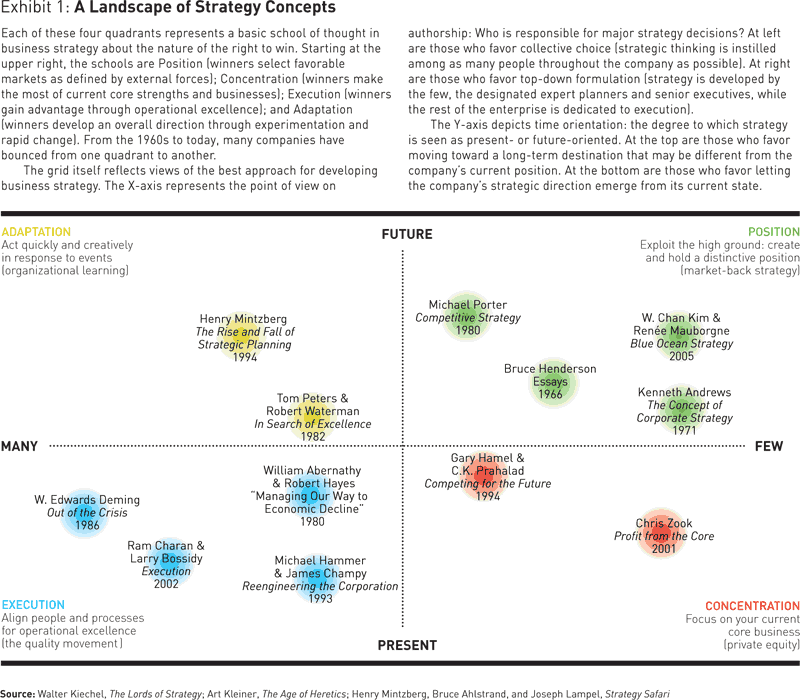
All corporate strategies are at heart theories about the right to win. That is why, for those trying to understand the nature of business success, the history of strategy is both helpful and fascinating. One valuable recent source is The Lords of Strategy: The Secret Intellectual History of the New Corporate World (Harvard Business Press, 2010), in which former Fortune managing editor Walter Kiechel recounts the prevailing theories of business strategy over the past 50 years, and the stories of the people who developed them. Drawing on Kiechel’s history and those of others, such as Henry Mintzberg, Bruce Ahlstrand, and Joseph Lampel in Strategy Safari: The Complete Guide through the Wilds of Strategic Management (2nd ed., FT Prentice Hall, 2009), we have created a map of this conceptual landscape, organized on the basic principles underlying theories of the right to win. (See Exhibit 1.) The map depicts four broad schools of strategy; each represents a hypothesis about the nature of long-term success in a competitive world.

The Basic Tension in Strategy

Business strategy, as we know it today, has a relatively short history. The word strategy was first applied in print to mainstream business in 1962, with the publication of Alfred Chandler’s book Strategy and Structure: Chapters in the History of the Industrial Enterprise (MIT Press). Since then, at least a dozen major trends and ideas have appeared under the rubric of business strategy, often in great conflict with one another, often drawing companies in very different directions. Despite their differences, all four schools of strategy represent attempts to resolve the same basic underlying problem: the tension between two conflicting business realities.
The first reality is that advantage is transient. Even the most formidable market position can be vulnerable to technological disruptions, upstart competition, shifting capital flows, new regulatory regimes, political changes, and other facets of a chaotic and unpredictable business environment. As William P. Barnett showed in The Red Queen among Organizations: How Competitiveness Evolves (Princeton University Press, 2008), this turbulence can never level off into stability; as companies copy and outdo one another’s proficiencies, the game of business continually becomes more challenging. Rapid economic growth in emerging markets has made advantage even more transient, bringing billions of people into the global economy, along with hundreds of energetic new business competitors.
One might assume that the answer is to become completely resilient, morphing to match the changing demands of the market. But companies can’t, because of the second reality: Corporate identity is slow to change. The innate qualities of an organization that distinguish it from all others — its operational processes, culture, relationships, and distinctive capabilities — are built up gradually, decision by decision, and continually reinforced through organizational practices and conversations. Very few companies have thoroughly reinvented themselves, and those that have managed it have typically had to force many people out, including top executives, and to replace them with new recruits chosen for a different set of attitudes and skills. Even when leaders recognize the need for change or know that the company’s survival is at stake, this identity is difficult to shift; if no deliberate effort is made to refresh it, it can stagnate to the point where it erodes advantage from within. As writers such as Jim Collins, Clayton Christensen, and Donald Sull have noted, it’s all too easy for established companies to fall prey to complacency and hubris (Collins), entrenched customer relationships and disruptive technologies (Christensen), or inertia (Sull).
Yet although the “stickiness” of a company’s identity is typically regarded as a weakness, it’s also a great source of strength. No company can survive long, let alone distinguish itself, without a rich body of capabilities and a resonant corporate culture. Indeed, the fundamental enabler of strategy — the source of competitive advantage — is a distinctive, coherent corporate identity. This is the quality that attracts customers, investors, employees, and suppliers. It is grounded in internal capabilities (that is, the things your company can do with distinction) and in market realities (that is, the games in which your company chooses to play).
The yin and yang of strategic fad and fashion — the movement of business leadership from one trend to another over the past 50 years — has often led companies to make incoherent and ineffective moves. The answer is not to keep adopting new theories in hopes of finding the right answer, but to develop your own capabilities-driven strategy: your own theory of coherence for your business. How do you capture value, now and in the future, for your chosen customers? What are your most important capabilities, and how do they fit together? How do you align them with your portfolio of products and services? The more clearly and strongly you make these choices, the better your chances of creating a corporate identity that gives you the right to win in the long run. Not surprisingly, each of the four basic schools of thought in Exhibit 1 (position, execution, adaptation, and concentration) has something significant to offer business strategists, so long as they are adopted in an appropriately balanced way.

The Value of Position

According to Walter Kiechel, strategy became relatively formal in the 1960s for two reasons. The first was an increasing amount of available data on business costs, prices, and operational performance. The second reason was uncertainty, and the anxiety that went with it. The economic stability of the early 1960s dissolved into the turbulence of the 1970s and ’80s, striking different components of society with different degrees of prosperity and calamity. No company could ever be sure it would remain on top (even in established industries such as steel and automobiles), global economies were highly interconnected (although it wasn’t always quite clear how they might interact), and corporate decision making was increasingly constrained by fiercer capital markets and upstart technologies.
When intuitively obvious decisions fail, people yearn for better guidance. Thus, starting in the mid-1960s, the idea of strategic planning, with echoes of Napoleon, Carl von Clausewitz, and Sun Tzu, evolved into an irresistible business management fashion. In its pure form — as delineated by Kenneth Andrews and Igor Ansoff, the premier authorities on business strategy at that time — a strategy was an overarching plan for growth, usually written up in a formal document and endorsed by the CEO, aimed at creating an unassailable position for the company in the marketplace.
These early efforts by the position (or positioning) school assumed that the right to win would be held by companies that comprehensively analyzed all critical factors: external markets, internal capabilities, and the needs of society. Although Andrews said the goal should be a simple “informing idea” about the direction of the business, it inevitably became a complex checklist of strengths, weaknesses, opportunities, and threats (the origin of the SWOT analysis still prevalent today). This was long before the invention of the spreadsheet program, so big companies hired armies of planning staffers to compile all this data into elaborate documents, which were debated in annual strategy sessions that became exercises in bureaucratic complexity. Only gradually did it become clear that the plans did not correlate with real-world performance or issues.
A breakthrough in the position school occurred in 1966 when Bruce Henderson, founder of the Boston Consulting Group (BCG), began to market services based on what he called the “experience curve.” Analyzing cost and price data across companies and industries, Henderson showed that as experience with operations led to greater proficiency, the capacity to produce increased and costs dropped. The phenomenon was hardly noticeable month by month, but every few years, capacity doubled and costs dropped 10 to 30 percent, so reliably that many companies could plan their investment cycles and competitive marketing accordingly. For example, Texas Instruments Inc. (TI) cut the prices of its semiconductor chips and electronic calculators every few months. Sales rose as customers switched to TI from competitors, and production costs then fell further, which allowed TI to drop prices even more. Even the billing procedures and advertising budgets became more efficient as those departments managed greater volumes.
To Henderson, the right to win went to companies that made the best use of the experience curve by holding the leading position in market share for their sectors. This meant emphasizing the value of some divisions over others, basing those judgments on the dynamics of each business’s customer base (Henderson was an early proponent of market segmentation) and on its competitive position. The famous growth-share matrix divided a company’s businesses into “stars” (high growth and market share), “dogs” (low growth and share), “question marks” (high growth, low share) and “cash cows” (low growth, high share), thus providing a clear rationale for reallocating investment. For instance, it was worth borrowing money to keep a star shining, because a star might end up dominating its market niche.
The experience curve and growth-share matrix rapidly became popular because they worked powerfully well — at first. But in practice, these tools had a serious flaw: As retroactive analyses of a company’s past success, they made it irresistible to continue that same behavior into the future, even when circumstances changed (for example, when competitors began to apply the same approach). This led many companies into counterproductive strategies. Some, including Texas Instruments, got caught up in ruthless price wars that contributed to the commoditization of their own products.
More generally, many business leaders became disenchanted with the idea of formal strategic planning. It was expensive, and it didn’t necessarily make companies profitable. For example, Ford and General Motors experienced losses of more than US$500 million in 1979 and 1980 — their first such losses in decades. In the aftermath of these and other sharp reversals, mainstream business leaders began to question the wisdom of the position school, and its claim on the right to win.

Execution Strikes Back

Those most annoyed by the position school tended to be in production and operations. No wonder, then, that the first great contrary reaction came from operations; specifically, from the Harvard Business School’s (HBS) operations management department, which had been gradually losing status to finance. Two members of the faculty found themselves in Vevey, Switzerland, during the summer of 1979: William Abernathy, the HBS expert on auto manufacturing, and Robert Hayes, known for his studies of assembly lines. Researching the differences between European and U.S. multinationals, Hayes visited a small machine tool manufacturer in southern Germany. Sophisticated Americans barely understood computer-aided manufacturing software, but this firm of 40 people was using it on a daily basis, and producing custom-made tools. Other plants in Germany, Switzerland, France, and even eastern Europe were using machine tools in ways that the Americans couldn’t match.
At a seminar that summer, a European businessman asked Hayes why American productivity had declined so much during the past 10 years. Hayes hauled out the standard answers: organized labor, government regulations, the oil crisis, and the attitudes of the younger generation (which, at the time, meant the baby boomers). The attendees looked at him with polite amusement. “We have all those factors here,” one said, “and our productivity is increasing.”
Confused and shaken, Hayes began taking regular hikes and having long conversations with Abernathy, who had just arrived in Vevey and saw similar stagnation in the U.S. auto industry. Only one explanation made sense to them: The reliance on market share and financial growth as strategic objectives was crippling U.S. industry. For example, many companies had cut back any initiative that didn’t seem to guarantee rapid returns, and the entire U.S. economy was suffering as a result.
Abernathy and Hayes wrote up this conclusion in an article for the Harvard Business Review (HBR) called “Managing Our Way to Economic Decline,” published in July/August 1980. It is still one of the magazine’s most requested reprints, and one of the most controversial articles in its history. They had introduced another school of strategic thought, based on the idea that the right to win came from execution and operational excellence: the development and deployment of better practices, processes, technologies, and products.
The execution message was bolstered by companies such as General Electric and Motorola, which provided influential examples of operations-oriented strategies with their reliance on executive training and such practices as Six Sigma.
Operational excellence was also a basic tenet of the quality movement — the continuous improvement practices that were developed at the Toyota Motor Corporation and a few other Japanese companies in the 1950s and ’60s and are now generally known as lean management. Of the many people associated with the quality movement, including Toyota’s influential chief scientist Taiichi Ohno, the most significant for corporate strategy was W. Edwards Deming. Deming was an American statistician born in 1900. He began consulting regularly in Japan just after World War II, helping Japanese companies develop their production systems. Ignored in the West at first, he became prominent in the United States after 1980, and actively taught and consulted with many of the world’s leading companies until his death in 1993. Deming saw his methods as critical for escaping economic malaise (his most prominent book was titled Out of the Crisis [MIT Press, 1986]). In his view, the right to win was held by companies that honed and refined their day-to-day processes and practices, eliminating waste, training people throughout the company to use statistical methods, and cultivating the intrinsic “joy in work” that people feel when they are truly engaged in their jobs.
Although the execution school would be frequently challenged, it continued to gain influence through the early 1990s — especially after it was adapted by Michael Hammer, an MIT computer science professor, into an approach called “reengineering.” According to Hammer, the right to win went to companies that looked freshly at all their processes, as if redesigning them from scratch. Unfortunately, many companies used reengineering as a launching pad for across-the-board layoffs that left them weaker, and operational excellence couldn’t compete with the exuberance of the high-tech bubble. By the end of the 1990s, execution-based strategy had been largely relegated to the production side of the business.
The idea of building value through managerial methods returned to strategic relevance after the dot-com bubble burst. Its return was symbolized by the business bestseller Execution: The Discipline of Getting Things Done, by strategy expert Ram Charan and then Honeywell CEO Larry Bossidy, a well-known GE alumnus (with Charles Burck; Crown Business, 2002). Many leaders now understood, through experience, both the value of improving execution and its challenges. It generally required major changes in managerial and employee behavior. As BCG strategist George Stalk complained to Walter Kiechel, “That was a lot more difficult than just ‘buying a concept off a shelf.’”

Michael Porter’s Advantage

The other major limit of the execution school was best articulated by HBS professor Michael Porter — probably the most influential thinker on corporate strategy in the institution’s history, and a source of new vitality for the position school. In his early publications, from the late 1970s to the early 1990s, Porter brought positioning to a level of unprecedented sophistication. He recast the turbulence of a company’s business environment into a “value chain” and “five forces” (competitors, customers, suppliers, aspiring entrants, and substitute offerings): two frameworks that could be used to analyze the value potential and competitive intensity of any business.
Then, in his flagship HBR article called “What Is Strategy?” (November/December 1996) Porter pointed out that operational excellence could guarantee competitive advantage for only a limited time. After that, it too would lead to diminishing returns as other companies caught up. (Indeed, most observers believe that Ford, GM, and other Western automobile manufacturers have done exactly that between 1980 and 2010; it may have taken them 30 years, but the quality and resale value of their motor vehicles is, as a whole, rising to meet that of Toyota and Honda.)
To Porter, execution-oriented ideas like reengineering, benchmarking, outsourcing, and change management all had the same strategic limit. They all led to better operations, but ignored the question of which businesses to operate in the first place. Porter argued for picking industries or markets where either overall conditions were favorable — where most companies were relatively weak, suppliers had relatively little clout, and aspiring entrants were few — or where a company could differentiate itself. In “What Is Strategy?” Porter used Southwest Airlines Company as an example of differentiation in a relatively unattractive industry. Southwest’s market power came from the choice not to follow the spoke-and-hub routing model of other airlines, but to offer “a unique and valuable strategic position” — flying only direct routes, with one type of aircraft, using automated ticketing and limited services (for example, no assigned seats). These and other strategic choices allowed the airline to operate a different type of flying business, one that could offer attractive prices and convenience even when compared with travel by bus, train, or car. Sure, operational excellence was involved: Southwest had perfected fast turnarounds and friendly customer service. But the core strategic decision was the pursuit of simplicity through a clear market strategy.
The position school became a major driver of the resurgence of corporate competitiveness in the West during the 1980s and ’90s. W. Chan Kim and Renée Mauborgne took the position argument to its extreme with Blue Ocean Strategy: How to Create Uncontested Market Space and Make the Competition Irrelevant (Harvard Business School Press, 2005). Big companies, they advised, should look for new upstart positions themselves, in places where there were no competitors already, breaking out of conventional ways of looking at their industry. The popularity of that approach demonstrated the pressure that business leaders felt to break free of established practices and find a niche that they could dominate with first-mover advantage.
The limits of the position school became evident in the 1990s and 2000s. Although Michael Porter took pains to explain that industry structures can change and can be shaped by the actions of leading companies, he was interpreted as saying that some industries are innately good and others are irredeemably bad. To many corporate leaders in tough businesses, or in highly regulated industries like electric power generation, there was no real advantage to developing distinctive capabilities or facility with execution. Some companies tried to escape by entering new businesses where they had no distinctive capabilities, “blue oceans” where they didn’t know how to swim. These efforts generally failed. And as the 2000s unfolded, companies with enviable market positions, such as Microsoft, also saw their advantage fade when new competitors, such as Google, emerged. This didn’t disprove Porter’s hypothesis, but it gave others an opening to criticize his thinking.

Adaptation and Experimentation

Starting in the 1990s, another group of strategy thinkers provided an alternative to the position and execution schools. This was the idea of strategy as perpetual adaptation, best represented by Henry Mintzberg, professor of management studies at McGill University. In his history The Rise and Fall of Strategic Planning: Reconceiving Roles for Planning, Plans, Planners (Free Press, 1994), Mintzberg dismissed the position school (which he called the design school) as formulaic. He acknowledged that execution was important, and much of his work was dedicated to analyzing what managers did in practice, but, like Porter, he felt execution was insufficient for success. His strategic approach centered on finding a more creative, experimental approach to executive decision making.
Thus, instead of analysis and planning, executives in the adaptation school (or, as Mintzberg called it, the learning school) sought to gain the right to win by experimenting with new directions. In Mintzberg’s words, they “let a thousand strategic flowers bloom…[using] an insightful style, to detect the patterns of success in these gardens of strategic flowers, rather than a cerebral style that favors analytical techniques to develop strategies in a hothouse.”
Adaptation has helped many companies; it’s been the source, for example, of the vitality of the Chinese manufacturing industry. It’s also been the most central guiding theme of Tom Peters’s work. The companies applauded by Peters — starting with his seminal business bestseller, In Search of Excellence: Lessons from America’s Best-Run Companies (with Robert Waterman; Harper & Row, 1982) — have varied enormously in their industries, approaches, and philosophies, but they all share a willingness to experiment with new ideas and directions, discard those that won’t work, and adjust their efforts to meet new challenges.
But the adaptation school is also seriously limited, because its freewheeling nature tends to lead to incoherence. A multitude of products and services that all have different capability needs and different market positions cannot possibly be brought into sync. The more diverse a company’s efforts become, the more it costs to develop and apply the advantaged capabilities they need. Letting a thousand flowers bloom can lead to a field full of weeds — and to businesses that can’t match the expertise and resources of more focused, coherent competitors.

Concentration at the Core

Hence the appeal of the fourth group of strategy thinkers — the concentration school. Its forerunners were Gary Hamel and C.K. Prahalad, authors of Competing for the Future (Harvard Business School Press, 1994), who argued that the most effective companies owed their success to a select set of “core competencies”: These were the bedrock skills and technological capabilities (such as new forms of hardware, software, systems, biotechnology, and financial engineering) that allowed companies to compete in distinctive ways. Companies that focused on these, and used them to develop a long-range “strategic intent,” would claim the right to win.
Chris Zook of Bain & Company, drawing on his firm’s experience with private equity, has been the most prominent recent exponent of this school. In his book Profit from the Core: A Return to Growth in Turbulent Times (2001, with James Allen; Harvard Business Press, 2010), he argues that the right to win tends to accrue to companies that stick to their core businesses and find new ways to exploit them for growth and value. This means differentiating a company by starting with its central capabilities: Enterprise, Dollar/Thrifty, and Avis all prospered by focusing on, respectively, rentals for people with car repairs, vacationers, and business travelers.
However, in practice, the concentration strategy often becomes a way of holding on to old approaches, even when they become outdated. Many companies (and private equity firms) translate this strategy into slash-and-burn retrenchment. They cut costs and minimize investments in R&D and marketing to create a pared-down company that produces more profits at first, but that can’t sustain the growth required for a healthy bottom line. When they seek to grow, it’s through “adjacencies”: products or services that seem related to their existing core businesses. But many adjacencies are less profitable than they were expected to be, in part because they may require very different capabilities — and in part because the truly successful game-changing leaps, like Apple’s into consumer media or Tata’s into the inexpensive Nano automobile, can’t be managed from a concentration strategy alone.

Strategy as a Way of Life

It’s important to note that most of the thinkers who introduced these strategies to business leaders saw the challenges and limits of their approaches, and even warned against misapplying them. But businesspeople misapplied them nonetheless. Each theory thus backfired, and created opportunities for the next.
How can your company gain the most from considering all these theories of the right to win? Only by stepping back, away from any particular answer, to look at your company’s identity as a whole, encompassing the way you expect to compete, the capabilities with which you will compete, and the portfolio decisions that fit. In fact, that’s exactly what happens with the packaged-foods company described at the beginning of this article.
The CEO’s question about the right to win has sparked many levels of discussion. For several more days, spread over a few weeks, the executive team talks through its three proposed strategies in detail: the estimated market value of each, the risks involved, and the capabilities required. All three strategies have roughly the same potential for increasing enterprise value, but the differences among them become clear when the functional leaders speak.
For example, the head of operations explains that the three strategies would require completely different investments. Becoming an innovator would mean configuring a flexible value chain to launch new products rapidly and economically. The closer-to-customers option would mean selling more food at different temperatures: some frozen, some fresh. It would also mean building a more direct, collaborative relationship between operations and R&D. And the category transformation strategy would require new process technologies, economies of scale, and deftly managed acquisitions.
The head of marketing and sales has a similar presentation. As an innovator, the company would focus advertising and promotion on new products, while ensuring rapid, widespread retail distribution. Being a solutions provider would move the company directly into engagement with consumers, through websites, social media, and better in-store displays. As a category leader, the company would seek to own the grocery shelf through “sharp pencil” tactics (in other words, tactics tailored to each brand and geographic region) for pricing, promotion, and merchandising.
The company executives ultimately settle on the category leader strategy. It fits best with the capabilities that they already have. Another company, even with the same market dynamics, might choose differently — appropriately so, because of very different capabilities and customs.
A capabilities-driven strategy process, like this one, takes into account “market back” aspirations (the position the leaders want to hold) and “capabilities forward” concerns (the company’s ability to deliver). In the course of discussion, ideas from all four schools of thought come forward: ideas about holding an unassailable position, executing with new capabilities, adapting rapidly to competitive pressures, and focusing on the core business as a platform for growth. It takes time to complete this process, and it is very difficult and stressful at times, but the company gains, in the end, from a far higher level of coherence.
It’s taken 50 years for the field of business strategy to reach the point at which many companies can conduct this kind of conversation effectively. Most companies have relied on business strategists for strategic answers. But now we see that we have to generate our own answers — our own theory of the right to win for each company, with its unique identity and circumstances — and that we have the tools to do so. Given the pressures that business continues to face, this leap in knowledge is coming just in time. 

The Sirens of CPG Strategy
by Steffen Lauster

Some strategic concepts, if they’re held as sacrosanct, can lead an entire industry in the wrong direction. Something of that sort has happened during the past two decades in the consumer packaged goods (CPG) industry. Two of the most influential strategy ideas are so widely held, so intuitively appealing, and so apparently true in practice that they are very hard to give up. Yet they can also be quite dangerous to follow.
The first of these misleading ideas is that “bigger is better.” Since the 1980s, CPG companies have tried hard to expand. The conventional wisdom said that the best shareholder returns would accrue to companies with huge brands and the scale to compete in developing markets. The second idea is that “consolidation is inevitable.” For years, experts have predicted that most consumer packaged goods segments would end up like carbonated beverages, shaving products, and disposable diapers — dominated by just two or three big players that took advantage of their scale to acquire or crowd out rivals, while a handful of niche players battled over the scraps.
Recent studies conducted by Booz & Company of total shareholder return among CPG companies show that both of these ideas are, at best, incomplete. Companies that follow them end up sacrificing performance. To be sure, there are categories where scale matters, where one or two players dominate. But many food and consumer products sectors are fragmenting instead, with room for many profitable entrants. In coffee, ready-to-eat meals, shampoos, and pasta sauces, for example, there are more small companies than there used to be; mass and price don’t matter as much as perceived quality. In the New York area, jars of Rao’s Homemade marinara sauce (the same sauce served in the famous Rao’s restaurant of East Harlem) are flying off the shelves.
These days, the best-performing consumer products companies — whether large or small — are those with the greatest coherence. Their market strategy, capabilities system, and product lineup all fit together. They invest their capital and attention in just three to six differentiated capabilities, supporting all the products they offer. This gives them a level of efficiency and effectiveness that most of their competitors can’t match.
In the end, the problem with strategy concepts is not that they’re wrong; they are, in fact, often right. But they are not universal. Beware any strategic idea that most other companies find beguiling. The right strategic destination is different for every company, even in a mature industry like consumer packaged goods.

Steffen Lauster is a partner with Booz & Company based in Cleveland.

Reprint No. 10407

strategy and business

Author Profiles:

  • Cesare Mainardi is the managing director of Booz & Company’s North American business and a member of the firm’s executive committee. He is coauthor, with Paul Leinwand, of The Essential Advantage: How to Win with a Capabilities-Driven Strategy (Harvard Business Press, 2010).
  • Art Kleiner is the editor-in-chief of strategy+business and the author of The Age of Heretics: A History of the Radical Thinkers Who Reinvented Corporate Management (2nd ed., Jossey-Bass, 2008).
  • Disclosure: At least four people named in this article have been contributors to s+b: Ram Charan, Walter Kiechel, Henry Mintzberg, and C.K. Prahalad. Others named in the article have had associations with s+b staff members, with Booz & Company, or with its competitors. Where we assess individuals’ contributions and impact, we have tried to do so independent of any such associations.

 
This is the result of an extensive set of discussions among a group of organization development consultants and internal HR staff under the auspices of the Change Affinity Group of the New Jersey Human Resource Planning Society.

Key Questions for Discussion:

    1. What is culture change?
    2. What are the major models?
    3. What is the role of executive management in culture change?
    4. What is the role of HR in culture change?
    5. What works and doesn’t work in culture change?

      Summary of Key Thinkers’ Ideas
    1. John Kotter’s perspective.
      1. Definitions
        1. “Culture” refers to norms of behavior and shared values among a group of people.
        2. “Norms of behavior” are ways of acting that persist because they are rewarded and the group teaches these behaviors to new people, sanctioning those who do not conform.
        3. “Shared values” are important concerns and goals held by most people in the group: they shape group behavior.
      2. In Kotter’s model, changing the culture is the last of eight steps, not the first.
        1. “Even when there is no personality incompatibility with a new vision, if shared values are the product of many years of experience in a firm, years of a different kind of experience are often needed to create any change. That is why culture change comes at the end of a transformation, not the beginning.”
        2. Culture is not something you can directly manipulate, as if by decree. Culture change occurs after you have successfully altered people’s actions and their new behavior has produced success, which can be traced back to the new actions and behaviors.
        3. This is not to say that culture issues don’t arise in the early stages of a transformation. But to try to change the culture as a first step is a bad idea what proof do you have to offer that it’s the right way to go?
        4. Remember, you are always trying to engender an adaptive culture, one that benefits the four main constituents: shareholders, employees, customers and management. This type of culture values good leadership and management. It also encourages teamwork at the top, while minimizing layers of management and bureaucracy, as well as counterproductive interdependencies.
      3. Anchoring change in a culture.
        1. Culture change comes last, not first.
        2. Lasting change depends on results. You must show new approaches work and that it’s worthwhile to change.
        3. Requires a lot of dialog.
        4. May involve turnover of key people who block change.
        5. Promotion practices need to be changed to be compatible with the new practices. New leaders should be compatible with the new culture and champions of it.
      4. Shallow roots require constant watering.
        1. Kotter uses an example of a technology-oriented company to illustrate the point. As long as the new general manager was around to focus the organization constantly on speed to market and the customer, progress was made substantial progress. When the GM retired, because the underlying cultural belief that “good technology will solve all our problems” had not changed, the company quickly regressed over two years.
      5. In an organization, the less visible shared values and group norms are, the harder they are to change.
      6. Culture is powerful for three reasons.
        1. Individuals are selected and indoctrinated to support the existing culture.
        2. Culture propagation occurs through the actions of hundreds or thousands of people in the organization.
        3. This reinforcement happens without much conscious intent and is therefore difficult to challenge or even discuss.
      7. There are different culture-change scenarios, some much harder to accomplish. For example:
        1. The core of the old culture is not incompatible with the new vision. The challenge is to graft new practices onto old roots, while eliminating inconsistent practices. This is least difficult to do.
        2. The core of the old culture is incompatible with the new vision. This is a much more difficult situation to cope with.
    2. Kotter and Heskett in Corporate Culture and Performance.
      1. Alan Wilkins’ study reflects the beliefs of many academics that culture is very hard to change. In 22 cases Wilkins studied, even the managers admitted failure in 16 instances.
      2. Kotter and Heskett studied 10 cases of major culture change that seemed to be successful. The companies were Bankers Trust, British Airways, ConAgra, First Chicago, General Electric, ICI, Nissan, SAS, American Express TRS, and Xerox. They found:
        1. “The single most important factor that distinguishes major culture changes that succeed from those that fail is competent leadership at the top.”
          1. All ten cases of major change occurred after an individual with a track record for leadership was appointed head of the organization. Each had a track record of producing change.
          2. In their new jobs they created change on a grander scale.
          3. These leaders demonstrated the close interrelationship of competition, leadership, change, strategy and culture.
          4. All of these leaders either:
            1. Came from the outside.
            2. Came to their firms after an early career somewhere else.
            3. “Grew up” outside the core of the company.
          5. While a limited sample, one can theorize that an outsider’s perspective is important to change.
            1. In all four very large companies in our study, the change leader had spent considerable time in the company before taking over, thereby developing a good sense of the resources in the company.
            2. Complete outsiders tended to be successful at smaller companies.
        2. Why you can’t change culture from the bottom up.
          1. The sheer resistance to change in an organization requires great power to overcome, and that power resides at the top.
          2. Interdependence in organizations makes it very difficult to change anything important, without changing everything. Only people at the top can do that.
    3. Delta Consulting’s (David Nadler) perspective: Discontinuous Change.
      1. Definitions:
        1. “Organizational culture” is a set of commonly shared values and beliefs. It influences the behavior of people and is reflected in work practices, i.e., how we do things here.
        2. “Values” are the fundamental axioms or established feelings about the desirability of some quality, like innovation or individualism.
        3. “Beliefs” are perceptions about the connections of things such as events and outcomes, for example: “Hard work will be rewarded,” or “challenging the boss will get you shot.”
      2. Culture is reflexive: Beliefs shape behavior, but behavior also shapes beliefs. Values affect beliefs and behavior, but beliefs and behavior also affect values.
      3. Often espoused beliefs and values are not consistent with the beliefs and values that can be inferred from observed behavior. This lack of alignment can cause great dysfunction.
      4. Most organizations are a mixture of many cultures: one in R&D, another in Sales, etc.
      5. External forces, historical forces and internal forces all shape behavior. Managers can most affect internal forces giving them a lever to change culture.
      6. In changing culture, there are three critical areas to address.
        1. Content of the change (vision of the new culture).
          1. Do a culture audit: What is the culture like, what needs to be changed?
          2. Leadership is essential for successful culture change.
          3. Key champions at all levels are required.
        2. Leverage points for change (what and how to change).
          1. Full-blown culture change requires change in all the key elements of organizational context: structure, business processes, measurement, appraisal and rewards. If, in fact, you do all these things, Nadler argues that culture change will be the ultimate outcome.
          2. Values must be articulated in terms of expected behavior. Establishing one value as more important than others is important to give people a set of priorities.
            1. Good technique used at AT&T, where Senior Executives interviewed people lower in the organization about the new values and how they saw them being implemented. This is a good check on implementation, and helps senior executives understand the issues involved in the effective transformation of a culture.
            2. A key test of culture change is who is getting promoted, the good guys or the bad guys
            3. What happens to someone delivering good results but not living the new values? This is a critical dilemma for leadership. Support and coaching for change must be offered; if a person refuses or does not change, then they must be removed. GE under Jack Welch was very strongly committed to having executives both get results and live the values. If they did not live the values, and did not improve, they were out.
        3. Tactical choices (when and where to change).
          1. Culture and values are the very foundation upon which the overall change agenda rests.
          2. Interventions into culture should be sequenced separately from the hardware changes. One effective sequence is to have culture initiatives occur sometime after the announcements of structural and work-process changes.
          3. Use bottom-up interventions also, e.g., education and training, meetings, forums, etc.
          4. Migrate change laterally from one organization to another. Use beta sites and skunk works to try out changes and work out the kinks. Transfer that learning to the next site. Customer visits can be a very powerful tool in this change. Customer needs get the attention of almost any level in the organization.
    4. Built to Last. By Collins and Porras.
      1. They do not talk about changing culture, but about what great companies do to maintain their cultures, which they describe as cult-like. This is useful to consider once you decide what you want to change the culture to.
      2. The cultures in visionary companies are not soft or undisciplined:

“Because visionary companies have such clarity about who they are, what they’re all about, and what they are trying to achieve, they tend not to have much room for people unwilling or unsuited to their demanding standards.”

    1. Visionary companies are not great places to work, at least not for everyone. If you can’t embrace their ideology, they expel you like a virus. If you do not fit their practices, they will weed you out in the hiring process or shortly thereafter.
    2. Cult-like cultures are key to preserving the core ideology of a company.
    3. Visionary companies have these characteristics about their culture that are cult-like:
      1. Fervently held ideology
      2. Indoctrination
      3. Tightness of fit
      4. Elitism
    4. Visionary companies create these cultures through practical, concrete things:
      1. Orientation and training programs
      2. Internal universities
      3. On-the-job socialization with peers and immediate supervisors
      4. Rigorous up-through-the-ranks policies such as promoting from within, and hiring young people and shaping their minds from the start.
      5. Exposure to pervasive myths of heroic deeds
      6. Corporate songs, cheers, etc.
      7. Tight screening practices; hiring and removal in first few years
      8. Incentives and advancement are closely linked to core ideology
      9. Awards, contests and public recognition are closely linked to core ideology
      10. Tolerance for honest mistakes, but severe penalties or termination for breaching core ideology
    5. These cult-like cultures succeed because they are balanced by mechanisms to stimulate progress, e.g., taking on challenging tasks (Big Hairy Audacious Goals or BHAGs).
    6. Adhering to a small set of core beliefs allows these companies to grant a good deal of operational autonomy.
    7. The authors conclude: “It means that companies seeking an ’empowered’ or decentralized work environment should first and foremost impose a tight ideology screen and indoctrinate people into that ideology, eject the viruses, and give those that remain the tremendous sense of responsibility that comes with being a member of an elite organization. It means getting the right actors on the stage, putting them in the right frame of mind, and then giving them the freedom to ad lib as they see fit.”
  1. The Last Word on Power: Executive Re-invention for Leaders Who Must Make the Impossible Happen. By Tracy Goss.
    1. The power to make the impossible happen.
      1. As a leader your source of success in the past is probably preventing you from making the impossible happen now. You must re-invent yourself, put past success at risk to make the impossible happen.
      2. “I define this advanced level of power as the ability to take something that you believe could never come to pass, declare it possible, and then move that possibility into a tangible reality.”
      3. She claims there is a set of theories and methods for learning to make the impossible happen, and that these can be taught.
      4. Reinventing yourself does not imply that something is wrong with you; it’s a process that takes you to a new place, to unfamiliar and unknown territory.
      5. Executive re-invention is primarily an ontological journey. Ontology is a branch of philosophy concerning the nature of reality and different ways of being.
      6. If you are going to re-invent your organization, then in order to succeed, you must first re-invent yourself. (Note: This is an alternate strategy to Kotter, where re-invention occurs when a different type leader takes over. None of Kotter’s success stories seems to have re-invented themselves.)
      7. Goss uses the analogy of a Navy SEAL and corporate leaders. The green recruit, despite being among the top 1% of officers in Navy, needs considerable training to take on the impossible missions assigned the SEALs. Similarly, the top 1% of leaders in organizations when they get to the top are not prepared to take on the impossible; they need training.
      8. Transformational change is an oxymoron. “Transformation” is a function of altering the way your being, to create something that is currently not possible in your reality. “Change” is a function of altering what you are doing, to improve something that is already possible in your reality.
        1. To transform yourself, you must transform your context, that is, the way you think, talk and act.
        2. “Language is the only leverage for changing the context of the world around you. This is because people apprehend and construct reality through the way they speak and listen.”
        3. “By learning to uncover the concealed aspects of your current conversations and learning to engage in different types of conversations, you can alter the way you are being, which, in turn, alters what’s possible.”
    2. The seven stages of leadership re-invention. First four have to do with freeing yourself from the past; last three, with building your capacity to make the impossible happen.
      1. Uncovering your winning strategy: learning to understand what has really created your current level of success.
      2. Experiencing the limits of the universal human paradigm at work in your actions. The universal human paradigm colors all choices, decisions and actions. Simply stated, it says: “There is a way that things should be, and when they are that way, things are right. When they’re not that way, there is something wrong with me, with them, or with it.” This paradigm is inherited simply by being brought into a group or culture.
      3. Learning to put everything at risk: becoming willing to operate with no guarantee you will succeed, with your eyes wide open to the high odds of failure and the accompanying consequences.
      4. Inventing a new master paradigm that provides you with a new source of power: making a series of declarations that constitute a new master paradigm (Similar to personal vision).
      5. Inventing an impossible game to play: making bold promises in a game you have chosen to play
      6. Breaking the addiction to interpretation: every problem and dilemma is seen through the way it contributes to your invented future, rather than through filters from the past.
      7. Operating beyond the limits of your winning strategy: building the capacity to bring about your “impossible future.”
  2. “The Reinvention Roller Coaster: Risking the Present for a Powerful Future.”  By Tracy Goss, Richard Pascale and Anthony Athos.
    1. Incremental change is not enough for many companies today. These companies need to re-invent themselves. Re-invention is not changing what is, but creating what isn’t. A butterfly is not more or a better caterpillar, it is a completely different animal.
    2. “When a company reinvents itself, it must alter the underlying assumptions and invisible premises on which its decisions and actions are based.” In other words, it must change its context.
      1. The first step is for a company to uncover its hidden context. A company is only going to do this when it is threatened, losing momentum or eager to break new ground.
      2. “The journey to reinvent yourself and your company is not as scary as they say it is; it’s worse,” says Mort Meyerson, chairman of Perot Systems. You do it only out of the conviction that the only way to compete in the future is to be a totally different company.
      3. Shifts in context can only occur when there is a shift in being. Nordstrom’s is used as an example. Their way of being is summarized as “Respond to Unreasonable Customer Requests.” Those that have tried to copy Nordstrom’s have not understood their fundamental way of being and have failed.
      4. A declaration from a leader, like Sir Colin Marshall’s pronouncement that British Airways would be “the world’s favorite airline” (when, at the time, it was one of the worst), does a couple of things:
          1. Creates possibility
          2. Stimulates interest and commitment
      5. A declaration is different from a vision statement, which provides a more elaborate description of the desired state and the criteria against which success will be measured.
      6. Key to re-invention is the re-invention of the leader (see Goss notes).
    3. Managing the present from the future
      1. Assemble a critical mass of key stakeholders.
        1. Many more than just the top 8 to 10 leaders.
        2. Should include key technologists and leading process engineers.
        3. Group should be sufficiently diverse to ensure conflict, which will get issues on the table so they can be resolved.
        4. Have to decide how it’s going to happen.
      2. Do an organizational audit to generate a complete picture of how the organization really works.
        1. Understand the competitive situation.
        2. Reveal barriers to moving from “as is” to the future.
        3. Core values.
        4. Key systems.
        5. Strategic assumptions.
        6. Core competencies, etc.
      3. Create urgency. Discuss the undiscussable.
        1. A threat that everyone perceives, but no one is willing to talk about, is most debilitating to an organization
        2. Book of Five Rings Japanese guide for samurai warriors. Written four centuries ago, directs the samurai to visualize his own death in the most graphic detail before going into battle. Idea being, once you have experienced death, there is not a lot left to fear: one can then fight with abandon.
        3. This helps explain the value of discussion about not changing and the dire consequences to a company in a difficult business situation.
      4. Harnessing contention.
        1. Conflict jump-starts the creative process.
        2. Most companies suppress contention.
        3. Control kills invention, learning and commitment.
        4. Emotions often accompany creative tension, and they are often unpleasant.
        5. Intel plays rugby; your ability at Intel to take direct, hard-hitting disagreement is a sign of fitness.
        6. Many excellent companies build conflict into their designs.
      5. Engineering organizational breakdowns.
        1. Breakdowns should happen by design, not accident.
        2. In trying to manage back from the future, concrete tasks will have to be undertaken; continuing on the current path will not get you there. Often you don’t know how to make these tasks occur. This will generate breakdowns, which can generate out-of-the-box thinking and solutions, if the situation is managed/lead correctly. Continuous open dialogue is key to working through breakdowns.
        3. Setting impossible deadlines is another way to encourage breakdowns and out-of-the-box thinking.
  3. Organizational Culture. By Edgar Schein, MIT (He, Kotter and Heskett are in similar places.)
    1. “Let me begin bluntly there is no such thing as the “right” culture and culture can not be fostered or installed.”
    2. Success of the company creates organizational culture. If the founders had a wrong set of assumptions about how things are, they would have failed. The right set of assumptions is relative to the business environment. The longer the company is successful, the more stable the culture becomes.
    3. Pronouncements that we must change our culture either will be denied or cause levels of anxiety that trigger intense resistance to change. Therefore, you will fail if you take culture head on.
    4. If the present culture is dysfunctional, or out of line with current environmental realities, then take these steps:
      1. Start with what the business problem is. The issue is not about culture, but about the mission of the organization and whether it is being fulfilled.
      2. Figure out what needs to be done strategically and tactically to solve the business problem. What does the organization need to do concretely to solve its survival or growth problems?
      3. When there is clear consensus on what needs to be done, examine the existing culture to find out how present tacit assumptions would aid or hinder that. Some parts of the culture may be fine, or certain subcultures within the organization maybe fine.
      4. Focus on those cultural elements that will help you get to where you need to go. It is easier to build up the strengths of a culture than to change dysfunctional elements. The diversity of a culture and its subcultures almost always have strengths to leverage.
      5. Identify the culture carriers who see the new direction and feel comfortable moving in that direction. This helps create role models, these people are often found in subcultures or in marginal roles in the organization.
      6. Build change teams around the new culture carriers. Different parts of the organization, because of environmental needs, may have to go in a different directions to produce the desired changes in thinking and acting.
      7. Top management must adjust the reward, incentive and control systems to be aligned with the new strategy.
      8. Ultimately the structures and routine processes of the organization must also be brought into alignment with the desired new directions.
    5. All of this takes a great deal of time and energy across many layers of management and many task forces and change teams. It is fueled by the need for a solution to a clear business problem. Culture change occurs as a by-product of fixing fundamental problems.
    6. If the culture prevents correcting the business strategy, that culture will be broken by destroying the group that carries the culture. That means firing a lot of people, or the organization will die.
    7. Culture is not a suit of clothes to be changed at will. The residue of past success, it is the most stable element in an organization.
  4. “Organizational Change.” Consortium Benchmarking Study conducted by the American Productivity and Quality Center.
    1. Overview of findings.
      1. Successful organizations believe the organization’s culture must be changed.
      2. Organization change requires vision, tenacity and a long-term horizon.
      3. Organization change requires commitment from top management.
      4. Organization change requires extensive communication with all stakeholders. Employees must be empowered and educated so they can exploit their new power.
      5. It is necessary to systematically measure progress and results.
    2. Key elements of success.
      1. Leadership
      2. Culture change
      3. Work force involvement
      4. Communication and measurement
      5. Education
      6. Supportive Human Resource systems
      7. A shared sense of urgency for change
    3. Triggers for change.
      1. Organizations on the brink of disaster that had engaged in change efforts consistently rated triggers higher than organizations not currently in dire circumstances.
      2. Highest ranking triggers
        1. Changing regulatory or legal environment
        2. Competition
        3. Customer dissatisfaction
        4. Declining or increasing profits
      3. Second ranked triggers
        1. Declining or increasing market share
        2. Declining or increasing revenue
        3. Rising costs
        4. Technology change
      4. Third ranked triggers
        1. Employee morale
        2. Merger or acquisition
        3. Public Image
        4. Quality
      1. Organizational Development and Change. By Thomas Cummings and Christopher Worley.
        1. Definition: Examination of different definitions suggests that organizational culture is the pattern of basic assumptions, values, norms and artifacts shared by organizational members. These shared meanings help members to make sense out of the organization. The meanings signal how work is to be done and evaluated, and how employees are to relate to each other and to constituencies such as customers, suppliers and government agencies.
        2. Corporate culture is the product of long-term social learning and reflects what has worked in the past.
        3. Diagnosing organizational culture culture change efforts begin with diagnoses.
          1. Behavioral approach
            1. Assesses key work behaviors that can be observed.
            2. Describes how specific relationships are managed and tasks performed (see example, pg. 483).
          2. Competing values approach
            1. Culture can be understood by how an organization handles dilemmas around four contradictory values. (see model, pg. 484).
            2. Four sets of competing values: Participation vs. goal achievement; internal focus vs. external focus; stability vs. creativity and innovation; organic processes vs. mechanistic processes.
          3. Deep assumptions approach
            1. Very difficult and time consuming to do.
            2. See pg. 485 for details.
        4. Culture change.
          1. There is considerable debate over whether it can be done or not.
          2. Given the problems with cultural change, most practitioners in this area suggest that changes in corporate culture should be considered only after other, less difficult and less costly solutions have either been applied or ruled out.
          3. Knowledge about culture change is in its formative stages; however, here is some practical advice if you embark on the journey:
            1. Start with a clear vision of the firm’s strategy and the shared values and behaviors needed to make it work.
            2. Have top management commitment, because culture change must be managed from the top.
            3. Symbolic leadership is critical: leaders must walk the talk. In successful cases of culture change, leaders almost always demonstrate a missionary zeal for new values and behaviors.
            4. Support organizational changes in structure, reward systems, HR systems, information systems and leadership style.
            5. Pay careful attention to the selection and socialization of new-comers, as well as the termination of deviants. This is particularly important for key leadership roles. Jan Carlzon of SAS replaced 13 of 15 top executives.
            6. Manage ethical and legal issues effectively. Don’t promise values for culture change that the organization can not deliver on.
      2. Corporate Culture: Removing the Hidden Barriers to Team Success. By Jacalyn Sherriton and James Stern.
        1. They believe that corporate culture change is needed for successful implementation of formal teams.
          1. Senior managers trying to implement teams continue to act individually: they are concerned about control over the teams and concerned that consensus decision making is too time consuming. They often set a very bad example, for example, by protecting their turf.
          2. Team members are typically not used to working in teams. They often are uncomfortable and lack the communication skills to make the teams work effectively.
          3. Introduction of teams while downsizing or facing threats of downsizing creates forces that are antithetical to teams.
        2. Corporate culture is defined by four elements.
          1. Ritualized patterns of beliefs, values and behaviors.
          2. Management environment created by management styles, philosophies, what is said, done and rewarded.
          3. Management environment created by systems and procedures.
          4. Written and unwritten norms and procedures.
        3. They believe that you can make a direct assault on culture change differing with Kotter, Heskett and Schein.
        4. Their book describes successful change in subcultures when top-level support was either absent or sporadic.
          1. They feel that each major functional organization such as marketing or R&D has its own subculture, as do divisions and other large units of the organization.
          2. Subcultures are influenced by the overall corporate culture, but subcultures are never the same as the overall culture.
          3. There is much more freedom to change a subculture than is commonly realized or acted upon
        5. “There is nothing more difficult to take in hand, more perilous to conduct, or more uncertain in its success than to take the lead in the introduction of a new order of things.” Niccolo Machiavelli
        6. How pervasive is the issue of culture and change? They did a survey of 100 companies and found that recently:
          1. 15% had been involved with a merger.
          2. 22% had been acquired.
          3. 41% had formed alliances.
          4. 78% were increasing the utilization of teams.
          5. 95% were involved in at least one of these initiatives that culture impacts significantly.
          6. Only 51% of respondents felt that their organization understood the need to address culture issues in making these changes.
          7. Only 31% of respondents felt their organization had the skills and knowledge to address organizational culture issues.
          8. Only 36% had assessed the culture and identified changes needed.
          9. But 56% (highest) had plans for training to address culture change.
        7. Gives a good detailed approach to what needs to be done to change culture. They also describe in some detail the culture needed to support teams. A lot of how-to’s. Very practical, particularly, if you need to work around some organizational constraints.
        8. Model does not put as much emphasis on the external environment, vision and strategy as other models.

Content Sponsor

Herminia Ibarra , Professor of Organizational Behavior, and Faculty Director of the INSEAD Leadership Initiative, contests that we learn to lead in relationship, by becoming a part of a community and network of leaders, but what we preach, however, is very different.

Let’s draw some inferences by considering a few schools of thought:

Situational leadership, — originally conceived as the antidote to the great man theories of leadership. The situational school brought us the notion of “fit:” person to situation and leader to follower. The original version said the situation makes the leader. The simpler version we retained says something else altogether, that good leaders choose among the leadership styles or change strategies in their repertoire the one that best matches their current situation.

Discover your strengths — another great example of a one-sided and static focus on personal attributes that make people effective leaders. According to this theory, we can categorize ourselves according to a number of themes and clusters of themes that describe our strengths; once identified, they help us make decisions about what situation best match us.

Practice — From Malcolm Gladwell’s Outliers to Geoff Colvin’s Talent is Overrated we learn about the magic rule of 10,000 hours. Bill Gates, we are told, became a computer wiz because he had access to an early computer and was able to clock the requisite number of hours. Putting in the hours, not innate talent, makes the leader.

Prof. Ibarra’s research on how effective managers make the transition to bigger, broader leadership roles and cements their contribution to the growth and transformation of their organization, incorporates 4 key enablers:

o    Motivate the transition to leadership. When asked to do things that don’t come naturally, we implicitly ask ourselves “am I the sort of person who behaves this way?” “Do I want to be that sort of person?”. When managers’ identification is rooted in functional groups or expert communities, the answers are negative when it comes to leadership, and thus it is no surprise that they do not sustain the arduous practice it takes to develop as leaders. On the other hand, when they identify with recognized leaders, learning to lead is motivated by the desire to become a member of a valued group.

o    Make the “competencies” come alive. One of the difficult things about learning to lead is distinguishing between “what” (content knowledge) and “how to” (process knowledge). We may know, for example, that “sensing external trends” is a critical competency in forging a strategic direction, and we may also want to become more like the leaders we know who are very good at that. But, how does one actually learn to strategize? In a successful learning cycle, role models, peer groups and communities of practice motivate change by changing our reference point on what is desirable and possible, and then once motivated, providing tacit knowledge on how to do it.

o    Experiment from the outside in. Many aspiring leaders struggle to stretch their leadership within their current organization and roles. Caught in between delivery pressures and outdated views of their capacities, they more quickly or easily find roles outside the organization that allow them to lead. Their new activities, in professional organizations, clubs, informal advisory and so on, create external identities that they eventually internalize.

o    Build external support & networks to sustain change. Often it is hard to get support for change from old mentors, bosses or trusted colleagues. They may have good intentions but maintain of what we can and should do that are based in the past and not the future. People and groups, on the fringe of our existing networks help us push off in new directions while providing the secure base in which change can take hold, one of the reasons why learning methods like peer coaching are so powerful.

Built To Last – Summary of Key Points Written by James Collins & Jerry Porras
About this book:
This summary of Built to Last is included because if one is going to change an organization, one needs to know what to change towards. This book is one of the best we know of that answers that question. It is one of the best pieces of research done on why certain organizations are more successful over time than others.

Introduction:
The book makes a comparison of Visionary Companies to a comparison group of good companies. The lessons of the Visionary Companies can be learned and practiced at all levels of the organization.

What is a Visionary Company?
For the purpose of this study they:

  1. were the premier leader in their industry, widely admired
  2. made an indelible mark on the world
  3. have multiple products and have had multiple CEO’s
  4. are at least 50 years old

The authors compared 18 Visionary Companies to 18 comparison companies. The comparison companies have done more than twice as well as the stock market since 1926, while the Visionary Companies have done 15 times as well as the stock market. The comparison is through the end of 1990. Think of the comparison companies as the bronze medalists. Most of the Visionary Companies have had problems, but have displayed a remarkable resiliency in overcoming business challenges.

  A dozen common myths were shattered:

  1. It takes a great idea to start a great company. In fact, having a great idea to begin with is negatively correlated with becoming a great company.
  2. Great companies require charismatic leaders. In fact, charismatic leaders can be detrimental to the long term health of the organization. The leaders of Visionary Companies sought to be clock builders not time tellers.
  3. The most successful companies exist to maximize profits. In fact, maximizing profits has not been the dominate theme in the Visionary Companies. They pursue a number of objectives, sort of like the balanced scorecard. Clearly, profit is one of their objectives.
  4. They share a common (“right”) set of core values. The core values don’t have to even be enlightened (Philip Morris), though they often are enlightened. What’s most important about core ideology is how deeply the company believes in its ideology and to what extend it is aligned with it.
  5. The only constant is change. The Visionary Companies have maintained their core values for many years. But they are adaptive, everything but the core values is subject to change.
  6. The companies are conservative. In fact, they are not. They are willing to engage in BHAG’s (big hairy audacious goals).
  7. These companies are comfortable places to work. In fact, only those comfortable with the core ideology are comfortable working there.
  8. Visionary Companies make their best moves by high level successful strategic planning. In fact, they progress by trying a lot of stuff and keeping what works.
  9. Companies should hire outsiders as CEO’s to breath new life into the organization. The authors found that only 4 of 113 CEO’s in Visionary Companies came from the outside. The comparison companies go to the outside 6 times more frequently.
  10. Visionary Companies focus on beating the competition. In fact, they focus on beating themselves. Always striving to be the best.
  11. You can’t have your cake and eat it to. The Visionary Companies believe in the genius of “the and” and abhor the tyranny of “the or.”
  12. Visionary Companies become visionary by writing vision statement. While they tend to write them, this is only one of thousands of things they do to be visionary.

Clock Building not Time Telling:
Clock building allows a visionary company to exist long beyond the founder. Leaders of Visionary Companies take an architectural approach to building the company. These leaders try to build a company. For example, Hewlett & Packard had no great concepts for products, they just wanted to build a company. HP went a year before it sold anything. Sony’s first products were not very good. J.W. Marriott’s first business was an A&W Root Beer stand in Washington DC, 3M started as a failed corundum mine. In fact, only 3 of 18 Visionary Companies started off successfully (J&J, Ford & GE). However, 11 of the comparison companies started out successfully with a great idea. The companies with early success are much more likely to stick with these products long after they should have been replaced by new products or abandoned.
For example, George Westinghouse was much more brilliant than Coffin at GE. Coffin’s major contribution to GE was the development of the world’s first industrial lab.
When David Packard was asked about HP’s greatest innovation, he responded by talking about the HP way. The article’s headline read, “Packard executive develops company by design, calculator by accident.”
The comparison companies were just as likely to have had strong leadership in their formative years. What the authors are describing is leadership at the Visionary Companies that is interested in socialized power not personalized power.
The contrast between Disney and Columbia Pictures is a good example to illustrate the differences between clock building and time telling. Tape goes into good details.
The Tyranny of the “Or”:
Visionary Companies do not accept that you have to chose between things, i.e. you can have quality or low cost. As F. Scott Fitzgerald pointed out, “The sign of a first rate mind is that it can hold two opposing ideas at the same time and be able to function.”
More than Profits:
Clock builders at Visionary Companies build clocks with a purpose, with a human spirit. The sense of purpose goes beyond just making money. Their values fix a stake in the ground, this is what we stand for, this is what we are all about. Profitability was not the driving force in the Visionary Companies, but seen as necessary. Profits are like oxygen, food and water. You can not live without them, but they are not the purpose of life. In seventeen of eighteen pairs the Visionary company was more ideologically driven than their counterpart. This was one of the strongest correlation in the study. For example, in examining TI the comparison to HP, the authors could not find one single statement that linked TI to anything other than trying to maximize shareholder return. They looked at over 40 articles, studies etc. on TI.
The authors give the example of Merck’s decision to develop a product to cure river blindness, an illness that affects millions in third world countries. While they knew there was not much profit in it, they also knew that they would probably get a lot of free and good publicity. George Merck 2nd, “If we focus on helping cure people through medicine, the profits will be there.”
Not one core value was common across the eighteen companies. There is no set of core values one needs to have to be a visionary company. What is key is the authenticity of the core values and the alignment to those core values. For example, Walmart’s key core value is customer service. Sam Walton would say if you are not serving the customer or helping someone to serve the customer we don’t need you.
Core values are the things the company holds self evident. Core values exist independent of the business environment. Purpose is the fundamental reasons the company exists beyond making money. You should never be able to complete or achieve your purpose. As Walt Disney said, “Disneyland will never be completed as long as there is imagination left in the world.” GE can never complete the task of improving the quality of life through technology and innovation.

Preserve the Core/Stimulate Progress:
The central concept of the book is preserve the core/stimulate progress. The only sacred cow in a company should be its philosophy of doing business. Companies must be able to adapt and change to thrive. Boeing’s being on the leading edge of aviation technology is core, however, building a 747 Jumbo Jet is a strategy that can change. Over time competencies needed, strategies and goals all change, but the core remains the same. The drive for change in a Visionary Company is internal, they don’t often wait for the external forces to make them change. These companies have a high level of achievement motive. Visionary Companies display an interesting mix of self confidence and self criticism. The self confidence allows them to set audacious goals. Self criticism allows them to make changes before the outside world demands them.
Visionary Companies develop tangible mechanisms to preserve the core and stimulate progress. For example, HP helps assure the HP way will continue by having a policy of promoting from within. It supports that policy by tying appropriate reinforcing criteria to selection, promotion and appraisal decisions.
The key is to align everything to the core . Comparison companies frequently tolerate cynicism, strategies, behavior and attitudes that are not aligned with the core values.
Big Hairy Audacious Goals (BHAG’s):
The Visionary Companies use BHAG’s to challenge and motivate their workforce. True commitment to the BHAG is critical, its where the rubber meets the road. A certain amount of hubris is needed to set these goals. However, the goals seem much more audacious to those outside the company than those inside the company. The leaders of the Visionary Companies had great faith they could do what they set out to do. The authors found that 14 of 18 Visionary Companies used BHAG’s more frequently than did the comparison companies.
As an example, they give Boeing’s decision to develop the 707 at a time when they were not the leader in commercial aviation. McDonnell Douglas then the commercial aviation leader thought the future of aviation was in propeller driven airplanes. Building the 707 was a BHAG, it required a commitment of a quarter of Boeing’s then net worth. Its accomplishment propelled Boeing into commercial aviation leadership, where it has stayed. Boeing has a history of using BHAG’s.
GE’s vision statement, which is a BHAG, is compared to Westinghouse’s. GE’s vision, “Be number 1 or number 2 in every market we serve and revolutionize this company to have the speed and agility of a small enterprise.” Westinghouse’s was, “Total quality, market leadership, technology driven, global, focused growth, diversified.” The contrast is that GE’s goal is clear, compelling and exciting, and therefore, much more likely to propel progress.
The example of the moon mission illustrates the motivational power of BHAG’s. Kennedy the charismatic leader, who set the BHAG, died six years before we landed on the moon. Yet we were able to achieve this momentous accomplish because the BHAG itself was compelling, it took on a life of its own. BHAG’s help Visionary Companies transition across changes in leadership.
Paul Galvin of Motorola used BHAG’s to propel the engineers to greater achievement, Zenith did this some in its early years, but stopped doing this with the death of its founder. Eugene McDonald, the founder of Zenith was a great leader, but he was a time teller. Galvin was a clock builder.
An organization can have multiple BHAG’s at one time at different levels of the organization. They need to be very clear and very compelling. A BHAG is a goal not a statement. They should be outside your comfort zone. An organization has to watch out that once they have achieved their goal, they do not become complacent. One answer to complacency is to set another BHAG. BHAG’s needs to be consist with your core ideology. Boeing’s decision to develop both the 707 and 747 were clearly consistent with its core ideology of being on the cutting edge of aviation technology.
When a company develops a sense of its ability to defy the odds and accomplish great things, it makes people feel they belong to something unique, better. This is a key to high morale.

Cult Like Cultures:
Visionary Companies are not great places to work for everyone. If you do not endorse the core values of a Visionary Company, you will probably not like working there. Visionary Companies are not soft. They tend to be more demanding of their people for both accomplishment and adherence to the core ideology.
Visionary have four things in common with a cult: 1) a fervently held ideology, 2) indoctrination procedures, 3) acceptance of only those who adhere to the core ideology and 4) elitism. They draw clear boundaries to being inside or outside the company. If you are inside you are part of an elite group. The authors are not saying that these companies are cults, just more cult like.
The authors use IBM and Disney as really good examples of what it means to indoctrinate their people. The “In Search of Excellence” video has excellent examples to illustrate.

Try a lot of Stuff and Keep What Works:
Many of the Visionary Companies did their best things by opportunistic experimentation. They tried a lot of stuff and kept what worked and got rid of what did not work. Examples include:

  • J&J getting into the talc (Baby Powder) business
  • Marriott’s getting into the business of supplying food to the airlines.
  • 3M’s getting into the wet sand paper and masking tape businesses.
  • Walmart’s people greeters system.

This is evolutionary progress. The book argues for a Visionary Company being able to make revolutionary progress (BHAG’s) and evolutionary progress, if it is going to remain great. Evolutionary theory holds that changes that are adaptive to the changing environment allow the species to survive. “Multiply, vary, let the strongest live and weakest die,” those were Darwin’s words. RW Johnson said, “Failure is our most important product.” Managing failure is a key to evolutionary progress. Many companies, try a lot of stuff. Many are not able to get rid of things that don’t work all that well. They don’t prune well.
A 3M concept is that, “You so often get to where you are going by stumbling, but you can not stumble unless you are moving forward.” 3M understands that big things often come from little things, but you can not tell which little things will blossom into big things, try a lot stuff and keep what works. 3M in contrast to Norton installed a lot of practices that encouraged individual initiative and experimentation, Norton did no such thing. The saying at Norton was you could develop any product you wanted as long as it had a hole in the middle and was round. Norton is in the grinding wheel business.
Five rules to pursue to achieve evolutionary progress:

  • Give it a try and quick
  • Accept that mistakes will be made, let the weakest die
  • Take small steps, its easier to accept failure when it is small
  • Give people a lot room to act, allow people to be persistent
  • Build that ticking clock, that is make the four points above into a process. 3M Examples: a) researchers get 15% of their time to research anything they want & b) turning new products into divisions when they get to a certain size.

They found that the Visionary Companies were less likely to stick to knitting than the comparison companies. The knitting in a Visionary Company is the core ideology.

Home Grown Management:
The authors point out that Jack Welch was not a savior for GE. Welch inherited a very well managed company. Welch’s predecessor retired as the most respect business leader at that time. He was CEO of the year, one year. GE performed as well under Jones’ eight years as they did under Welch’s first eight years. Swope, CEO in the 20’s, introduced what we would call today the Balanced Scorecard. Welch has done a fine job at GE, but the point is that so did Welch’s predecessors at GE. They all: 1) were management guru’s for their time, 2) changed the company and 3) outperformed the competition.
The Welch era is about average for GE. See page 280 for the data. Also see tape for excellent description of the succession planning process used by Jones to select Welch. Jones started the selection of his successor seven years prior to the actual selection.
Comparison companies are six times more likely to have their CEO come from the outside. Only about 3.5% of CEO’s (4) at Visionary Companies came from the outside and three of them were from one company. Its the continuity of quality leadership that counts at the Visionary Companies. The authors found that continuity of leadership was better in 15 out of 18 pairs. Continuity of leadership is critical if you are going to preserve the core, while stimulating progress.

Good Enough Never Is:
A critical question at Visionary Companies is, How can we do better tomorrow than we have done today? Visionary Companies are tremendously demanding of themselves, i.e. they have very high standards.
Willard Marriott adapted what we’d call continuous improvement principles soon after opening his first AW Root Beer stand. Comfort is not the objective in Visionary Companies, they install powerful mechanisms to increase discomfort and stimulate change before the external environment demands it. They worry about becoming fat, lazy and complacent. Examples of mechanisms used to challenge complacency:

  • The brand structure at P&G
  • Merck consciously yields market share as products become older and less profitable
  • Motorola stops funding products that stop improving Comparison companies much more frequently take the easy road, milking successful products. Visionary Companies are much more likely to invest in the future. In all eight pairs where there was data, the Visionary Companies invested more in R&D. The Visionary Companies invested 30% more in R&D than the comparison companies. They also invested much more in human capital. They were much more likely to be early adopters of new ideas and technology. They give a good example of how Philip Morris reinvested in their future trying to become number one, while RJ Nabisco executives were spending money on self aggrandizing monuments to themselves (excellent example of personalized power at work).
    In 16 of 18 companies the Visionary Companies drove themselves harder for self improvement. They use the parable of the Black Belt to explain this ongoing quest for self improvement. The question posed to a would be holder of the black belt is, What is the essential meaning of the Black Belt? The person receiving the Black Belt must understand that they are at a beginning, not the end of a journey. The journey is a journey of never ending quest for self improvement and understanding.
    The End of the Beginning:
    To become a Visionary Company you must align objectives, strategies, policies and mechanisms within the company. You never really attain full alignment. Sweat the small stuff that paints a total picture of alignment. Cluster mechanisms to create alignment. don’t shot gun mechanisms. That is, cluster reinforcing mechanisms together to deliver a powerful punch. Be guided by your own compass in creating your great company. Ask not whether this practice is good, but whether its fits with our own ideology and ambitions. Obliterate misalignments.
    • Be a clock builder not a time teller, that is, an architect
    • Embrace the genius of the “and”
    • Preserve the core, while stimulating progress
    • Seek consistent alignment.

    People at all levels can help build a Visionary Company.

    Where to begin in building a Visionary Company? 

    First understand your core ideology and then build a worthwhile purpose.
    Put in place BHAG’s and mechanisms to stimulate progress.
    Then align the organization. The biggest mistake managers make is failing to get alignment.


Rather than seek increased revenues and profits by expanding products and markets, companies should follow a seven-step strategy for achieving more with less.

Faced with economic headwinds, many global corporations are struggling to grow their businesses profitably. In the consumer packaged goods business, for example, the worldwide recession has hurt premium brands as consumers have traded down to cheaper brands, private labels, or generics. In the retailing business, same-store sales are flat or declining for numerous companies. Meanwhile, many business leaders continue to seek growth by extending their existing product lines and brands, as well as by entering new geographic regions. After all, growth is supposed to be about “more” — more products on the shelf, more categories, more brands, and more markets.
However, this approach is exactly the opposite of what business leaders should do to drive increased revenues and profits. A typical “growth through more” strategy diffuses the organization’s efforts. It increases the complexity of the organization and its operations. We have found that “growth through less,” or more precisely “growth through focus,” is the best prescription for growth, regardless of the economic environment. This conclusion is based on our own experience in three well-known companies — Kraft Foods, Unilever, and Fonterra Brands (a dairy products business based in New Zealand) — on three continents over 10 years. In all three cases, a deliberate strategy of focusing on a few markets, brands, and categories produced impressive revenue and profit expansion. We have learned that seemingly mature businesses can be energized by making fewer but larger bets and by focusing relentlessly on executing a simple but powerful vision.
Growth through focus is not as easy as choosing what strategic bets to make. Rather, it requires the leadership team to follow a systematic approach that spans everything from strategy and vision to execution and measurement. We propose a framework that consists of seven steps that an organization must go through in its quest for growth through focus. Our framework is grounded in three key ideas: focus in strategy, simplicity in communication, and empowerment in execution………

Growth and the Winemaker’s Logic

To understand the logic behind growth through focus, consider what winemakers know about getting the best out of grapevines. Grapevines are very vigorous. With abundant water and nutrients in the soil, they tend to grow into large, leafy plants. However, overly vigorous vines produce lower-quality wine and smaller crops. When growing conditions are too rich, grapevines grow more leaves and become tangled. Leaves take nutrients away from grapes, which contain the seeds for future growth, and create shade, which inhibits ripening. To improve the quality of grapes, winemakers carefully prune grapevines and remove excess bunches of grapes to reduce yields. The remaining bunches ripen more fully and ultimately produce more concentrated wine.

Many companies, in effect, behave like inattentive vintners. Growth initiatives are often overstimulated with money and leadership attention. The result is lots of activity and a large number of growth projects, and this activity often does not correlate with outcomes. Quantity does not mean quality. To improve the quality of growth, business leaders need to cut back on marginal products, brands, and markets so that they have a better chance of winning in their chosen areas of focus.
Following the winemaker’s logic, company leaders must overturn conventional thinking about how to manage the organization, processes, and people for growth. (See the exhibit.) For example, a conventional core belief about growth is that companies need to extend their product lines and brands and to expand their categories and markets. Leaders hope that the more arrows they have in their quiver and the more targets they have to shoot at, the more bull’s-eyes they will score. But in reality, growth often comes from fewer but stronger arrows aimed at fewer targets. The engines of growth are focus (fewer brands, fewer categories, and fewer markets) and simplicity (simple vision, simplified execution, and simpler organizational designs). Conventional thinking also assumes that although complexity adds cost and makes the organization less agile, it is inevitable in a large global company. But complexity is an avoidable enemy of growth if you know what you are doing.
The logic of growth through focus also suggests a very different view on planning and leadership. Many companies tend to make long-term strategic plans, but they often have a short attention span in execution. CEOs and business leaders get seduced by doing something new and different well before the strategy has had time to play out. We recommend the reverse: Plan quickly and then stay the course for a long time, as long as five years. Leaders should resist the temptation to change strategies too often.

Seven Steps in Growth through Focus

Our experience suggests that growth through focus requires the organization to progress systematically through a set of seven steps: discovery, strategy, vision, people, execution, organization, and metrics. Taken together, they represent a powerful formula for driving profitable growth.
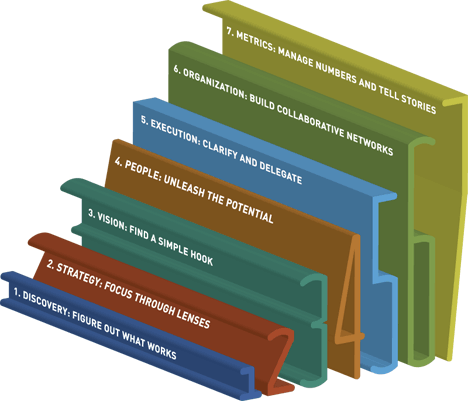
1. Discovery: Figure Out What Works

Science fiction author William Gibson observed, “The future is already here. It’s just not very evenly distributed.” And so it is with excellence. All large companies have pockets of excellent growth performance. The first step in the growth journey is to discover what is working well and where the company is already winning. These pockets of excellence help identify focus areas for growth. An effective way to uncover what works is to conduct a series of workshops with the top leaders from the company.
At Unilever’s Lipton beverages business, the process began at Colworth House, the company’s R&D center in the United Kingdom. The top 100 leaders of Unilever beverages from around the world were invited to a workshop in 2000, whose agenda was to build upon what was working well in specific markets and to scale the success across other geographies. One year later, this was followed by a “10 in 10” workshop in Brussels to discuss how to achieve sales of US$10 billion within 10 years in these markets and to imagine the future of Lipton as seen through the eyes of Unilever’s major competitors.
In Kraft Foods’ international business, the growth process kicked off in 2007 with seven workshops in six locations around the world, each including about 20 of the company’s regional business leaders. The agenda was open-ended, with the top leaders taking a backseat to prevent their rank from impeding the flow of ideas and insights. An external facilitator ensured that collective experience was gathered objectively. The workshops focused on what worked rather than on what did not work, because it is easier to build on what is working than to fix what isn’t working. To ensure a customer focus, workshops included extensive immersion with consumers and customers to provide insights into behavior, needs, and problems. This kind of immersion generates insights in ways that quantitative market research never can.
A few themes began to emerge from the workshops. Kraft Foods had excellent people, but their insights and ideas had been getting lost because of geographic dispersion, and their potential was not being fully realized. The company’s iconic brands had been built over many years, but several were underperforming. The planning process had tended to focus internally instead of externally, and had looked backward rather than forward. There was a lot of emphasis on analyzing what happened instead of figuring out what needed to be done. The conclusion was clear. The company urgently needed to establish clear priorities and accountability at a global, regional, and local level.
At the outset, the discovery process should be inclusive and democratic. It is important to involve key stakeholders within the company, particularly those who can make a valuable contribution and those who have the influence to get the masses of employees behind them. In addition, great insights often come from engaging with suppliers, creative and media agencies, and consultants who have worked with the company for a long time. On the other end of the spectrum, it is also important to listen to people who push back — and to manage dissent. As the process goes on and the framework and vision are agreed upon, debate on the strategic framework should cease and the emphasis should switch to execution.

2. Strategy: Focus through Lenses

The discovery process produces a set of success themes. In the second step, these themes need to be clustered and prioritized to define the focused bets that the company should make. Narrowing the focus is essential in order to concentrate resources on areas where the company has the best chances of winning. To take an analogy from photography, sharpening the focus on an object requires a telephoto lens that homes in on the subject while de-emphasizing background objects. Similarly, we have found that strategic focus requires lenses through which a company can look at its businesses. Lenses can be categories that the company is doing well in, brands that are performing well, geographies that are doing a stellar job, and platforms (like wellness or bone health in healthcare) that can serve to unify the company’s products and brands.
Consider the experience at Fonterra Brands. Through the discovery process, the company used two lenses — a product platform and a distribution channel. Using the platform lens, Fonterra identified osteoporosis as a key platform to bet on, based on its expertise in bone-health products. To pursue leadership on this platform, Fonterra entered into a partnership with GE Healthcare’s Lunar business to tackle the growing global health problem of osteoporosis using Fonterra’s Anlene bone-health products and GE Healthcare’s bone density technology. The partnership’s first initiative was the Anlene Bone Health Check, which provided free bone density screenings to millions of people in nine countries in Asia.
Using the second lens, Fonterra bet on the food-service channel as a key to its future growth. The outcome was a focused business called Fonterra Foodservices, which offers a complete suite of dairy products and tailored solutions for food-service professionals. Focusing through the distribution channel lens led to the strategy of creating a single “cow to customer” integrated business.
During the focusing process, each lens may produce several possible opportunities. These opportunities should be prioritized according to two criteria: the expected impact of the initiatives and the effort required. This exercise should result in a one-page preliminary plan that lists priorities for each lens. This preliminary plan should then go through several rounds of iteration with the input of key stakeholders. To improve the framework’s odds of adoption, it is important to involve as many of these stakeholders as possible in “owning” the outcome.
Once you find out what works, you can focus on it and scale the success to other markets, products, and brands. In the Unilever workshops, the company discovered that Lipton Portugal and Lipton Arabia were performing consistently well over time. Diving deeper into the reasons for this standout performance, the company found an interesting theme. In both markets, Lipton had been successful because it competed in the broad beverages market rather than limiting itself to the tea category. Further, in these markets, Lipton had done an excellent job of adapting its products to local tastes. For instance, Portugal had a successful iced tea business, whereas Arabia represented a successful hot tea market, despite the fact that Arabian countries have hot climates. The idea of taking a broader view of the business while remaining relevant to local tastes could be applied to Lipton’s other markets and categories.

3. Vision: Find a Simple Hook

Once the focus areas have been defined, the findings need to be summarized in a compelling yet simple vision. The vision serves as a rallying cry for the organization to align its efforts behind a clearly understood goal. Too frequently, the business strategies of large corporations are poorly understood outside the corporate headquarters and beyond the senior leadership of the company. To get everyone in the organization behind the strategy, it is vital to communicate the strategy across all levels and functions in the organization. This is the role that the vision plays.
To make the vision compelling yet easy to understand, we recommend creating a “hook.” The hook should be kept consistent over time and across customer touch points. It can be a color, a number, an acronym, a phrase, or a symbol. At Fonterra, the rallying cries were “Winning through Brands” and “Dairy for Life.” The vision embodied two themes: farmers’ pride (Fonterra is a cooperative owned by farmers) and the company’s emphasis on natural products, captured through the blue and green color of the company’s logo and merchandising. At Kraft International, the vision was expressed in numbers — “the 5-10-10 strategy,” which meant winning by focusing on five categories, 10 brands, and 10 markets. At Lipton, the vision was “Paint the World Yellow with Lipton.” The brand’s characteristic color signified brightness and sunshine, and stood for a broader Lipton beverage experience than just a cup of tea.
Once a vision is chosen, it needs to be launched with a bang through a seminal event designed to inspire the team. For Kraft Foods’ international business, the top 100 leaders were brought together on the 99th floor of the Willis (formerly Sears) Tower in Chicago in May 2007. The event kicked off with awards for teams around the world that recognized great work in various categories. Awards can set a positive tone, instill a can-do attitude, and make people feel like winners. At Lipton, the kickoff event was held at Colworth House, the 18th-century mansion at Colworth Science Park, where everything was painted yellow — including the lawn in front of the building. The theme “Paint the World Yellow with Lipton” was brought to life through winning stories from successful markets.
In communicating the vision, pictures are often worth a thousand words or PowerPoint slides. Simple visuals that depict the “from–to” journey can serve as powerful communication tools. Lipton used two visuals to bring the transformation journey to life — a picture of Audrey Hepburn, representing the Lipton brand as it was (classic, aristocratic, reserved), and a picture of Cameron Diaz, representing the new Lipton (bright, sunny, vibrant).

4. People: Unleash the Potential

Once the vision and strategy have been defined and powerfully communicated, the next step is to find the right people and to place disproportionate resources in their hands. The right people need to be placed in all functions — supply chain, R&D, marketing and sales — to ensure that you have the skills to win. Selecting those people requires a rigorous process of matching skills with the needs of the business. For instance, if the strategy involves focusing on a specific channel or set of brands, you need to find people who have expertise in the relevant channels and brands and put them in charge.
In Kraft Foods’ international business, significant changes were made in the top leadership. Less than two years after launching the transformation initiative, two-thirds of the top 30 leaders were new to their roles. Many of the new leaders came from within Kraft Foods. Some were hired externally, and some came from the successful acquisition of Groupe Danone’s biscuit business in November 2007. Similarly, at Lipton, a number of managers were hired from leading companies in the beverage industry (Coke, Pepsi, Schweppes) to augment the traditional grocery skills within Unilever.
Once new leaders are appointed, they need to be given the freedom to operate within the strategic framework so that their potential can be truly unleashed. Leaders should be challenged to act as entrepreneurs within large companies that have traditionally been perceived as process-driven and bureaucratic. In our experience, the biggest enemy of creativity and imagination in large companies is the budget. Resource constraints, real or perceived, limit the imagination of business leaders and prevent them from thinking creatively. To liberate people from these constraints, we recommend a counterintuitive approach: Give people huge targets and empower them with virtually unlimited resources. The targets should represent a quantum leap from historical results. Although it may seem that unlimited resources would encourage profligate spending, business leaders have a strong incentive to spend wisely, because they do need to deliver profits and margins, not just revenue increases. When leaders are asked to act like owners, they behave with an amazing sense of responsibility and often arrive at sensible trade-offs among risks, rewards, and resources. It is important that leaders not be penalized for failure unless they consistently fail to learn from experience.
Unleashing the potential of people also involves identifying and nurturing tomorrow’s growth leaders. During Kraft Foods’ transformation journey, a formal program called the Winners’ Circle was created to recognize and reward performance and potential in the international business. This program was designed after benchmarking against some of the world’s best companies. Rising stars from around the globe were nominated through a rigorous selection process, and the Winners’ Circle members were inducted into a leadership program designed to build their capabilities. Today, their career progress is carefully monitored and they are selected for challenging growth assignments across the company. The program has generated tremendous buzz within Kraft Foods because of its richness and depth.

5. Execution: Clarify and Delegate

With the discovery, strategy, vision, and people in place, the next challenge is execution. This is the most important step in the journey, and it is also the most difficult. Execution has two key elements. First, everyone needs to be clear about who will do what, to avoid ambiguity about roles and responsibilities. Second, decision making needs to be moved closer to customers and consumers so that the people responsible for results have the operating freedom they need. Most organizations have a mistaken conviction that the leadership team has superior knowledge on every subject. This belief conditions managers to assume that success lies in pleasing the leadership team rather than in winning in the market.
Kraft Foods found that the organization had become such a complex matrix that accountability was fragmented across functions, markets, and business units, yet decision making had become highly centralized. Decisions such as product pricing were being made at corporate headquarters, which took longer and excluded the rich knowledge and context of local markets. Even such routine decisions as the pricing of coffee in Germany were made at the corporate headquarters in Northfield, Ill.! This was changed to give business leaders the freedom to make decisions that would allow them to compete effectively in their markets. The role of corporate headquarters was made more strategic and less operational. Certain decisions involving food safety and purchasing were still kept centralized because they had to be made on a large scale, as opposed to those that demanded intimacy with local consumers and customers. These changes have had a profound effect in making the organization more nimble.
To accelerate execution, we recommend a strong bias for action. Business leaders should demand a dramatic reduction in internal documents and meetings. In our experience, too many meetings and documents foster analysis paralysis, promote internal focus versus external focus, and emphasize the past over the future. Much of the documentation is generated to please senior management, with endless hours spent on “wordsmithing” and editing. For the most part, we suggest a “no PowerPoint” policy in presentations; meetings are often far more productive if they focus on discussion based on pre-reading. Numbers may help tell the story, but too often, we find that numbers become the story and the big picture gets lost.

6. Organization: Build Collaborative Networks

Growth initiatives rarely fit within organizational silos of function, geography, and business unit. Rather, they need to be managed by creating communities and networks across the company, formal as well as informal. At Kraft Foods, certain networks, such as R&D, have always been strong. However, as business units were pushed to take P&L responsibility, it was important to set up collaborative networks to ensure that the best people with the best ideas were connected to leverage expertise and scale. Kraft Foods set up global category teams consisting of executives drawn from different functions and geographies to manage global brands, innovation, and supply chains across markets. Each team follows the approach that works best for its brand or category in terms of what needs to be done by whom, globally or locally.
Consider the example of Oreo cookies, one of Kraft Foods’ billion-dollar brands. Oreo was a strong brand in the United States but had historically been weak in the rest of the world. One reason was the assumption that what was good for Oreo in the U.S. was also good in China, the U.K., and elsewhere. The company learned from experience that this was not the case. To grow the brand in China, Oreo cookies were made less sweet to suit local consumer tastes. Oreo packages were made smaller, and new forms, like wafers, were introduced. Heavy emphasis was placed on local promotions and on-the-ground marketing activities unique to China. This localization, however, was carried out within the global brand positioning for Oreo. After implementation of the new strategy, Oreo became the market leader in China, and the Oreo business outside the U.S. began growing about 30 percent per year. Through the global category teams, Kraft Foods now has an energized, highly motivated community of employees around the world who sleep and dream Oreo.
This approach of matching skills with priorities and connecting communities to get the best mix of global and local ideas, within a clearly defined strategy, has a powerful effect in leveraging scale and expertise.

7. Metrics: Manage Numbers and Tell Stories

As the execution and organization processes get under way, it is important to keep score. Scorecards should be objective, and they should be kept simple. Overly complex metrics take attention away from the measures that really matter and can obfuscate execution priorities. At Kraft Foods, Chairman and CEO Irene Rosenfeld asked that the businesses create a one-page scorecard system that included three key measures — sales, profits, and cash flow. These three measures were made the basis for bonuses to all employees. This simple scorecard dramatically reduced reporting complexity and created clear accountability for results. Kraft Foods’ international business also uses a single-page scorecard to monitor the progress of the 5-10-10 strategy. Simplicity begets focus, because everyone knows what numbers the executives are looking at.
Managing growth requires a focus on numbers, but numbers alone are not enough. Storytelling is a powerful tool for propagating the culture of winning in the organization. A conscious effort should be made to write up and disseminate success stories from around the world. Leadership should make it a point at every large internal meeting to put successful people on the stage to share their stories with their colleagues. Success stories become part of the culture, and successful people become heroes in the eyes of their peers and managers. Moreover, highlighting the achievements of successful teams creates “positive shame”; the teams that are not on the stage feel strong peer pressure. This positive pressure is far more effective than the “negative shame” that would be created if the less-successful teams were berated in reviews.

Avoiding the Traps

With any transformation initiative, there are pitfalls to avoid and hurdles to overcome on the way to success. Here are a few to keep in mind in implementing growth through focus.
One common pitfall is to seek to build scale before fixing underlying problems. In choosing the markets and categories to focus on, for example, it is easy to get seduced by the size of the opportunity. Most large companies covet the hundreds of millions of consumers in emerging markets such as China, India, and Brazil. And they quote the minuscule per capita consumption of their products as an indicator of vast untapped potential. To convert potential into actual revenues and profits, however, you first need a business model that works. You must have the distribution reach, the supply chain, the manufacturing capabilities, and the right products before you can scale the business. Kraft Foods was in China for many years and had set ambitious targets that it did not achieve. In reality, the model was not working and the business was losing money. Scaling up the model simply made things worse. To fix this problem, Kraft Foods redesigned its business model, integrated its business with the acquired Danone biscuits unit, and got the appropriate talent on the ground. Only then did Kraft Foods’ business in China begin to grow and make money.
Another potential trap in implementing growth through focus is neglecting or mismanaging the parts of the business that do not fall within the core focus areas. This is the “tail” of your business — products, brands, categories, and markets that do not make it to the priority list. Consider, for example, the brand portfolio. Most large companies have hundreds of brands, but only a few will make it to the priority list. So what should you do with the rest? Simply cutting off the tail can be disastrous, because the decline of the tail is often faster than the growth of the core. Further, the non-core businesses often have fixed costs that are linked to the core businesses. Finally, cutting and divesting can have a huge demoralizing effect, because people often have strong emotional ties to some of these businesses.
What you need is a clear plan to manage the tail. We find it helpful to cluster the non-core businesses into two buckets — “milk or divest” and “local jewels.” The two buckets need very different management approaches. The first category includes businesses that do not make money and have no hope of making money, despite repeated promises of future turnarounds. These need to be divested over a defined time frame. Fonterra Brands exited markets such as Mexico and Egypt where the business had not performed well for some time, which freed valuable resources that could be redeployed to grow the core businesses. Local jewels are successful local businesses that can be retained in the portfolio but managed at arm’s length by local teams, leaving the global teams to focus on the core businesses. At Kraft Foods, the company found a number of such jewels that are now managed locally, but still help to provide scale in manufacturing and distribution. These businesses should be left to determine their own destiny but should be held accountable for revenues, margins, and cash flow.
Too often, when companies rationalize and focus, they slash expenses across the board. Two areas that take the brunt of cost cutting are people-related expenses (recruitment, training, travel) and brand advertising. However, talent and brands are the two most valuable assets for driving growth. We recommend increasing investments in hiring and developing talent, even ahead of the company’s needs. We also recommend increasing investments in building brands. The good news is that the growth-through-focus approach yields significant cost savings through elimination of management layers, reduction of overhead, and elimination of marginal businesses. Focus frees up resources that can be used to invest in the future.
Once a strategic direction has been established, it is important to stay the course until the strategy has been fully implemented. We find that large companies suffer from “corporate attention deficit disorder” — they tend to search for new strategies every few years, particularly after a change in leadership. But growth through focus requires patience and perseverance. In our experience, the transformation process takes as long as five years to play out. Leaders should resist the temptation to go for the “next big thing” in strategy peddled by management consulting firms and management gurus. Change for the sake of change merely produces a loss of momentum.
Finally, keeping a positive tone is vital to the success of growth through focus. It is very easy to slip into a negative spiral that can destroy morale and derail the transformation initiative. Although you do need to face the facts and make the difficult decisions, it is important to keep a positive tone and to promote a can-do attitude among employees. The energy that comes from winning is infectious. It inspires people to achieve goals that they have never before considered possible. Leaders should act as evangelists and cheerleaders, spreading the positive energy and making sure the teams are having fun at winning.
The sun generates a tremendous amount of energy, but it gives us only a warm glow. By contrast, a laser beam that uses a few kilowatts of energy can cut through metal. Such is the power of focus. If you are running a large global business with a big portfolio of brands, products, and markets, adding to your portfolio is likely to create more complexity than growth. To win in your businesses, you must harness the power of focus. By following the seven steps in our blueprint, business leaders can drive profitable growth even in difficult economic times. 

Building Scale for Focus: A Tale of Two Acquisitions

Growth through focus involves a reduction in the number of products, categories, brands, and markets that the company should focus on. But it also demands an increase in the scale of the businesses that the company chooses to focus on. Scale can be generated by building on the brand and product assets that the company has in its portfolio through organic growth. However, organic growth may not be enough to get to the required scale, particularly when the company is betting on markets or categories in which it is not a market leader. Further, in some emerging markets, building distribution networks from scratch is a Herculean task. This is where acquisitions play an important role in the growth-through-focus approach. They can help the company acquire scale in its chosen domains. The acquisition strategy should be driven by the focus strategy, and a clear logic should link the acquisition to the strategic framework for growth.
Consider Kraft Foods. The company had chosen biscuits and chocolates as two of the categories it wanted to focus on. It had also determined that markets like India, China, Brazil, Russia, and Mexico would be important for the company in the future. However, it lacked the scale, the brands, and the distribution networks it needed to compete globally in these categories and these markets.
Using this focus strategy, Kraft Foods identified two key acquisitions — the global biscuit business of Groupe Danone and Cadbury PLC, the U.K.-based confectionery company. In November 2007, Kraft Foods acquired the global biscuit business of Groupe Danone for US$7.8 billion. After this acquisition, Kraft Foods’ biscuits business accounted for 20 percent of the company’s revenue and catapulted Kraft Foods into the leading position in this category across the world. More importantly, it gave Kraft Foods an engine for faster growth in emerging markets. And in February 2010, Kraft Foods completed the acquisition of Cadbury for $19.5 billion, which has made the company a global powerhouse in snacks, confectionery, and quick meals. Kraft Foods now has access to Cadbury’s strong international distribution networks, which will allow it to penetrate deeper into emerging markets.

The focus lenses chosen in the second step of our approach can be used to identify and prioritize acquisition targets. In the case of Kraft Foods, the Danone biscuits and Cadbury business were attractive targets because they represented a triple win on the 5-10-10 scorecard — priority categories, strong brands, and strong presence in the key markets that Kraft Foods had decided to focus on. Further, these acquisitions brought in talent and a diversity of culture that will be a powerful asset for Kraft Foods as it grows its international business.
strategy and business

Author Profiles:

  • Sanjay Khosla is president of Developing Markets and Global Categories for Kraft Foods. He has more than three decades of leadership experience in global consumer packaged goods companies and has lived and worked around the world.
  • Mohanbir Sawhney is the Robert R. McCormick Tribune Foundation Clinical Professor of Technology and director of the Center for Research in Technology and Innovation at Northwestern University’s Kellogg School of Management. He has coauthored five books and many articles on marketing, technology, and innovation.

There are many theories on how to correctly “onboard” someone to an organization or a team. Most focus on how to provide the new hire with the information and skills she needs to succeed. But that can only take her so far. She will need connections and an understanding of the inner workings and culture of your company to be truly successful. Whether she is transitioning from another part of the organization or is brand new, you can get her up to speed more quickly by going beyond the basics and explaining how things actually get done.
What the Experts Say

According to Michael Watkins, the Chairman of Genesis Advisers and author of The First 90 Days and Your Next Move, there are four domains that new hires need to master: business orientation, expectations alignment, political connection, and cultural adaptation. The last two are often the hardest for managers to convey, and yet the most critical for the new person to understand. Watkins’ research shows that lack of cultural adaptation is the most common reason newly-hired managers fail. “It’s also the hardest area for managers to provide good advice, in part because they are embedded in the culture and not necessarily reflective about it,” he says. Jon Katzenbach, Senior Partner of Booz & Company, author of The Wisdom of Teams, and co-author of the forthcoming Leading Outside the Lines, notes that “a lot of onboarding focuses on the formal side of the organization and is programmatic.” But helping new hires understand the informal side of the organization will accelerate their acclimation. Follow these three steps to get your new employee productive faster.
1. Start early
Onboarding really begins with hiring. Start as early as possible in the process to expose your new hire to the organization’s or unit’s culture and to explain how work gets done. While selling your organization in the interview process is key to recruiting the right person, don’t risk his eventual success by not being upfront about how things truly work. “The starting point is to recognize that the best onboarding process can’t compensate for the sins of recruiting,” Watkins says. Be honest and don’t allow your vision of how you wish your company operated to confuse your communication of the reality of the situation.
Always recruit for cultural fit as well as skills and experience and identify transition risks, such as capability gaps or tenuous relationships, before the new hire starts. If he is transitioning from another part of the organization, don’t assume that he knows the culture. Companies, even small ones, often have different ways of doing things across units or functions.
2. Get them the right network
“The first thing a manager can do is ensure that the new hire understands how important the informal or ‘shadow’ organization is in getting things done,” Watkins says. It is your responsibility to explain this, but she will only truly experience it by meeting her colleagues. As soon as she starts — or even before — introduce her to the right people. “If the informal organization is really important, then the manager can accelerate the new hire’s political learning process by identifying key stakeholders and helping to establish connections,” Watkins says. Katzenbach suggests creating an “indoctrination inventory that includes meeting the people recognized as valuable resources for understanding how to make the organization work for you.”
You also need to be sure early in her new job she meets with “nodes” or “culture carriers” — people who others go to for different kinds of information and insight. These won’t necessarily be the people who have the highest rank or best title; instead they may be may be particularly connected middle managers or administrative assistants who decide when key meetings are held and who gets invited. “One simple way to do this is to identify ten people that the new hire really needs to know, explain to the new hire why they are important, and send messages to these stakeholders asking them to meet with the new hire,” Watkins says. If you don’t know who these people are, ask around or create a network map that helps you identify the “go to” people in your organization.
3. Get them working
This may seem like a no-brainer for bringing new people on board. Yet many companies start off new hires with a stack of reading and a series of trainings. Giving them real work immerses them in the way things function at the organization. This doesn’t mean you should let them “sink or swim”; definitely provide the support they need. Katzenbach recommends putting them on a real team where they can work on a real business problem. “Get them in working mode rather than a training or student mode,” he says. Doing this instead of busy work exposes them to the company culture, introduces them to the ways things get done, and helps them to begin making the critical connections they need to productively contribute.

Principles to Remember
Do:

  • Hire for cultural fit as much as for capabilities and skill
  • Introduce your new hire to “culture carriers” and “nodes”
  • Explain how work actually gets done at your organization

Don’t:

  • Let a new hire stay in “learning” mode for too long
  • Assume your new hire can’t be productive from the start
  • Rely on the org chart to help explain lines of communication

Case Study #1: Working within the first five minutes on the job
Michelle Pomorksi, started her job as a contract programmer at the software design and development company Menlo Innovations after an intensive hiring process. Within five minutes of walking into the office in Ann Arbor, Michigan, Michelle was working on a project. This wasn’t an “onboarding project” but a real one for clients. She was “tripled” (that’s company lingo for teamed with two other people) and sent off to a client site to do interviews. Rather than observing, Michelle actively participated and was expected to contribute by asking questions.
Rich Sheridan, founder and CEO of Menlo, thinks he has created a unique process to get new people productive faster than at other software companies. Every new hire is immediately paired with a current employee to do design and development work, in what the company calls “paired programming.” Pairs are switched every week so by the end of the first three weeks, a new person has three mentors to rely on for advice and help. Even better, after the initial three weeks, she is ready to mentor someone new. “The real power is in the pairing,” Michelle says. “There isn’t one day I’ve gone to work that I haven’t learned and taught at least one thing.”
The process is facilitated by an open work space: Menlo doesn’t have offices, cubes or doors. Rich thinks his hiring and onboarding strategy gives him an advantage over competitors because he can seamlessly expand and contract his work force according to client demand. It also makes employees enjoy a task they might otherwise dread. He acknowledges that onboarding this way requires careful attention to how pairs are put together and a good deal of orchestration. But he does not see it as a loss to productivity. “I probably get four times as much work done with two people pairs than most people get with two individuals,” he says.
Case Study #2: Start early and see the whole picture
Pat Lee, a top Marketing Director at Johnson & Johnson Asia, happily received a promotion to Vice President of Marketing. But, she was not fully prepared for the suddenness of the promotion and all that it entailed, including relocating to a different country. She immediately began planning the logistics of the move: deciding which town to live in, exploring job prospects for her spouse, investigating schools for her children. She expected to have all these details worked out in advance so that she could “hit the ground running” on her first day in the new job.
However, Joe, her HR business partner, urged her to begin the transition to the actual job before she made the move. He suggested she take a “transition risk assessment” to help her better understand the challenges she faced in the new role. This helped Pat to fully see the situation she was getting into and better understand herself. It uncovered several issues: she had never worked in another country before; she had never taken on a regional role; she had minimal understanding of how her company did business in other countries; and she had little knowledge of the people on her new staff, the office politics, and how things got done. She also didn’t know what her new boss expected of her and what phase of operation her businesses were in — start-up, turnaround, downsizing, optimizing on-going, etc. She realized she needed to address these problems and so with Joe, developed a Transition Acceleration Plan and started working with a coach, who helped her by interviewing her boss, direct reports, and colleagues to get honest feedback about their expectations. seo data . Doug Soo Hoo, former Director of Learning and Development at J&J, explains that this intense process is “a good way to get out of ‘sink or swim mode’ and an investment in the company that also shows a caring for the success of the individual.”
After three months on the job, Pat’s boss and her peers gave her rave reviews on how quickly she had mastered the “ins and outs” of the new situation and taken actions to address them. One of her new reports said it was almost as if she had been in the division for years.

According to IBM Global CEO Study titled “The Enterprise of the Future”. “Disruptive by Nature” is the fourth of the five characteristics that define the Enterprise of the Future.

Business processes, as well as some products and services, are becoming more virtual. New delivery channels and electronic methods of distribution are overturning traditional industry conventions. And these advances are not just changing the way individual companies work — they’re creating entirely new industries according to the survey.

Bottom line is simple. If the company is not ‘disruptive by nature’ it will be very difficult avoid commoditizing of its products or services. Future organizations cannot just capitalize on existing product advantage they possess. They need to continually look for ways to disrupt their own products and services. If they are not willing to do it, it’s quite likely that their competitors will be working on those products substitutes.

According to the study, The Enterprise of the future is:

1) Hungry for change: The Enterprise of the Future is capable of changing quickly and successfully. Instead of merely responding to trends, it shapes and leads them. ip info Market and industry shifts are a chance to move ahead of the competitions

2) Innovate Beyond Customer Imagination: The Enterprise of the Future surpasses the expectations of increasingly demanding customers. Deep collaborative relationships allow it to surprise customers with innovations that make both its customers and its own business more successful.

3) Globally Integrated: The Enterprise of the Future is integrating to take advantage of today’s global economy. Its business is strategically designed to access the best capabilities, knowledge and assets from wherever they reside in the world and apply them wherever required in the world.

4) Disruptive by Nature: The Enterprise of the Future radically challenges its business model, disrupting the basis of competition. It shifts the value proposition, overturns traditional delivery approaches and, as soon as opportunities arise, reinvents itself and its entire industry.

5) Genuine, Not Just Generous: The Enterprise of the Future goes beyond philanthropy and compliance and reflects genuine concern for society in all actions and decisions


According to a fascinating article in the current issue of Scientific American Mind, new research suggests that simply letting employees decorate their own office space yields quite significant benefits in productivity and employee well-being.

In the authors’ experiments, workers who could customize their office decor showed about a 30% improvement in productivity and well-being over those placed in undecorated office space. Not a bad return on office mementos! Meanwhile, people who worked in an environment that had been set up to include art and plants were 15% more productive than those in the undecorated space.
Bosses, however, should resist the urge to tinker unnecessarily with an employee’s decor if they’ve let the employee choose it. In the experiments, Scientific American Mind reports, productivity gains disappeared for “disempowered” workers who had their decoration choices overridden and their office rearranged — even though the rearranged office still contained art and plants. The Scientific American Mind article’s authors, S. Alexander Haslam and Craig Knight, conclude:

Employees perform best when they are encouraged to decorate their offices as they see fit, with plants and ornaments, comic calendars, photographs of their children or their cats — whatever makes them feel most comfortable and in their element.

seo data ip info .

Extract from the MIT Sloan Management Review article Flat World, Hard Boundaries – How To Lead Across Them

…Technological innovations have revolutionized the workplace, bringing the competitive power of emerging economies’ fast-growth organizations into closer alignment with their developed-world counterparts. Paradoxically, at the same time that these developments have made doing business across borders easier, relational barriers — obstacles to productive human interactions — not only remain largely unchanged but in some cases have deepened. 

Consider the hurdles faced by those who lead functionally diverse teams across levels of management — often involving a variety of organizational partners who may be based in different countries. These leaders’ jobs are made easier by the technological advances that help to close gaps involving distance and knowledge. But the leaders also are confronted with entrenched boundaries such as residual bitterness between historical enemies, culture clashes, turf battles and generation gaps. Such boundaries invite conflict, impose limitations on performance and stifle innovation…

Technology has changed the way knowledge work gets done.
But have you changed your work habits enough to get the most from information technology?

MIT Sloan Professor Erik Brynjolfsson

MIT Sloan Professor

Erik Brynjolfsson

Researchers Sinan Aral, Erik Brynjolfsson and Marshall Van Alstyne have been studying information worker productivity for a number of years. (See, for example, “What Makes Information Workers Productive,”
In a new working paper, the three researchers highlight selected findings from their own work and that of others in order to offer practical tips to help information workers — and top managers — improve their own productivity and that of their organizations.
Here’s a quick summary of Aral, Brynolfsson and Van Alstyne’s four recommendations for improving individual productivity in information work:
1. Be an “information hub” in your network and maintain a diverse network of contacts.
Getting or sending a lot of e-mail is not, by itself, the best predictor of high productivity. But workers who are more central to information networks – who are well-connected and broker information between others – tend to be more productive, the researchers report.
2. Keep your e-mail messages brief and focused.
Research, the three authors observe, suggests that people who send short e-mails are likely to get responses more quickly than those who send longer, less focused ones. And getting faster responses to e-mail questions translates into better productivity.
3. Use technology such as e-mail to multitask more — within reason.
In one of their studies, Aral, Brynolfsson and Van Alstyne found that more productive employees used technology to enable them to multitask more and complete more projects. But that tip comes with an important caveat: The researchers also found that, if taken to extremes, excessive multiasking can actually decrease productivity.

4. Delegate routine information work to subordinates and use information-support systems.
The scholars found that the most productive information workers were more likely to allow lower-value information work to be handled by subordinates or IT-based tools. Those high-productivity information workers also were most likely to have knowledge of specialized information sources that gave them an advantage.

The Productivity Paradox

There’s a strange paradox when it comes to productivity. Rather than an exponential curve, our productivity will eventually reach a plateau, even with advances in technology. So what does that mean for our personal levels of productivity? And what does this mean for our economy as a whole? Here’s what you should know about the productivity paradox, its causes, and what possible solutions we may have to combat it.

What is the Productivity Paradox?

There is a discrepancy between the investment in IT growth and the national level of productivity and productive output. The term “productivity paradox” became popularized after being used in the title of a 1993 paper by MIT’s Erik Brynjolfsson, a Professor of Management at the MIT Sloan School of Management, and the Director of the MIT Center for Digital Business.

In his paper, Brynjolfsson argued that while there doesn’t seem to be a direct, measurable correlation between improvements in IT and improvements in output, this might be more of a reflection on how productive output is measured and tracked.

“Intangibles such as better responsiveness to customers and increased coordination with suppliers do not always increase the amount or even intrinsic quality of output, but they do help make sure it arrives at the right time, at the right place, with the right attributes for each customer.

Just as managers look beyond “productivity” for some of the benefits of IT, so must researchers be prepared to look beyond conventional productivity measurement techniques,” he wrote in his conclusion.

How Do We Measure Productivity, Anyway?

And this brings up a good point. How is exactly is productivity measured?

In the case of the US Bureau of Labor Statistics, productivity gain is measured as the percentage change in gross domestic product per hour of labor.

But other publications, such as US Today, argue that this is not the best way to track productivity, and instead use something called Total Factor Productivity (TFP). According to US Today, TFP “examines revenue per employee after subtracting productivity improvements that result from increases in capital assets, under the assumption that an investment in modern plants, equipment and technology automatically improves productivity.”

In other words, this method weights productivity changes by how much improvement there is since the last time productivity stats were gathered.

But if we can’t even agree on the best way to track productivity, then how can we know for certain if we’ve entered the productivity paradox?

Possible Causes of the Productivity Paradox

Brynjolfsson argued that there are four probable causes for the paradox.

▪ Mismeasurement: the gains are real, but our current measures miss them;
▪ Redistribution: there are private gains, but they come at the expense of other firms and individuals, leaving little net gain;
▪ Time lags: the gains take a long time to show up; and
▪ Mismanagement: there are no gains because of the unusual difficulties in managing IT or information itself.

Why Work-Life Balance is Becoming Critical

The problem of work-life balance is becoming more acute in organizations, and there is a disconnect between employers’ and employees’ perspective on this issue.

A study of the issue of work-life balance in Europe completed by Joan Lazar and published in the journal, European Research Studies (link is external), showed that competing and multi-faceted demands between work and home responsibilities have increased substantially in Europe, and the result has been many government-led policy initiatives. Her research shows that workers who feel they have some control over their working environment tend to suffer less stress-related ill-health; and turnover is less frequent.

Millennials will represent the majority of the workforce within the next few years. Employers that grasp the importance of understanding Millennials will be better positioned to adjust their employer branding strategies and employment offerings around the expectations of Millennials. Of these expectations, two stand out: Millennials rank achieving wealth below spending time with family followed by personal growth and learning. They spend a much higher value on having enough personal time. Work-life balance is critical to them.

WorkplaceTrends.com, a research and advisory membership portal servicing forward-thinking HR professionals, and CareerArc, a global recruitment and outplacement firm, announced the results of a new study (link is external)entitled, “2015 Workplace Flexibility Study.” The study was based on a national survey of 1087 professionals. The study included the following conclusions:

  • 67% of HR professionals think that their employees have a balanced work-life, yet 45% of employees feel that they don’t have enough time each week
  • 65% of employees say that their manager expects them to be reachable outside of the office
  • 64% of HR professionals expect their employees to be reachable outside of the office on their personal time
  • 87% of HR leaders believe that workplace flexibility programs lead to employee satisfaction, and 70% of HR leaders use workplace flexibility programs as a recruiting and retention tool
  • 50% of employers ranked workplace flexibility as the most important benefit they believe their employees desired, compared to 75% of employees
  • 79% of employees ranked financial support, such as tuition assistance, as being most important after time off.
  • Only 34% of the organizations surveyed currently offer outplacement assistance to their laid-off employees.

Dan Schawbel, Founder of WorkplaceTrends.com and New York Times best-selling author of Promote Yourself, said “Technology has expanded the 9-to-5 workday into the 24/7 workday, which has made it extremely difficult for employees to have personal time… In the future, every company will have flexibility program and those that don’t will lose the battle for the top talent.”

Part of the problem can be seen in the debate or push-back from employers. They are concerned that giving workers too much flexibility or “free time” will result in abuses.  At the same time, there is no evidence to support the proposition that “face-time” or “seat time” is the equivalent of engagement or productivity, which can realistically only be measured by results. There are new studies now available that show that in organizations that provide flexible work-life balance arrangements productivity actually increases.

The other perspective that becomes part of the issue of work-life balance is that of gender. With the increase in the numbers of women in the workforce, combined with the predominant expectation that they will continue to shoulder most of the responsibilities of child-rearing, the lack of work-life balance becomes more acute.

My experience in coaching CEOs and senior executives is that work-life balance is a serious and troublesome issue for them. Increasing demands on their time, and brutal meeting schedules regularly interfere with their intentions to spend time with their families. But most interestingly, many of them express dissatisfaction about not having time for themselves, because precious little time is left over.

It’s clear from recent studies such as the WorkplaceTrends.com and CareerArc study, that the issue of work-life balance is becoming more significant, particularly in light of the large influx of Millennials into the workplace. Smart employers would do well to take note and become proactive.

Post published by Ray Williams  in Wired for Success

Buddhist trained HR executive, Michael Carroll, author of the Mindful Leader: Awakening Your Natural Management Skills Through Mindfulness Meditation applies the key principles of mindfulness and how they could apply to leaders of organizations. He argues that mindfulness in leaders and their organizations can:

  • Heal toxic workplace cultures where anxiety and stress inhibit creativity and performance;
  • Cultivate confidence;
  • Pursue organizational goals without promptness;
  • Lead with wisdom, not only with ambition, relentless drive and power;
  • Develop innate leadership strengths.

seo data . ip info .

I recently encountered an organization where succession planning – the hiring of a new Chief Operating Officer – was completely held up because the Human Resources department had not received a signature from the CEO, who was on an extended trip. Inquiries about the position went unanswered and leaders in the organization were unable to get things unstuck because of strict adherence to the “rule” (“No signature, no progress”).

It reminded me of when the bureaucracy at my former institution completely shut down my laboratory for a week – all because of a lightbulb. Our single overhead bulb had burned out. We called the Buildings and Grounds department, and of course a form had to be filled out, but were told that completing orders could took 3-5 working days. I brought in a desk lamp from home so that my research assistants could continue their work. When, days later, the B&G workers showed up, we were told that we needed to have an energy-saving bulb, but those bulbs were on backorder. Later, I noticed the students were standing outside the lab. seo data . “Why aren’t you working?” I asked. “They took the bulb out of your desklamp” It wasn’t up to the new code.

Peter Drucker, the Father of Modern Management, warned that it only takes about twenty minutes for a bureaucracy to take hold. Drucker also said, “bureaucracies are about rules, not results.” Now don’t get me wrong, bureaucracies have many positive aspects. They provide guidelines and standardized procedures that provide uniformity in goods or services, and when appropriately used they can lead to fair treatment. However, when small-minded people adhere strictly to the bureaucratic code, without critical analysis, without thinking about the broader implications, and neglecting the overriding mission and goals of the company, it can kill the organization.

Here is when bureaucracies fail:

When the bureaucracy kills the organization’s “humanity.” If people in the organization simply communicate respectfully with one another, they can determine if the rules should be applied, or if a reasonable exception can be made. In the HR example above, there simply was no direct communication (and no feedback at all that the process had been stalled).

When the bureaucracy conflicts with the organization’s mission or purpose. In my lab, the issue was how can we continue to do our work? Rather than shutting us down, an exception should have been made to allow the work to continue. In a service-oriented environment, the someone in the Buildings and Grounds department should have become involved and tried to keep us in operation.

When the bureaucracy impedes progress. The rules and regulations of a bureaucracy need to enable the organization to achieve its goals. ip info When a rule impedes progress, the rule needs to be immediately reevaluated.

How Does a Leader (or Anyone) Combat the Bureaucracy?

It takes character. We use a virtue ethics approach to leader character that focuses on the 4 cardinal virtues: Fortitude, Prudence, Temperance, and Justice. It takes fortitude (aka “courage”) to battle the bureaucracy. Prudence is acting wisely. Temperance is needed to keep from getting angry and lashing out. Putting the humanity back into the situation – sitting down with other leaders and department heads to solve the problems is the way to go. And, the issue of justice, or fairness, is important. We need to consider what’s fair for all the parties involved, and the broader implications.

In short, bureaucracies are good when they work for us and our organizations, but they can easily become misaligned from the purpose and mission of the company. In other instances, people within the organization can use the bureaucracy for their own selfish purposes (e.g., to avoid work, to “punish” those they don’t like). It is our job as leaders, and empowered followers, to make sure the bureaucracy is working positively for the entire organization.

Post published by Ronald E Riggio Ph.D.  in Cutting-Edge Leadership

  •     Identifying Opportunities & Mobilizing Knowledge Resources: Strategic planning and investment for competitiveness
  •     Creating actionable and achievable plans
  •     Providing ongoing analysis and benchmarking
  •     Aligning Incentives and Investments
  •     Bridging Sustainability and Economic Development: New policies for a changing world
  •     Enterprise Design Coordination – Adaptive Business Processes and Workflows
  •     Dynamic Resource Management
  •     Intelligent Business Decision Support
  •     Event-Driven Planning and Scheduling
  •     Leadership refocused with new strategy and cohesive vision
  •     Strategic plans created for the global marketplace
  •     Supply chains streamlined
  •     Products redefined
  •     New markets targeted
  •     Cost-saving measures developed
  •     Silos leveled & Teams aligned

seo data . ip info

The ability to ‘think ahead’ and plan a strategy, implies keeping in touch with employee opinions, technological advances and market trends that will help shape your vision – to be shared. Leaders, by definition, must have followers that aspire to the leader’s vision. Once you’ve  ‘thought ahead’ into the future, you need to communicate your vision with conviction and confidence, as to inspire, energize and unite your team.A leader must be capable of shaping internal politics that will support performance improvement initiatives. During times of change, uncertainty and fear reign supreme. ip info As a result, leaders confronting strategic and organizational change, have to manage communication effectively. seo data As a leader, you have to portray a compelling vision for the future, while implementing change.  Processes that build a shared vision of the future, create positive coalitions, and allow open expression of competing views will prepare people for the change.

Motivating people to peak performance is a must of  leadership. But how can you unleash the full individual emotional commitment and collective potential of your people so that they achieve higher levels of performance?

Generating emotional energy and commitment takes time and effort, as to ensure that the right balance between achieving the task, building the team and  sustaining morale.

Organizations have some form of program designed to nurture high-potential employees. However a recent study by the Corporate Executive Board revealed that 40% of “high-potential” job moves  produce disappointing results.

Disengagement of employees also is remarkable: One in three emerging stars reported feeling disengaged from his or her company.
Even more striking, 12% of all the high potentials in the study said they were actively searching for a new job.Why do companies have so much difficulty in their succession planning?

The Corporate Executive Board’s research revealed that senior managers make misguided assumptions about these employees and take actions on their behalf that actually hinder their development. When dealing with high-potential employees, firms tend to make six common errors: assuming that all of them are highly engaged, equating current performance with future potential, delegating the management of high potentials down in the organization, shielding promising employees from early derailment, expecting stars to share the pain of organization-wide cutbacks, and failing to link high potentials and their careers to corporate strategy.
In other words “tune into their brains”.

Having knowledge of how our brain functions facilitates enhanced performance.

Key points to take into account are:

  • Learning should be broken down into “bite-size” to increase itsne absorbency and effectiveness.
  • Allow time for your people to integrate learning into long-term memory.
  • Fairness and respect gives brain a chemical boost.
  • Stress inhibits clear thinking.
  • Uncertainty arouses fear that decreases the ability to make decisions.
  • Employees need some ownership over situations to better accept change.
  • Engaging people in more active learning techniques improves retention.
And here are some things you should do to keep your top talent on track:

  • don’t just assume they are engaged – give them stimulating work, a chance to prosper, and recognition or they will walk
  • don’t mistake current high performance for future potential – test candidates for ability, engagement, and aspiration
  • don’t delegate talent development to line managers – this will limit the talents access to senior members
  • don’t shield talent – place talent in live fire roles
  • don’t assume top talent will take one for the team – compensate top talent differently and creatively
  • don’t keep young leaders in the dark – share strategy with them

Part of successful leadership is adapting your leadership style or behaviors to address the qualities and needs of the followers – a component of the highly-effective transformational leadership. The emerging group of workers – who most are calling the “Millennial Generation” – born between 1980 and 2000, are a different breed than the generation before them (Generation X) and the Baby Boomers before them.

Here are the ways in which Millennials differ from their predecessors:

They are Technologically Savvy. Obviously. They grew up with PCs, the Internet, and i-phones. They embrace, rather than resist, new technology (as opposed to Boomers). AND, they are interconnected. Bully an employee and you will end up on eBosswatch, Rate My Boss, or another on-line “evaluation system” – and their 840 facebook friends will instantly know all about it, too.

They Play Well With Others. (Good in teams). Millennials are so networked that they are never truly alone. They can collaborate and aren’t afraid to ask others for assistance (as opposed to the do-it-alone, Gen Xers).

They Want the World (and They Want it Now). Millennials are hopeful, and cautiously optimistic. seo data . They are “civic-minded” and want to change the world and make it a better place, but they are impatient about it. Millennials grew up volunteering in school and elsewhere, so they are committed to social causes and to righting the world’s ills.

They Want Recognition and to Be Taken Seriously. Doted on and empowered by their parents, Millennials want their ideas to be heard. They want to participate in decisionmaking, and they don’t believe much in the authority hierarchy or in the idea of having to have “put in time” or “earn your stripes.”

They Want Employee-Centered and “Fun” Workplaces. With the tough job market, Millennials are realizing that they need to be creative, flexible, and innovative to support themselves. But, the thought of spending their lives in a traditional corporate environment is seen as a fate worse than death. Google and other cutting-edge organizations realize this and have developed creative, fun, and employee-centered environments to attract and retain the most talented Millennials.

So, how do you manage and lead Millennials?

Take into account their needs. Realize that they are creative and good at multi-tasking, but they need structure. In their creative hubbub, they might get lost without it. Take advantage of their tech-savviness and their ability to work together well.

Importantly, Millennials are idealistic and have a strong sense of what they want their leaders to be. In short, they want their leaders to be heroes (superhero movies are box-office winners with Millennials), who have integrity, and a sense of fairness and concern for employees. Leading the Millennial Generation successfully is going to be the key to success in the near future.

There are a variety of resources and an emerging body of research on Millennials. There is a great deal of attention to Millennials from colleges, libraries, and in the career and recruitment literature because most Millennials are still in school or just emerging into the workplace.

Post published by Ronald E Riggio Ph.D. in Cutting-Edge Leadership

Sujansky & Ferri-Reed  “Keeping the Millennials (link is external)

http://www.pmaef.com/articles/generationalstudies/ManagingMillennials.pdf (link is external)

Our modern world has become unbalanced, with little time allocated for just “being” and reflection.  Mindfulness can restore that balance to leaders and workplaces. Mindfulness, practiced  in organizations, can be a powerful antidote to the fear and aggression build-ups.
High-performance organizations, such as  Apple, Procter and Gamble, Unilever, Raytheon, Microsoft, SAP, NortelNetworks, Comcast, Yahoo, Google, eBay are offering employees classes in mindful meditation and senior executives such as Bill Ford Jr., Michael Stephen, Robert Shapiro and Michael Rennie practice regular mindful mediation as part of their leadership-enhancement routines.

IMG_0642

Mindfulness can restore balance to leaders and workplaces

Research contests that  mindfulness-enhanced traits include the capacity to suspend judgments, to act in awareness of our moment-to-moment experience, to attain emotional equilibrium.
Jon Kabat-Zinn, founder of the Mindfulness-Based Stress Reduction Clinic at the University of Massachusetts Medical School, describes mindfulness as “paying attention in a particular way, on purpose, in the present moment and non-judgmentally.” Other definitions are: “bringing one’s complete attention to the present experience on a moment-to-moment basis,” and  “it includes a quality of compassion, acceptance and loving-kindness.”

David Rock, writing in Psychology Today argues that “busy people who run our companies and institutions …tend to spend little time thinking about themselves and other people, but a lot of time thinking about strategy, data and systems. As a result the circuits involved in thinking about oneself and other people, the medial prefrontal cortex, tend to be not too well developed.” Rock says “speaking to an executive about mindfulness can be a bit like speaking to a classical musician about jazz.”

The three fundamental elements of mindfulness are:

  • objectivity,
  • openness, and
  • observation

All together, create a threefold that enable the mind to become conscious of its mechanics and liberate it from its preoccupations of indecisiveness.

John Baldoni  a leadership consultant,and author of eight books, including Lead Your Boss, The Subtle Art of Managing Up, contests that creating urgency to save a sinking ship is imperative. Working long hours to do so is also critical, but working day after day for months on end without a break is a bad idea. When a team is crashing on a deadline, pulling together can be energizing. But when there is no deadline in sight, the long hours exact vengeance in the form of loss of energy as well as diminished commitment. Managers do not become more creative by working harder; they burnout more quickly. You need give people a break from the day to day flow of work.

Here are some suggestions for sustaining performance under pressure…

Set standards. The team leader must make it clear that during the crisis people are expected to assume a greater work load. The leader sets the example by taking more than his fair share of the work. Part of that work means being there for his team. At the same time, the leader does not need to decide how individuals must work. Often employees can decide how best to do their jobs. For example, mandatory meetings are fine, but every meeting need not be mandatory.
Get a buddy. One way to work smarter is to do what I have seen efficient organizations do. Team up with a co-worker to cover for you, not simply on vacations but also during times you will be out of the office. If your buddy is junior to you, then it can be a development opportunity. The leader can also buddy with a colleague or boss to stand in for him, too. Many organizations preach team as in collaboration but too few take advantage of treating teammates as partners. You can do more when individuals work together.
Mandate fresh air time. Get out of the office from time to time. This can be as simple as going out for lunch, or taking a walk in the afternoon. Clock time in the gym, too. Fitness is essential for tackling a heavy workload. The leader also sets the tone by making time for himself. When the team sees the boss taking a break (mental or physical), it gives the team permission to do likewise. Without the leader’s example, no one will follow through on making time for self.
Clocking long hours is not reserved for the corporate suite. Working in government, or even in the highest office in the land — the White House — can be grueling. President Obama vowed to make his administration family friendly, but as his chief of staff, Rahm Emmanuel quips, “It’s friendly to your [Obama] family.” As a result many staffers, as reported in the New York Times, are feeling stressed chiefly because they miss time with their families. Continued long stretches of working extraordinary hours will cause talented people to leave early.
Taking breaks is not the same as doing business as usual. It is an acknowledgement that people are your most valuable resource. They need rest and relaxation as well as an opportunity to reconnect with their families. Rather than diminish urgency, it heightens it. Getting outside of the bubble of work allows the mind and body to recharge and be better prepared to face the gauntlet of challenges that lie ahead.

Slumps can be devastating. They can take an otherwise productive, happy person and reduce him to a lethargic, depressed, indifferent person.

So what do you do?
If you’re like most people, you take a break from all of your projects and aspirations.
And you spend some time feeling depressed and indifferent to progress.

After a few weeks or months have passed, you exit your slump, but you do so very aware of how much time you’ve lost and how many opportunities you’ve forgone.

In the remainder of this guide, I’m going to help you to avoid that scenario. Instead of losing weeks or months to this slump or the next slump, you’re going to learn 21 ways to re-motivate yourself, refocus your life and goals, become happy and productive; and leave this slump in the distant past.
1. Take Action. Before you landed in this slump, you had goals, dreams, and lists of things you needed to do to accomplish them. At some point, you lost confidence in these ideas and stopped working on your projects and carrying out your dreams.
Well, it’s time to pursue those dreams once again. And you can do so by taking action. Ignore your feelings of lethargy and indifference and focus on making tangible progress. As you start checking things off of your “to do” list, you’ll feel better about yourself and the possibility of accomplishing your goals.
2. Ratchet Up Your Efforts. Working hard does not guarantee that you will accomplish your goals. But not working hard will undoubtedly ensure that you do not.
Be mindful of this when you’re deciding what to do for the day. Don’t simply drift along, waiting for your projects to make sense of themselves. Take control, make plans, and move towards them each day.
3. Pay Attention to People Who Have Succeeded. Just because someone else succeeded doesn’t mean you will. But it can provide a motivational example of path to your goal that has worked for someone else.
So, cast aside your doubts, stop telling yourself that you can’t do what others did–and instead take their examples for what they are: a source of inspiration and hope. And, most importantly, a means to get out of your slump.
4. Learn by Doing. If you’re faced with a complicated decision with no clear answer, one of the best ways you can move forward is to simply do, rather than thinking.
What do I mean by this? Instead of persevering on the decision, pick one of the options in front of you; and move forward with your best effort to make it work.
If you fail ultimately, at least you can eliminate that path as a dead-end and then move forward with the other path.
5. Avoid Over-thinking. Thinking hard and carefully about many things is critical to success, but if taken to an extreme, it can become pathological. It can paralyze talented, driven individuals; and prevent them from attaining the success they would otherwise have.
So, next time you find yourself paralyzed by a decision, stop over-analyzing the situation–and just pick one path or the other.
6. Re-organize Your Work Area. No matter what you do, it’s always a good idea to have everything you need organized and within close reach. Re-organize your work area, so that it is a productive environment, rather than a sprawling, disorganized heap of documents.
7. Start Afresh. One frequent source of slumps is boredom. If you’re unhappy with your current routine, it may affect your ability to work and to accomplish your goals. Consider switching your daily routine to something new that excites you and motivates you to accomplish new things.
8. Reward Yourself. Surprisingly, slumps are very common among those who work hard. Why? Because, eventually they hit a wall, can’t figure out how to get around it, and keep working until they’re thoroughly burnt out and frazzled.
So, don’t do this. Set specific goals, accomplish them, and then reward yourself by taking the rest of the night off to relax. When you come back to your work, you’ll be happy and refreshed.
9. Visit a New Place. Instead of mindlessly chugging along with your daily route, break free and visit a new place. Take a drive to the beach or to a lake. Take a walk through the woods. Drive somewhere new and relaxing. Experience the small pleasures in life to demonstrate to yourself that there are reasons to move forward, to make progress, and to indulge in life.
10. Refocus Yourself. Slumps tend to make life feel unclear, unfocused, and pointless. Take some time to refocus yourself, re-think your aspirations, and decide what goals to keep and what goals to discard.
11. Schedule Things, Rather than Letting Things Happen to You. Don’t allow your schedule to morph into an unpredictable, unmanageable blob. Take the time to record things you need to do, schedule them into your life, and tend to them carefully. This is not only a good way to prevent disasters, but also to commit yourself to getting work done.
12. Physical Activity. The cause of slumps is not always or entirely psychological. In many cases, complacency and a lack of physical exercise can leave us in a mental fog. One cure for this problem is to get some vigorous exercise. Not only will it get your blood pumping and make your thoughts clearer, but it will also release endorphins, making you feel happy and more satisfied with your life and goals.
13. Eliminate Negative Thoughts. Skepticism and self-doubt are healthy when applied in moderation, but when they prevent you from achieving your goals, it may be time to reign them in. If you constantly find yourself doubting that you an accomplish something, instead re-direct your thoughts towards considering how you can accomplish it.
14. Challenge Yourself to Accomplish Something New. If you find yourself repeating the same tasks on a daily basis, you may become bored and complacent. Find ways to challenge yourself–for instance, by seeing whether you can do some task in half the amount of time–so that you engage your work and goals, rather than becoming indifferent to them.
15. Create Artificial Scarcity. Most people work best when they have no other choice. When that project is due in two days, you buckle down, stay focused, and get it done. But one week before that, you probably sat in front of the computer, “working” on it, but truly got very little accomplished.
Next time, start on the project later, rather than sooner. Save that extra time when you wouldn’t really be working to do something fun and refreshing.
16. Change Your Diet. Another frequent cause of “slumps” is diet. If you find your busy schedule forcing you into an unhealthy diet that causes you to put on weight and feel sluggish, put an end to it immediately. Not only will this help you physically, but it will help you to avoid the mental and emotional burden that comes with weight gain and unhealthy eating.
17. Spend a Day to Improve Your Productivity. Hard work isn’t the only ingredient in success. Another critical component is productivity. You can think about productivity as the amount you accomplish in each hour. So, spend an afternoon or even a full day figuring out how you can be more productive. This might simply mean re-arranging your filing cabinet or learning how to use certain programs on your computer better.
18. Simplify Your Goals. It’s often easy to convince ourselves that our goals have to be complicated and hard to achieve. But it many cases, there are achievable, simple goals that are still very desirable. So, take some time to decide whether you can make your goals clearer, simpler, and easier to attain.
19. Take the Path of Least Resistance. Instead of taking the path you think you “should take” or “ought to take,” instead focus on what paths cause the fewest problems and present the fewest challenges. If you can find and exploit these paths, you’ll save yourself time and make it easier to finish what you set out to do.
20. Sleep More. Many hard-working individuals whip themselves up into a frenzy; and convince themselves that they should never stop working. When taken to an extreme, this can be very detrimental to their goals. Keep this in mind when deciding whether to go to sleep or to keep working late into the night. If you don’t sleep, you might get more done tonight, but you’ll definitely be tired and get less done tomorrow. So go to sleep and come back refreshed tomorrow.
21. Make an Effort to Learn from Others. Rather than always focusing on your own stories and struggles, make a concerted effort to truly understand other people and their daily trials. Learn from them, absorb their stories, and use them to motivate yourself.
No matter how depressed and indifferent you feel right now, you have the capabilities to break out of your slump. You have 21 different ways in which you can do it. It’s just a matter of taking a handful of them, living by them on a daily basis, and pushing forward.
So, don’t let your slump get the best of you. Reclaim your career, your family life, your goals, your aspirations, and your hunger for new and challenging experiences. Leave this slump in your past; and return to your productive, happy life.

James Heskett, a Baker Foundation Professor, Emeritus, at Harvard Business School, examined the degree to which strategy, execution, and culture contribute to organizational success, via 3 key questions that reflect all aspects of competitive sucess:


1. If your organization’s performance (operating income) = 100%, roughly what percentage is accounted for by the quality of the organization’s strategy (clients we target; products, services and results we offer; the way we organize and compensate people, etc.) vs. seo data the quality of the organization’s execution of its strategy (the quality of our people, work, processes, decisions, etc.)?2. If your organization’s strategy = 100%, roughly what proportion of its effectiveness is dependent upon and accounted for by the organization’s culture (widely-shared values, beliefs, behaviors, rites and rituals, etc.)?3. If the execution of your organization’s strategy = 100%, roughly what proportion of its effectiveness is dependent upon and accounted for by the organization’s culture?

In this unpredictable economic climate, leaders must be capable to lead their companies to quickly adapt to new market forces. Business models are changing to catch up with the emerging drivers of competition.

Success hinges first and foremost on “Thinking-Ahead” strategy  and robust execution.
Because execution plays such a critical role in success or failure, especially during a crisis, many companies are turning to new technology solutions to ensure they can deliver on strategies and emerge even stronger. Any company that fails to adapt quickly and efficiently to market changes can miss important opportunities or risk their very survival.

Here are some key points to consider:

  • A new strategy is not enough – executing under these extreme market conditions is not enough, meaning you need to make sure you touch every point of the strategy timeline and product offering.
  • Align your workforce with what you want to accomplish – workforce alignment and performance is critical.
  • Be prepared to change course or rethink your strategy monthly – it is difficult to get your strategy right the first time so review religiously.
  • Leverage performance and talent management solutions for business execution – this will help you attain the top and bottom line results.
    * Key points from Workforce Magazine

seo data . ip info .

Key points for spotting emerging leaders:

  • individuals who consistently deliver ambitious results for the company
  • individuals who consistently demonstrate the ability to grow, adapt, and be more flexible than their other top performing peers
  • individuals who ask for opportunity and expand their capacity of operation and influence
  • individuals who take things to the next level (ie: imagination, creativity, product futures etc)
  • individuals who have strong powers of observation, judgment, reactions that are spot on
  • individuals who are clear thinkers and have a point-of-view that may be counter to the trend, and finally
  • individuals who ask questions that are insightful that get the thought process into a creative frenzy.

ip info .

“Leaders get the best out of followers and followers get the best out of leaders,” says Manfred Kets De Vries, Clinical Professor of Leadership Development at INSEAD.

The connection between leaders and their staff is only one of many circular connections he sees.

The challenge for leaders multiplies as organisations get bigger and as globalisation makes companies more diverse and more virtual.  “It’s very hard to manage large organisations, things become so enormous,” he said in an interview with INSEAD Knowledge.
Another circular challenge for leaders is to keep an organisation growing over generations. “To me, the real test of a leader is how well his or her successor does, and very few leaders pass that test,” he says.
Leaders have to help people re-invent their organisations. Kets De Vries imagines this as an ancient mythical serpent that swallows its tail but is constantly reborn in a circular connection.
To complete that circle, leaders are required to leverage their vision and their skills to create sustainable, results-oriented organisations. He believes group or team coaching is one of the most effective ways of achieving that long-term success.
Kets De Vries, the Director of INSEAD’s Global Leadership Centre, recently won a lifetime achievement award from the International Leadership Association for his contributions to the study of leadership. It was the first time the prestigious organisation had given the awards.
His extensive work in coaching business leaders has led him to believe that leaders need greater self-awareness: “Many executives don’t know themselves very well.” Some know the issues but they don’t know how to shift direction. Kets De Vries says for those executives it’s very difficult to set the right goals and get people to buy into your values and goals.
“Leaders need to help people think outside of the box,” he says, adding:  “When you are riding on a dead horse the best thing is to dismount. Many people try to keep on riding the dead horse, but you have to do something different.”

That requires teams of good leaders not just a single strong executive in any successful organisation. “Leadership is a team sport,” he says. That team needs to have clear goals and values. The leadership teams that are most successful know how to get people to buy into those values and practice those values.
Leaders, he believes, should strive to create better places to work. Kets De Vries argues that isn’t just an altruistic notion. Work today is complicated by rapidly changing technology, virtual working teams separated by cultural and geographical differences and the challenges for individuals of managing their own careers.
Workers want jobs that make them want to come to work everyday and that should be an important goal for any executive.
Leaders who make a deep connection with their employees will succeed, he says.  They lead in ways that are symbolic – as well as literal – to create organisations where people feel like they can and should do their best.
“You have to get people’s hearts and minds and get them to buy into the DNA of an organisation,” he says.
  • Assemble a critical mass of key stakeholders.
  1. Many more than just the top 8 to 10 leaders.
  2. Should include key technologists and leading process engineers.
  3. Group should be sufficiently diverse to ensure conflict, which will get issues on the table so they can be resolved.
  4. Have to decide how it’s going to happen.
  • Do an organizational audit to generate a complete picture of how the organization really works.
  1. Understand the competitive situation.
  2. Reveal barriers to moving from “as is” to the future.
  3. Core values.
  4. Key systems.
  5. Strategic assumptions.
  6. Core competencies, etc.
  • Create urgency.
  1. A threat that everyone perceives, but no one is willing to talk about, is most debilitating to an organization
  2. Book of Five Rings  Japanese guide for samurai warriors. Written four centuries ago, directs the samurai to visualize his own death in the most graphic detail before going into battle. Idea being, once you have experienced death, there is not a lot left to fear: one can then fight with abandon.
  3. This helps explain the value of discussion about not changing and the dire consequences to a company in a difficult business situation.
  • Harnessing contention.
  1. Conflict jump-starts the creative process.
  2. Most companies suppress contention.
  3. Control kills invention, learning and commitment.
  4. Emotions often accompany creative tension, and they are often unpleasant.
  5. Intel plays rugby; your ability at Intel to take direct, hard-hitting disagreement is a sign of fitness.
  6. Many excellent companies build conflict into their designs.
  • Induce organizational breakdowns that foster out-of-the-box thinking and solutions.
  1. Breakdowns should happen by design, not accident.
  2. In trying to manage back from the future, concrete tasks will have to be undertaken; continuing on the current path will not get you there. Often you don’t know how to make these tasks occur. This will generate breakdowns, which can generate out-of-the-box thinking and solutions, if the situation is managed/lead correctly. ip info . Continuous open dialogue is key to working through breakdowns.
  3. Setting impossible deadlines is another way to encourage breakdowns and out-of-the-box thinking


Insights from: “The Reinvention Roller Coaster: Risking the Present for a Powerful Future.” By Tracy Goss, Richard Pascale and Anthony Athos.

If you’re looking to benchmark your leadership ability the following self examination by Mike Myatt, Chief Strategy Officer, N2growth will give you a baseline to build from. While this test is not as detailed as more comprehensive assessments, I have nonetheless found it to be fairly thorough. That said, any self exam is only as good as the honesty of those taking the test. If you check your ego at the door and give a thoughtful, introspective evaluation of your ability, it is likely that you’ll learn something about your leadership abilities or lack thereof. Better yet, for those of you bold enough to place yourself under what might be the harsh scrutiny of others, you can get the benefits of a mini leadership 360 review by asking your co-workers to rate you as a leader. If you’re game to test your leadership ability read on to take the exam…
The examination is broken down into 10 sections, each worth 10 points. If you believe you possess a fully developed competency in a section give yourself 10 points. If you possess no competency whatsoever give yourself 0 points. Grade your examination as follows:

  • 90 – 100 points = A
  • 80 – 89 points   = B
  • 70 – 79 points   = C
  • 60 – 69 points   = D
  • 59 & below        = F

As I mentioned above, use the results of the exam to determine your strengths and weaknesses as a leader. If you find that you lack skill sets and competencies in certain areas seek out mentors and coaches to shore-up your weaknesses, and more importantly, use your professional advisors to assist you in leveraging your strengths. On with the exam….

Section I: Character.
Great leaders do the right thing regardless of circumstances, situational context or other influencing factors. They will not compromise their value system and personal ethics for temporary gain. Without a consistent and enduring display of sound character you’ll find it difficult to earn the trust and respect of those you lead. While your character will be tested often as a leader, great leaders no there is no substitute for the truth.
Section II: Vision.
Great leaders possess the ability to create a vision for the organizations they lead. They have the foresight to not only create a clear and well defined vision, but also have the ability to articulately communicate the vision. Perhaps most importantly they have the ability to align interests and sell the vision unifying leadership, management, staff and external stakeholders as well.
Section III: Strategy.
Great leaders are strategic thinkers who have the ability to translate their vision into an actionable strategy to insure its success. Strategically inclined leaders think in terms of creating leverage, anticipating & leading change, managing risk & opportunities, being customer focused, astutely deploying resources, always insuring that the business model is in alignment with current market conditions, but fluid enough to accommodate changes in market dynamics and any other items that create an advantage or defend a weakness.
Section IV: Tactics.
Great leaders tend to be tactical geniuses and display a strong bias to action. They understand the difference between raw data and useful information. Moreover they know how to leverage information and resources to achieve their objectives. They are focued, results driven and achievement oriented.
Section V: Focus.
Great leaders are focused on the mission at hand. They don’t bite-off more than they can chew by falling prey to initiative overload. Great leaders don’t major in the minors and understand that the main thing is to keep the main thing the main thing…Great leaders are committed to not losing focus and not giving-up.
Section VI: Persuasiveness.
Great leaders understand how to manage conflict and close positional gaps. They tend to be contextual leaders who know which skill sets to draw upon based upon the circumstances at hand to create needed outcomes and to catalyze change. They lead by serving as opposed to intimidating. Great leaders are masters of inspiration being able to take even the most critical skeptics and convert them into evangelists for the cause.
Section VII: Likeability.
Great leaders possess great interpersonal skills. They tend to be people-centric and understand the concept of servant leadership. People tend to like leaders who display good decisioning skills and high levels of integrity. While great leaders are typically very direct, they are also intuitive individuals who thrive on finesse and subtlety. They don’t expect or need to be liked to get the job done, but realize the value that likeability can offer where it can be achieved without comprising trust or integrity.
Section VIII: Decisioning Ability.
Great leaders possess the ability to consistently make good decisions. They thrive on making the tough call and are willing to be accountable for their actions. Great leaders also have the ability to make decisions quickly and often with incomplete data sets. Rarely do leaders have the luxury of being able to secure all of the information needed for a risk free decision. Rather they understand how to make a timely decision while managing any corresponding risks as others are still trying to connect the dots.
Section IX: Team Building.
Great leaders create great teams throughout the entire value chain. They understand the need for talent and are effective at recruiting, deployment, development and retention of tier-one talent. Great leaders also surround themselves with the best professional advisors possible and they openly seek the counsel of others in matters of importance. They are committed to both personal and professional growth. They tend to almost be addicted to increasing their knowledge base and sphere of influence. They are voracious learners always looking for better methods, different approaches, enhanced efficiencies, better technology and increased velocity. They are not afraid of change and growth in fact they tend to relish it.
Section X: Results.
The proof of great leadership is ultimately found in the results being attained. Leaders can be extremely strong in any of the areas above, but if they are not leading effectively or productively, if they are not meeting performance expectations, then they have work to do. Great leaders get results…

There you have it…rate yourself from 1 – 10 in each of the above sections, tabulate your score and assess the outcome based upon the grading schedule contained above.


Why do leaders fail?
They make bad decisions.
And in some cases they compound bad decision upon bad decision.

The truth is that even leaders who don’t fail make bad decisions from time-to-time. Those leaders who avoid making decisions solely for fear of making a bad decision, or conversely those that make decisions just for the sake of making a decision will likely not last long. The fact of the matter is that senior executives who rise to the C-suite do so largely based upon their ability to consistently make sound decisions.

Making sound decisions is a skill set that needs to be developed like any other. The first key in understanding how to make great decisions is learning how to synthesize the overwhelming amount incoming information leaders must deal with on a daily basis, while making the best decisions possible in a timely fashion. The key to dealing with the volumenous amounts of infomation is as simple as becoming discerning surrounding the filtering of various inputs.
Understanding that a hierarchy of knowledge exists is critically important when attempting to make prudent decisions. Put simply…not all inputs should weigh equally in one’s decisioning process. By developing a qualitative and quantitative filtering mechanism for your decisioning process you can make better decisions in a shorter period of time.

The hierarchy of knowledge is as follows:

  • Gut Instincts: This is an experiential and/or emotional filter that may often times have no current underpinning of hard analytical support. That said, in absence of other decisioning filters it can sometimes be all a person has to go on when making a decision. Even when more refined analytics are available, your instincts can often provide a very valuable gut check against the reasonability or bias of other inputs. The big take away here is that intuitive decisioning can be refined and improved. My advice is to actually work at becoming very discerning.
  • Data: Raw data is comprised of disparate facts, statistics, or random inputs that in-and-of-themselves hold little value. Making conclusions based on data in its raw form will lead to flawed decisions based on incomplete data sets.
  • Information: Information is simply an evolved, or more complete data set. Information is therefore derived from a collection of processed data where context and meaning have been added to disparate facts which allow for a more thorough analysis.
  • Knowledge: Knowledge is information that has been refined by analysis such that it has been assimilated, tested and/or validated. Most importantly, knowledge is actionable with a high degree of accuracy because proof of concept exists.

Even though people often treat theory as knowledge, and opinion as fact, they are not one in the same. I have witnessed many a savvy executive blur the lines between fact and fiction resulting in an ill advised decision when decisions are made under extreme pressure and outside of a sound decisioning framework. Decisions made at the gut instinct or data level can be made quickly, but offer a higher level of risk. Decisioning at the information level affords a higher degree of risk management, but are still not as safe as those decisions based upon actionable knowledge.
Another aspect that needs to be factored into the decisioning process is the source of the input. I believe it was Cyrus the Great who said “diversity in counsel, unity in command” meaning that good leaders seek the counsel of others, but maintain command control over the final decision. While most successful leaders subscribe to this theory, the real question in not whether you should seek counsel, but in fact where, and how much counsel you should seek. You see more input, or the wrong input, doesn’t necessarily add value to a decisioning process. Volume for the sake of volume will only tend to confuse matters, and seeking input from sources that can’t offer significant contributions is likely a waste of time. Two other issues that should be considered in your decisioning process as they relate to the source of input are as follows:

  1. Credibility: What is the track record of your source? Is the source reliable and credible? Are they delivering data, information or knowledge? Will the source tell you what you want to hear, what they want you to hear, or will they provide the unedited version of cold hard truth?
  2. Bias: Are there any hidden and/or competing agendas that are coloring the input being received? Is the input being provided for the benefit of the source or the benefit of the enterprise?

The complexity of the current business landscape, combined with ever increasing expectations of performance, and the speed at which decisions must be made, are a potential recipe for disaster for today’s executive unless a defined methodology for decisioning is put into place. If you incorporate the following metrics into your decisioning framework you will minimize the chances of making a bad decision:

  1. Perform a Situation Analysis: What is motivating the need for a decision? What would happen if no decision is made? Who will the decision impact (both directly and indirectly)? What data, analytics, research, or supporting information do you have to validate the inclinations driving your decision?
  2. Subject your Decision to Public Scrutiny: There are no private decisions. Sooner or later the details surrounding any decision will likely come out. If your decision were printed on the front page of the newspaper how would you feel? What would your family think of your decision? How would your shareholders and employees feel about your decision? Have you sought counsel and/or feedback before making your decision?
  3. Conduct a Cost/Benefit Analysis: Do the potential benefits derived from the decision justify the expected costs? What if the costs exceed projections, and the benefits fall short of projections?
  4. Assess the Risk/Reward Ratio: What are all the possible rewards, and when contrasted with all the potential risks are the odds in your favor, or are they stacked against you?
  5. Assess Whether it is the Right Thing To Do: Standing behind decisions that everyone supports doesn’t particularly require a lot of chutzpah. On the other hand, standing behind what one believes is the right decision in the face of tremendous controversy is the stuff great leaders are made of. My wife has always told me that “you can’t go wrong by going right,” and as usual I find her advice to be spot on…Never compromise you value system, your character, or your integrity.
  6. Make The Decision: Perhaps most importantly you must have a bias toward action, and be willing to make the decision. Moreover as a CEO you must learn to make the best decision possible even if you possess an incomplete data set. Don’t fall prey to analysis paralysis, but rather make the best decision possible with the information at hand using some of the methods mentioned above. Opportunities and not static, and the law of diminishing returns applies to most opportunities in that the longer you wait to seize the opportunity the smaller the return typically is. In fact, more likely is the case that the opportunity will completely evaporate if you wait too long to seize it.

By Mike Myatt, Chief Strategy Officer, N2growth

Charlie Feld, the former CIO of Frito-Lay and a pioneer in his field, explains how IT can play a key role in developing corporate strategy.

Charles (“Charlie”) Feld began his career in information technology leadership at IBM in 1966, back in the days of the mainframe and whirring tape drives, when IT was separated from the rest of the business by the proverbial glass wall. Since then, he has seen vast changes in both the technology that underpins how businesses operate and in how IT and its relationship with the business are managed. He has contributed greatly to those changes, most notably as CIO of Frito-Lay Inc. in the 1980s, where he pioneered the use of wireless handheld devices that enabled delivery people to constantly update sales figures from the road. Today, he is a leading advocate of the evolution of IT from a provider of services to an enabler of overall strategy, especially when innovative uses of technology can transform the way a business operates.
Following his work at Frito-Lay, Feld developed a general framework for IT-enabled business transformation. This led to his founding of a consultancy called the Feld Group in 1992 (it was subsequently purchased by EDS in 2004, became part of Hewlett-Packard Company in 2008, and is now independent again). That framework, and its related management techniques, has been the basis of his approach ever since, and it forms the basis of his new book, Blind Spot: A Leader’s Guide to IT-Enabled Business Transformation (Olive Press, 2010). The Feld Group’s research arm, called the Center for IT Leadership, has championed a strategic role for IT in business transformation, and the role of the CIO as a leader in that transformation. This view of IT leadership is validated by experience at companies as diverse as BNSF Railway, Southwest Airlines, Delta Air Lines, Coca-Cola, WellPoint, and CBS.
Feld’s ideas have particular resonance today. As computing infrastructure and interface design continue to evolve, it is crucial for IT leaders to find a viable pattern for strong leadership, to build their own leadership capabilities, and ultimately, to ensure that their specialized knowledge is integrated with real-world experience in multiple aspects of the business.
Feld recently sat down with strategy+business to discuss a wide-ranging set of topics, including his transformation framework, the proper career path for CIOs, and how to encourage top executives to mentor the leaders of the future.
S+B: What was your purpose in writing Blind Spot?
FELD:
My goal was to reenergize the dialogue around the strategic role of the chief information officer. I wanted to help CIOs and their counterparts throughout the executive team who are currently working on IT-enabled transformations. And I wanted to continue my contribution to the creation of the next generation of IT leaders. I believe that IT leadership will be one of the most exciting and critical corporate roles of the next 20 years.
Companies have tried taking their best technicians and putting them in charge of IT. That has worked, but only in some cases. They’ve also tried taking the best business executives and putting them in charge, and that has been spotty, at best. There is no simple solution. World-class CIOs must excel at the intersection of business and IT. In other words, they must become true renaissance leaders.
Many executives are beginning to develop a passion for this intersection. However, there’s no generally accepted framework in business and IT for learning, assessing, and measuring IT results, as there are in professions such as engineering, manufacturing, and finance. The CIO profession is still relatively new, and each individual learns on the job, through trial and error.
At the same time, technology has matured phenomenally over the last 50 years — much more rapidly than other functions. To go from wired boards to the kind of stuff we have now in just 50 years is spectacular. But the framework that businesses now need to harness, leverage, and manage this new type of IT — for communicating its potential, measuring its value, and making sure they get results — has not developed at the same pace at most companies.

Business leaders see Google and iPhones in use in their personal lives. They see really bright consultants, offshore firms, and software engineers developing powerful new tools. But when they go to their offices, they’re living with 30-year-old technology. They can’t understand why they can’t have what they see outside. These same business leaders would certainly understand the investment of time and money required to modernize their fleet or manufacturing equipment, as well as the benefits of doing so. But there is a lack of understanding about what is required to modernize IT systems. Instead, the CIO often gets berated. That is a common blind spot.
Being closely connected with business strategy is critically important. At Frito-Lay, we developed our own framework for IT-related change projects. It was based on the notion that we had to justify anything we did with IT in terms of the company’s overall strategy. We had to specify how we would use it, what it meant for the business, and how we would manage it. This was before people used words like alignment.
Driving Change through IT
S+B: What did your framework consist of?
FELD:
It was built around four basic questions for leaders who are using IT to drive change: Why? (Why do anything?) What? (What will we do?) How? (How will we do it?) and Who? (Who will lead and manage the change?). It took a couple of years to develop the framework at Frito-Lay and several years to execute the transformation. (See Exhibit 1.)

The first stage, strategy, typically lasts about 90 days. You articulate a future-state plan and assess the skills, structures, and leadership abilities within the IT and technology group. You proceed from there in a very structured way, in 90-day increments, to planning the details and repositioning the organization — a stage we called the turn — to getting up and running with the new way of working, to hitting your stride and accelerating the change, and then to industrializing the new approach. The goal is to have the organization’s “muscle memory” rewired in order to accelerate results with consistency over time.
The framework worked great at Frito-Lay. The culture at Frito-Lay was very professional. Everybody in the company, including the executive team, grew up with this kind of discipline, structure, and culture. As new people came in, they learned and embraced it. We accomplished some really good things. But I didn’t know if what we had done and how we had done it at Frito-Lay were generally applicable to other businesses.
When I left in 1992 and started my own firm, the Feld Group, I convinced myself that just about any smart business executive at any company would understand the framework. And for the most part, IT people understood the principles. We started sharing this with companies and building teams of four or five highly skilled and experienced people from the Feld Group to help. That proved that the framework was generally applicable if executed and championed by a few strong IT leaders. It was successful, but not very scalable.
My mission now is to convey my experiences, ideas, and framework in a way that’s much more scalable. I’d like to do that by enabling current business and IT leaders to think and lead in ways that I’ve found to be effective and by helping to develop the next generation of business and IT leadership. My focus will be an open source approach — collaborative, open, and focused on enabling others. In other words, the model has IT leaders building and improving the framework, helping each other by expanding the body of learning from our first 40 years.

S+B: Do you see this kind of framework as applicable to any functional business problem, or is it strictly for IT?
FELD:
The point is to enable CIOs to make their role wider. They must think of themselves, and be thought of by others in their organization, as a systems leader and an integrator, not just a technology leader. I know this is subtle, but it’s a critical difference required for them to help their companies realize the potential that IT could have if they use it well.
Both executive teams and IT organizations themselves have, in many cases, given up on the notion that IT is really important. They’re in the Nick Carr camp and believe “IT Doesn’t Matter” [the title of Carr’s May 2003 Harvard Business Review article about the commoditization of computer capabilities], and believe that you can just outsource information technology, forget about it, and it will be fine.
S+B: You’re suggesting that as companies outsource their computer systems and lower investments, the distinctive value of IT has diminished. It becomes a utility, just keeping the lights on.
FELD:
And unfortunately, this kind of thinking doesn’t come to grips with the realities of growth: that a 21st-century business model requires a modern systems model. Customers demand it, operational excellence leverages it, and speed and innovation require it. If your company has been around for 40 years, unless you’ve been on a transformational journey for both business and IT, your systems evolution will leave you with a level of complexity in your data, interfaces, and platforms that makes IT slow and expensive. Therefore, if you want some new features, the cost and speed-to-market are a disadvantage. There is nothing quick about these systems. And customers hate dealing with your complexity.
The ideas that got us to this state weren’t bad. They were the best ideas of their time. You can go through the history of your system, and see why its designers did what they did. That was simply the state of the art in the 1980s and 1990s. Senior executives can be frustrated, but they need to understand the context that got us there.
S+B: How should today’s CIO at a Fortune 500 company build a case for transformation now?
FELD:
To some extent, it depends on the situation. This framework can be used in a turnaround situation, in a moment of big business change (like a merger or a bankruptcy), or in an effort to take the business and IT to the next level. It’s easier for a new CIO, who can say, “Look, let’s establish where we are so that we can measure our progress.” A CIO who has been there for 10 years probably won’t have the same opportunity and will have to make a stronger move.
The first step is to establish a clear view of your current state. What is it about this system that impedes your speed-to-market, desired customer experience, economics, or supply chain leverage? You have to ask and answer the question, Why do anything? To justify the future, you’ve got to be able to describe the end state you could construct if you were unconstrained. That gives you an answer to the question, “What will we do?” If you have an honest and accurate assessment of the current state, a compelling “why,” and a vision for “what” you could build, you can begin to change the dialogue about IT in a matter of months.
In every company I’ve seen, people have been willing to spend money. But they’re not always spending it right. If somebody wrote you a check for $1 billion, you still couldn’t rip the old system out and replace it all at once. Even if you’re implementing a big transformational system, you need to do it in phases. So the “how” becomes the next part of the dialogue. In a way, it’s like urban renewal. You’ve got to connect it back to everything else because you’ve got to live in the city while you’re rebuilding it.

S+B: It sounds like the timing is governed by the business itself — the ability of the business to absorb the change, or the business need.
FELD:
Or the affordability. Here is a way to think about an IT transformation. If I outsourced my IT and freed up 20 percent of my spending, I’d reinvest it. I wouldn’t just take it off the table. Therefore, unless you have a context — a place to go and an idea of what to reinvest in — within which to have this conversation with the executive committee and the board, you are probably just cutting costs.
However, if you have a multiyear plan, you will get closer to your vision each year. In fact, you’d be amazed at what you can get done in two to four years. From there, you will need to sustain and build on this success. You do this by industrializing the new way of doing things and by periodically reviewing and recalibrating your strategy. This will move you forward, toward a continuous renewal strategy, much as you would experience with your plant and fleet equipment.
S+B: How does a CIO gain the credibility to lead this way?
FELD:
First of all, I believe that chief information officer is a misleading title. The role is not just about information or technology. It’s about systems and integration. You could still call it the “CIO,” but the mental model should be “chief integration officer.” The most important skills are to be a systems thinker and to be able to see the system that is the company.
This is made difficult by the tactical pressure of today’s business environment. Projects are in many cases an endless stream of work orders coming from the middle of the organization. You are constantly driven to build functional solutions, which inevitably don’t fit together. In an airline, for instance, if you optimize the gate schedules you cause problems in maintenance. If you optimize maintenance, you cause problems in flight ops. Whose job is it, if not the COO’s and the CIO’s, to make sure the whole system works — for customers, for employees, and for shareholders? In many cases, fixing the “seams” between functions gives you more value than fixing problems in any individual department.
A good way to think about systems thinking was articulated in Peter Senge’s The Fifth Discipline: The Art and Practice of the Learning Organization [Doubleday/Currency, 1990]. When things get complicated, you can learn through analysis — breaking down the problem into digestible components. But, as things get faster and more complex still, you have to learn from dynamics — seeing how the patterns evolve over time. To be a good IT systems person, you’ve got to have experience and an analytical mind, but to be a great IT leader, you’ve also got to be able to see dynamic patterns. Otherwise, you’ll keep building structures and programs that don’t connect to the larger ecosystem of your company: including customers, employees, suppliers, partners, and others.
Career Path for a Visionary CIO
S+B: You’re implying that the CIO needs to be a visionary who can convince people of the value of a bold direction.
FELD:
This is a big, exciting, difficult, and critical role, pivotal to the future of large companies. I think about two major groups I’d like to help with this challenge and opportunity — the business and IT leaders who are in place today, and the future generation of leaders for whom the challenges could be even bigger down the road.
If I had a CIO role in a major enterprise today, I’d certainly be reaching out for help and collaboration. No matter how good you have been or think you are, things are changing so rapidly that good executives need to be open to others’ ideas, frameworks, tools, and experiences, and must constantly strive to develop their leaders. This type of 21st-century mind-set will help them in their jobs, help their departments, help their companies, and help the profession of CIOs.

A lot of smart and driven people are in position to take leadership. But again, this is hard, mission-critical stuff. Our profession is still young, and it lacks the necessary framework and truly strategic best practices. I think we can change that over the next decade.
The bigger challenge, and perhaps the bigger impact over time, lies in the development of the next generation of leaders — both on the business side and in IT leadership roles. We need versatile, multidisciplinary, multicultural leaders who can think strategically about systems and patterns and who can take leadership of an organization and drive execution.
If you’re at a company that doesn’t develop this sort of leader deliberately, you need to foster that effort more deliberately. In most companies, people come into the IT function and stay there for 20 years, as opposed to being moved about and given different experiences and a wider aperture. You’ve got to make investments in future high-potential leaders.
There are only two things you can’t teach people: IQ and a work ethic. People either have them or they don’t. But you can improve people’s contributions by improving their experiences and their perspective. The challenge is to take really bright people who know a lot, who work hard and are frustrated, and open them up to new experiences. Things look different from different angles.
If you want to get people to understand the business of a railroad, put them in the yards. Not as a management trainee; let them go work in the yard. If you’re at Home Depot, let your high-potential people work in the store for a couple of years. Make investments in them. If you have a really good young business leader in the planning department, put him or her in IT to learn the technology. Think of the role of IT and the development of your people as a whole system. Culture, performance, and leadership are all interwoven.
S+B: Can you illustrate this idea of talent development within an IT context?
FELD:
Sure. If somebody is a mainframe information management systems developer working on the distribution system for 20 years, he or she is not going to have a broad enough perspective to be an IT leader. If you want to improve the capabilities of such people, you’ve got to give them more and different experiences. You have to plan their career cycle — what you assign them to and how you control their movement — particularly if they’re high performers with high potential. If they’ve been working on operational systems for two years, they need to work on customer systems next.
Tom Nealon, now the CIO of JCPenney, used to be the CIO of Southwest Airlines. Before that, he was the CIO at Frito-Lay. When he joined Frito-Lay out of college, he spent a couple of years in computer operations, then four or five in systems development, and a couple of years in systems engineering. Then Tom moved out of IT on a round trip to the financial planning department for two years. Within 10 years, he had developed into a well-rounded leader who had seen the business from different places. He’d been a user, so now he knew why IT frustrates people. He’d been in operations, so he knew what a poorly designed system looks like, and what to do when you get a call in the middle of the night and there’s no documentation. It made him better at everything. At 32 years old, Tom was ready to become a vice president. By his mid-30s, he was Frito’s CIO.
If you’re in an organization where talent management, performance management, recruiting, and project staffing are all integrated into a vibrant workforce management system, you can have a great career progression without moving from one company to another.To make this work, you’ve got to have a culture in which team leaders are willing to let people go and are proud of the fact that the next technical leader or vice president may emerge from their part of the company. In addition, you have to back that up with muscle. If you, as a business leader, try to take someone from a team to get this broader experience, and the team leader says, “You can’t have them. I don’t have a replacement for them,” you have to be able to say, ”OK, you’ve got another six months. But after that, this person’s moving.” It should be a badge of honor for an executive to have developed a lot of people around the company.
You also need a model for high-performing technical specialists who love what they do as part of a team. Not everyone wants to be the CIO. Great teams are the source of great execution and innovation. You need a culture in which people feel that what’s most important is whether the company wins or loses. Most people want to do well because of their peer relationships, not because of their bonuses. If you’re a database or a security specialist and you’ve got application teams depending on you, you don’t want to let them down. That’s a cultural thing.S+B: Are you suggesting that individual incentives don’t work?
FELD:
They are part of it, but not the main factor. You also need team-oriented incentives. Companies should base a large percentage of senior leaders’ performance reviews on how they lead, manage, and develop people. You sometimes have to base half their bonus on these factors at the beginning, to get their attention. They still get a pay increase if they deliver their projects. But, if you’re an executive, and the company has to keep looking outside for new people because you haven’t developed your team, then why should you get a bonus? For sure, you’re expected to get your projects done. But what assets did you leave behind?S+B: In summary, what is your outlook for the IT profession? You have a lot of knowledge and optimism. But we all know CIOs face big challenges today and going forward.
FELD:
The reason I am optimistic about the future of the contribution of CIOs and IT in general in the 21st century is that successful businesses and governments will require modern IT systems and technology. Therefore, the demand for business and IT leadership is becoming critical. I also believe that the supply of highly talented, energetic young people will continue to increase. People who have grown up in an always-on world will have a passion to be the builders of the future. The need is to leverage the knowledge gained during the first 40 years of this young profession and help accelerate their experiences. My personal goal is to contribute in any way I can.

strategy and business

Author Profiles:

  • Mike Cooke is a partner with Booz & Company based in Chicago. He focuses on information technology strategy and effectiveness in the automotive, aircraft, and consumer products industries.
  • Edward Baker, a longtime business and technology journalist, is a contributing editor of strategy+business.

s+b Thought Leaders is an exclusive monthly newsletter featuring our latest interviews with business leaders, authors, strategists, scholars, and other experts.

To browse our full coverage, visit:
www.strategy-business.com/thought_leaders.
Conventional wisdom tells us that leaders are the men and women who stand up, speak out, give orders, make plans and are generally the most dominant, outgoing people in a group.

But that is not always the case, according to new research on leadership and group dynamics from Wharton management professor Adam Grant and two colleagues, who challenge the assumption that the most effective leaders are extraverts.

Learn More > Analyzing Effective Leaders: Why Extraverts Are Not Always the Most Successful Bosses

costa rica . seo data ip info .

When leaders use their influence to overpower people for selfish gain, they become less effective. Good leaders understand that influence is power and that how they handle power will affect their impact and results. The more you understand influence, the better you are able to maximize it for the benefit of those you lead—which in turn benefits you as well.

Jeremie Kubicek is the author of the newly released book, Leadership is Dead: How Influence is Reviving It. He is the CEO of GiANT Impact, a leader development company whose focus is to awaken leaders by raising their capacity to lead. Understanding influence is what makes leadership come alive, and here are five ways that Jeremie says that you can amplify your leadership abilities:

  1. Aim high. If your employees think that the goal of your organization is to make money so that you can buy a second home, they will not do their best work. People want to work for larger visions than bank accounts—especially your bank account. website traffic . Instead, aim high and aspire to make the world a better place to energize everyone.
  2. Be for others. People want to know you have their best interests at heart, too. The problem is that many leaders are primarily for themselves. seo data Or, at least that is what they show. Employees ask themselves if you are for them or only for yourself. Once they think that you’re only looking out for No. 1, they will label you and changing that label is difficult.
  3. Lead yourself. The starting point of effective leadership is to lead yourself; it is called self-awareness. To lead yourself you must know yourself—your tendencies, capacity constraints, strengths and weaknesses. When people see that you can lead yourself, then they will trust that you have the ability to lead them.
  4. Be intentional. Accidental leadership is not a good strategy. Being intentional means that you have a plan to achieve the organization’s goals. In particular, being intentional with relationships takes time, so think about how you want key employees to grow. Think about what you want the team to be focused on at the next meeting. Make intentionality a part of your culture.
  5. Look at the big picture. When we teach ourselves to think big, we enable ourselves to gain perspective. Then we can look at the big picture and make decisions that benefit the entire team. If we only look at one issue at a time, then we miss the benefit of seeing things from a different perspective. When we think bigger, we benefit ourselves and others.

According to Kubicek, leadership typically dies over time when a leader becomes more and more self-absorbed and focused solely on his or her own personal agenda. These five points are ways to counter death and begin giving your leadership new life. When leadership comes alive, so does the organization and the team.

You can learn more from Kubicek at his website or learn more about his book at Leadership Is Dead

Jeff DeGraff is a visionary in the field of Innovation and Creativity.

The long list of companies and organizations who have sought his advice includes GE, Eaton, Coca Cola, the FBI, Telemundo, Pfizer, and many more. His breakthrough methods for the systematic development of innovation, applying innovation to the practice of leadership, and monetizing innovation, coupled with his dynamic and personal style, have made him a leader in the field. He has also championed hands-on action learning by establishing Innovatrium, an innovation laboratory across the street from the Ross School of Business, University of Michigan, where he serves as a Clinical Professor. Innovatrium is the future of business education, where business leaders, professors and students collaborate to solve real world interdisciplinary problems. ip info . Jeff is also a renowned speaker and has given keynote speeches in national and international conferences for GE, Visa, American Airlines, and many others. seo data . His books, including “Creativity at Work” and “Leading Innovation” have been used as Innovation playbooks by many Fortune 500 companies.

For more information visit www.innovationyou.com

To build your capabilities and cast a wider net for ideas, you must figure out which of the three types of innovation strategies you already have — and design your R&D approach accordingly.


Finding and developing good ideas is what corporate innovation strategy is all about. That’s why the concept referred to as open innovation has dominated so many discussions about research and development during the past decade. The logic is unassailable: Every company and every line of business within a company can benefit from looking outside its organizational boundaries for innovative business ideas, for collaboration in developing those ideas, and for validation of those ideas in the real world of consumers. It is nearly impossible to be consistently smarter than the rest of the world; tapping into new sources of business ideas can be a powerful exercise for overcoming this challenge.

Moreover, the benefits of actively pursuing open innovation have been clearly demonstrated. Booz & Company’s research shows that companies with robust open innovation capabilities — including strong technology-scouting practices and cross-boundary collaboration — are seven times as effective as firms with weak capabilities, and twice as effective as those with moderate capabilities, in generating returns on their overall R&D project investment portfolio. Some companies, most notably Procter & Gamble, have maintained leadership in their industries through renowned open innovation strategies, building links between inside groups and outsiders such as customers, inventors, academics, and even competitors.

But many companies have embraced open innovation only to conclude that it doesn’t work for them. Often they take it on as a panacea for innovation ills. They then discover that putting processes in place to find, capture, and commercialize business ideas, and creating a corporate culture that promotes and protects collaboration, are not easy tasks. The problem is not the concept: Good ideas can be found outside the R&D lab, and this type of research and development strategy can be made to work. The primary problem is not even the “not invented here” form of innovation culture that is blamed for blocking outside ideas in many companies. In truth, many companies are willing to build an innovation culture that is open to the ideas of outsiders, but it isn’t always obvious how to make the shift.

The basic problem is the isolation between open innovation and a company’s current R&D strategy. Most companies already have a basic, ingrained approach to innovation, tied tightly not just to generating ideas (which is comparatively easy) but to developing and executing them (which is the hard, value-creating part of innovation). In short, if you are looking to build an open innovation practice, it will work only when you match your company’s efforts to look outside with the capabilities you already have on the inside. To do that, you must recognize the kind of R&D system you already have in place — and treat it as your strategic core.

A Trio of R&D Strategies

Every year, Booz & Company surveys data on R&D spending and performance for 1,000 publicly held companies around the world — those with the highest annual budgets. This study, the “Global Innovation 1000,” has yielded a number of insights about the best way to design an innovation strategy. Among them is the recognition that successful companies tend to choose one of three distinct approaches. They become Need Seekers, Technology Drivers, or Market Readers, and that choice, in turn, determines how they can succeed.

A Need Seeker strategy directly engages current and potential customers to better capture their unarticulated needs, shapes new products and services, and strives to make the company the first to market with those new offerings. An example is Stanley Black & Decker Inc.’s DeWalt division, a maker of power tools for professionals, which regularly sends members of its R&D group out to construction sites to research builders’ needs, observe construction crews in action, and test new products with them.

A Technology Driver strategy follows the direction suggested by the company’s technological capabilities, leveraging its investment in research and development to drive both breakthrough innovation and incremental change, often seeking to solve customers’ unarticulated needs with new technology. An example is the German technology giant Siemens AG, which spends 5 percent of its overall R&D budget on planning for the long term, and develops detailed technology road maps within individual business units.

A Market Reader strategy monitors customers and competitors with equal care, but the company maintains a more cautious approach, focusing largely on creating value through incremental change and being a “fast follower” of proven concepts. An example is the Visteon Corporation, which conducts well-designed research into market trends before investing in new innovations — such as reconfigurable digital displays for cars — but is prepared to move with full force and rapid speed when it discovers demand.

Research suggests that the three strategies deliver comparable financial success if tightly aligned with a company’s overall business strategy. But it also demonstrates that each of these innovation models requires a distinct set of innovation capabilities to succeed. (See Exhibit 1.)

In light of these findings, companies that develop the appropriate innovation strategy must align it with their overall corporate goals and assemble a cohesive set of capabilities to gain a clear financial advantage. The key isn’t to be good at everything, but rather to excel at what matters most to your success.

That’s why open innovation is a critical capability only for Need Seekers and Technology Drivers. These companies rely on being early to market, with innovations rooted in either the latest technology or new customer insight. Need Seekers are continuously looking for ideas, often from customers, to drive incremental improvements in their products as well as to spur entirely new offerings. Technology Drivers depend heavily on developing new, often untested, technologies that can be converted into products. Their success depends not just on importing fresh ideas from a wide variety of sources, but also on ensuring that the products that they do go on to develop will ultimately succeed in the marketplace.

And Market Readers? These companies have built their strategy around a fast-follower model. They should focus on being strong in other capabilities, particularly in the stages of product development and commercialization.

Establishing Open Execution

Few companies have the wherewithal to develop enough new products and services to keep growing in an increasingly competitive business climate. One thing is certain: A scattershot approach to open innovation will not succeed. If you are seriously interested in open innovation, you will need to establish a systematic process for capturing the best ideas, whether from within or outside your company, and focus on the specific set of capabilities needed to capture, develop, and commercialize the good ideas that surface. Open innovation, like any key capability, can keep you one step ahead of the competition, but only if it is approached with rigor and seriousness of purpose.

Reaping the full benefits of open innovation is no easy task, especially for companies that have yet to venture into this often complex and tricky domain. We typically divide the effort into five activity areas, which are addressed concurrently: organization, external relationships, culture, processes and tools, and incentives.

Organization. No open innovation effort will succeed without the involvement of a senior-level executive to champion the program. An innovation office with access to a dedicated innovation fund should be established under his or her auspices. The office’s mission should be to seek out new ideas, and the office should put together two kinds of teams: some dedicated to developing and managing relationships with external partners; others, chosen from different business units, to organize cross-functional innovation processes.

External relationships. The key to successful open innovation lies in establishing strong relationships with outside partners — whether they be universities, other companies, or even independent inventors and consumers — and developing systematic processes for surfacing and vetting ideas. Adequate intellectual property (IP) policies must be agreed on, policies that allow for the proper licensing of external ideas and make clear the conditions under which external partners can use that IP. But it is critical to ensure that such protections are not allowed to become legal handcuffs that restrict opportunities via an excessive aversion to risk.

Culture. Promoting open innovation may present a set of internal challenges. Companies that struggle to innovate, especially Technology Drivers, tend to lack a truly collaborative cross-functional environment. Success depends on fostering a culture that expects and rewards the free exchange of ideas across divisions and geographies, making it easy to disseminate ideas and gain access to ideas from other groups. You can’t do this by fiat; a decree that “from now on, we will be open to new ideas and experimentation” will be ignored. To build a collaborative culture and move away from the not-invented-here syndrome, start by changing behaviors; attitudes will follow. Companies that do this well have typically established a team for designing new practices. For example, the team might design and establish an active internal venture capital investment scheme, to review ideas quickly and then move right away to vetting and acting upon them if they are worthwhile. This in itself will give innovators better reasons to share their ideas.

Processes and tools. Companies that make the most of open innovation are highly disciplined in their own use of technology, and in their process innovation. They communicate frequently and use consistent processes, backed up with simple, flexible IT tools, to track new ideas, select the best ideas, manage the development stage, and link R&D with other functions such as marketing and manufacturing. Some companies are turning to social media tools to promote internal and external collaboration.

Incentives. Once discovered, good ideas need to be captured effectively. Creating solutions that benefit both you and your partners is critical to successfully developing external ideas. Internal budgets for divisions and functions should be tied in part to those areas’ innovation efforts, as should individual incentives. This will require a process for developing and tracking key innovation metrics.

Each of the three types of companies has its own approach to these activities, and gains leverage from them in a different way. For example, Need Seekers may convene cross-functional groups that can integrate their separate ideas into common innovation practices. That might not work so well for Technology Drivers, which are typically working with highly specialized and intensive R&D practices, and which may need intensive ways to train their marketing teams and bring them on board (and which may have outsourced manufacturing altogether). Although the details will vary, the basic message is clear: Companies have an enormous amount to gain from open innovation. They will, however, realize those gains only if they think of this new approach as an innate part of their distinctive R&D skill — a capability that, in the end, gives them a distinctive edge.

strategy and business

Author Profiles:

  • Barry Jaruzelski is a partner with Booz & Company based in Florham Park, N.J., and is the global leader of the firm’s innovation practice. He focuses on the high-technology and industrial sectors, and specializes in corporate and product strategy.
  • Richard Holman is a Booz & Company principal based in Florham Park, N.J., and a leader of the firm’s innovation practice. He specializes in highly engineered product industries such as aerospace and high technology.
  • This article was adapted from “Casting a Wide Net: Building the Capabilities for Open Innovation,” (PDF) by Barry Jaruzelski and Richard Holman, Ivey Business Journal, March/April 2011.

Fred J. Palensky, chief technology officer at one of the world’s most innovative companies, explains how to foster the ongoing cross-pollination of ideas.

As part of Booz & Company’s annual study of the innovation strategies of the world’s highest-spending companies on R&D, the firm conducted a survey that asked senior innovation executives to vote for the world’s most innovative company. (See “The Global Innovation 1000: How the Top Innovators Keep Winning,” by Barry Jaruzelski and Kevin Dehoff, s+b.) The third most frequently cited innovation leader was 3M, right behind Apple and Google. That came as no surprise, given 3M’s track record of developing smart, successful new products.

3M’s ability to keep churning out new innovations is very much dependent on the company’s long-standing commitment to open innovation, both internal and external. We recently spoke with Fred J. Palensky, 3M’s chief technology officer, who discussed the many ways his company creates and develops ideas through open innovation, and explained why its highly collaborative culture and innovation leadership are essential to the process.

S+B: Can you describe how 3M’s open innovation processes are organized?
PALENSKY:
The reason 3M is what it is today — a company that has developed organically across consumer, electronic, transportation, industrial, safety, security and display, and electronic markets — is our shared, leveraged technology and innovation model. We assume that technologies and technological capabilities have no boundaries or barriers. Any product or manufacturing technology is available to any business in any industry in any geography around the world.

As the company’s senior technology executive, I’m responsible for the corporate research laboratories. I represent the entire technical community at 3M, which includes about 10,000 R&D people in 73 labs around the world. About 15 to 20 percent of those people work in corporate research, which is responsible for developing, transmitting, and supporting technologies throughout the company. I also head up the corporate technical operations committee, or CTOC, which ensures the development, health, sustainability, and transmission of 3M’s tech capabilities across all the businesses, geographies, and industries in which we operate.

We have 63 full-scale operating businesses in dozens of industries in more than 70 countries around the world. Each one of those businesses conducts its own research, while maintaining connections with all the other R&D operations throughout the company.

S+B: What enables the cross-pollination of ideas?
PALENSKY: We believe that no one business has everything it needs to conduct business in its marketplace without leveraging the rest of the company. So every single technical employee in the company has dual citizenship — they’re part of a particular business, lab, or country, and part of the 3M global technical community. We don’t restrict people from moving from one business to another, from one industry to another, or across country boundaries. Most of the people who run the businesses, the country offices, and the labs have been in five or six or 10 different parts of the company before. They’ve grown up inside the 3M culture. I myself have been at 3M for 34 years, and I’ve had 14 different jobs in five different industries and three different countries. I like to think of it as a movement of people and ideas that’s not mandated but officially endorsed.

S+B: 3M also has an active external open innovation program. Can you describe it?
PALENSKY: Our corporate labs are continually bringing in new employees and technologies from universities and other sources. And we collaborate closely with customers. We have 30 customer technology centers around the world, where our technical and marketing employees meet with customers and expose them to the full range of 3M technology platforms. We ask them what their technical issues, problems, and opportunities are, and whether any of 3M’s many different technologies can help them. The constant technical interaction is critical in creating new innovations.

S+B: Can you discuss a specific product that arose out of 3M’s open innovation process?
PALENSKY: Really, all of them. To take one example, we just introduced an entirely new kind of sandpaper — shaped, fine-grained, self-sharpening, structured abrasives. The mineral technology came from the abrasives division, some of the shape technology came from optical systems, coating technologies came from the tape division, and mathematical modeling and fracture analysis came from the corporate research center. Altogether, the abrasives division used seven different technologies to create the product, only two of which came from the division itself.

S+B: What role does culture play in sustaining open innovation at 3M?
PALENSKY: I think our success is driven much more by culture than it is by structure or organization. We’ve been practicing open innovation at 3M throughout our history. The company started out making sandpaper, and our salesmen sold our products to all kinds of people. When they visited auto-body shops, they watched workers struggle to paint fine lines and borders. So the salesmen went back to the office and talked about the problem. That was the beginning of our masking tape business. That’s the culture that has sustained us ever since.

But we also actively support that culture. All of our technical people at the corporate labs dedicate about 15 percent of their efforts toward programs, interactions, learning, and teaching in areas outside their particular responsibilities. In addition to the various programs we’re developing at the corporate labs, we are working on more than 300 joint programs with various divisions and businesses. So, in addition to their corporate responsibilities, everyone is also a member of a team that is working alongside division members in either technology transfer or new product development projects.

All of this creates a community of collaboration, and it ensures that everybody has some skin in the innovation game. And because our senior leaders have grown up in this culture, they continue to nurture and protect this highly collaborative, enterprising environment. Cultures are unique and extraordinarily difficult to duplicate. And it takes a real effort to sustain them.

strategy and business

Author Profiles:

  • Barry Jaruzelski is a partner with Booz & Company in Florham Park, N.J., and is the global leader of the firm’s innovation practice. He has spent more than 20 years working with high-tech and industrial clients on corporate and product strategy, product development efficiency and effectiveness, and the transformation of core innovation processes.
  • Richard Holman is a principal with Booz & Company based in Florham Park, N.J. He is a leader of the firm’s global innovation practice, specializing in fields with highly engineered products, such as aerospace, industrial, and high tech.
  • Edward Baker, former editor of CIO Insight magazine, is a contributing editor to strategy+business.
  • This interview was originally published as part of “Casting a Wide Net: Building the Capabilities for Open Innovation,” by Jaruzelski and Holman, Ivey Business Journal, March/April 2011.

How Performance Reviews Pay Off

Sometimes, the least productive workers will bounce back the most.

Title: Driven by Social Comparisons: How Feedback about Coworkers’ Effort Influences Individual Productivity (PDF)

Authors: Francesca Gino (Harvard Business School) and Bradley R. Staats (University of North Carolina at Chapel Hill)

This paper examines the impact of performance reviews on productivity, and finds that feedback delivered on a regular basis, whether positive or negative, tends to result in improved performance. On a short-term basis, though, the impact varies, sometimes in ways that are counter-intuitive: Positive reviews, for example, do little to boost productivity, and negative reviews that are somewhat vague and indirect cause performance to fall off, but reviews that are directly negative cause productivity to leap. The research offers guidance to managers concerning the pitfalls and potential benefits in framing their messages in reviews, and suggests there is a need to provide feedback on a frequent basis.

In an ideal scenario, employees would be evaluated through the use of objective standards, but as the researchers point out, in organizational settings this is rarely possible. Instead, the very nature of performance feedback promotes what they call social comparison processes, as employees are informed about their performance relative to that of their co-workers. In this study, employees were not told their exact ranking, or that of their co-workers, but were informed where they stood in relation to either the “bottom 10” or “top 10” in terms of productivity.

The researchers conducted their experiment at APLUS, the consumer finance subsidiary of Shinsei Bank, a medium-sized Japanese bank. The 70 employees in the study performed largely repetitive tasks: They entered information from customer applications into a central data system. Their salary was not linked to their performance, and they had no specific goals to meet, which enabled the researchers to weigh the effects of performance feedback in an incentive-free context.

At the beginning of the monthlong study, the workers were split into three groups. One received negative feedback on a daily basis, a second received positive feedback on a daily basis, and the third, acting as the control group, received no feedback. The groups were randomly chosen without regard to past performance — in fact, none of the workers had ever before received a performance review from the company. Over the course of the month, the researchers analyzed more than 480,000 data-entering transactions performed by the three groups. By tracking the completion times and accuracy of the employees’ efforts, the researchers were able to measure daily changes in productivity for each of the workers.

Employees in the “negative” group were told they fell into the bottom 10 if, in fact, that was the case that day (what the researchers called direct feedback) or that they were not in the bottom 10 (an indirect approach that implied poor performance). In other words, even the best-performing employees in the negative group would get indirect negative feedback and know only that they were not ranked near the bottom. Similarly, employees in the “positive” group were told that they ranked in the top 10 or that they were not in the top 10.

On a day-to-day basis, the researchers found that neither form of positive feedback had much effect on productivity. Bad reviews, however, carried far more significance. When workers first received direct negative feedback, their performance jumped 13.6 percent, on average, the next day. But when employees first received an indirect negative review, they faltered, dropping an average of 17 percent in productivity the following day. ip info . The difference, say the researchers, is that those in the bottom 10 were motivated to improve by the shame they felt, whereas those who were not in the bottom 10 simply felt relief.

In the long term, however, all forms of the performance feedback used in the study helped. The researchers found that both groups receiving feedback boosted their performance over the course of the month in comparison with the control group; the positive group’s productivity was up approximately 20 percent and the negative group’s about 30 percent. So although couching an employee’s performance review in positive terms may not make a difference the next day, it will over time. And whereas giving an employee indirect negative feedback can hurt performance in the short term, over the long term it’s still better than no criticism at all.

The researchers acknowledge that the study’s setting — a Japanese bank — may raise questions about whether the results are widely applicable. Because reputation and saving face are particularly important in Japan, employees there might react more strongly to criticism than workers in other societies. But the authors point out that the feedback was private and did not include specific rankings. In addition, because the company had no history of laying off employees for inadequate performance and offered no bonuses for working harder, the researchers could focus solely on the effects of the feedback itself. These two factors make the findings relevant beyond Japan, the researchers say. The researchers also believe the findings are applicable beyond job settings that are highly routine and quantifiable.

The results show that although regular feedback can improve worker performance over time, the pace of change can vary. Managers shouldn’t expect to see an immediate increase in productivity from their best workers. As for the rest, indirect praise isn’t likely to produce an immediate uptick, and indirect criticism may actually make things worse for a while. Telling underperforming employees that they are in the bottom segment — which, of course, could be defined more broadly than the “bottom 10” — offers the best chance of getting a quick and dramatic improvement.

Bottom Line:
Managers should consistently tell their employees where they stand: Whether presented in positive or negative terms, feedback tends to improve performance over time. In the short term, the biggest improvement may come from workers who are told they are in the bottom rankings.

Publisher: Harvard Business School Working Paper No. 11-078

Can you make yourself more creative?

According to Shelley Carson, author of the new book Your Creative Brain: Seven Steps to Maximize Imagination, Productivity, and Innovation in Your Life, you can.

In a recent conversation with the Boston Globe, Carson, who has a PhD in psychology from Harvard University and teaches at Harvard Extension School, noted these three things: “In the business world, creativity is now the number-one quality that head hunters are looking for in top-level chief executives. Most of the elite business schools in the country now have courses on creativity, and many Fortune 500 companies have hired creativity consultants.”
It’s possible, she says, for creativity-challenged people to use “biofeedback programs and other types of cognitive behavioral research” to change brain activation patterns to “mimic the brain activation of highly creative people.”
“What we have found in recent years in the neuroscience of creativity is that highly creative people tend to activate certain neural patterns in their brain when they are solving a creative problem or doing creative work,” she told the Globe.
Creativity and control are closely linked, she says. “I subscribe to the cognitive disinhibition theory of creativity,” Carson said. “A lot of people are really afraid to turn down the volume on the executive function part of their brain. They want control over their cognitive awareness and their mental workspace. It’s very difficult for them to relinquish that control and say to the guys back there in research and development, throw at me what you’ve got.”
An interview with Carson posted at her website gives a little more detail about this idea that you can make your brain more open to new material:

What do you think are the greatest challenges for people who want to get more creative?
Everyone has a built-in censoring system in their brains that filters thoughts, images, and memories, and stimuli from the outside world before they reach conscious awareness. Our censoring system keeps us focused on our current goals and on information that prior learning has taught us is “appropriate.” Learning to loosen up this mental filtering system to allow more novel ideas and stimuli into conscious awareness is one of the biggest challenges for people who don’t think of themselves as creative. In Your Creative Brain, I provide a lot of information on how to loosen the censoring system so that ideas can flow more fluently.

Does every brain really have the potential to be creative?
Yes! While it’s true that some brains are naturally more inclined toward creative ideation than others, all brains have a marvelous ability to continually change and develop. Research has shown that people who are naturally highly creative can switch between various brain activation patterns more easily than those who are less naturally creative. However, this is a skill that can be practiced and learned. Although it may not make an Einstein out of everyone, practice and exercise can definitely make any brain more creative.

Bruce Mau and John Kao
Image: Dave Gillespie (Bruce Mau) and Eva Kolenko (John Kao)


Bruce Mao: The Labor of Creativity A renowned designer of everything from carpets to soft drink packaging to planned communities says that creativity comes from going the extra miles.
“Creativity has been made into a mythology. Certain people have it and certain people don’t. The reality is it’s hard work.” That’s the creative wisdom of Bruce Mau, one of the world’s most sought-after designers.
Mau — whose company, Bruce Mau Design, has offices in Toronto and Chicago — has made a career of challenging the sacred priesthood of creativity. He demonstrates how to meld big ideas with practical realities and consumer psychology. He is at the vanguard of a movement to transform design from an insular world of magical seers to a practice that can solve problems from sustainability to poverty.
Mau’s reputation as a savvy creative tactician has led to a very unorthodox client list, from Guatemalan leaders looking to create a brighter future for their people to Arizona State University, whose president is working with him to redesign higher education. Mau’s firm has designed everything from the look of Canada’s largest bookstore, Indigo, to the décor of New Meadowlands Stadium in New Jersey, future home of the New York Jets and Giants.
Belief in the myths, instead of the reality of creating, keeps companies from reaching the pinnacle of inventiveness necessary to stand out in a crowd and grow, Mau says. Chief among the folk tales is the belief that great ideas or product designs spring fully formed from the minds of innovative people. We see the finished result, not the hundreds or thousands of hours that went into spawning, developing, refining, honing, testing, retesting and rethinking. Mau thinks entrepreneurs are too impulsive and don’t spend nearly enough time on the crafting, thinking and vetting.
“They look only at the idea, and the real challenge is looking at the idea in context,” he says. “You have to look at the market as well as the product. You have to get into the heads of customers. The ability to see the context as well as the object–that’s a design method.”
When Mau was hired by architect Frank Gehry to design the signage for the Walt Disney Concert Hall in Los Angeles, he tested 5,000 typographic variants. Running the fonts through animation, he and his team invented a new font from imagery that appeared as one font blended into another.
The creative process is far from inscrutable, Mau says. There’s an actual methodology that can be taught to others. He’s just launched a new business with partner Bisi Williams, the Massive Change Network, to spread design techniques via the web to help solve issues from overpopulation to climate change. He spelled out his keys to the creative process in “The Incomplete Manifesto for Growth,” a 43-point menu of strategies and attitudes (see it at brucemaudesign.com).
The gist? Throw out everything you thought you knew about creativity. A few examples:
Keep moving. Allow failure and migration to be part of your practice.
Ask stupid questions. Assess the answer, not the question.
Capture accidents. The wrong answer sometimes is the right one in search of a different question.
With the complex issues facing entrepreneurs, Mau is adamant about the necessity of teams. And, he contends, the difference between great design and design that misses the mark is empathy–the ability to make the human connection.

John Kao: Think Like a Musician

A leading expert on business innovation has a radical prescription for any company serious about growth: Play harder.
John Kao thinks you need to play on the job. “When people use the word play in a business context, it sounds kind of frivolous, but being playful is very much the source of new ideas,” says Kao, author of Innovation Nation and chairman of the global Institute for Large Scale Innovation.

Kao, a jazz pianist who once played with Frank Zappa and the Mothers of Invention before going on to create executive and MBA programs in innovation at Harvard Business School, says entrepreneurs can learn a lot about the creative process by listening to jazz music.
Creativity requires a skill set that’s polar opposite from results-oriented production mode. Instead of end points, the goal is what Kao calls the jazz musicians’ white space,” the zone of improvisation in which new associations and connections are born in the moment, without regard to where they are going.
“The balancing act is finding the sweet spot, as jazz musicians do, between discipline and structure on the one hand and freedom and inspiration on the other,” says Kao, author of Jamming: The Art and Discipline of Business Creativity. “You need to have freedom from judgment to explore new things. If you laugh at other people’s ideas or go to the feasibility questions of how much is it going to cost and how long is it going to take, you’re never going to get new ideas.”
Motivation research shows that we are more creative when we are driven, not by the external reward or result, but by the enjoyment or challenge of the experience itself. This allows for freewheeling brainstorming without the fear of failure.
Failing is good, Kao says–at least in the idea department. That’s where innovation has always come from, whether it’s in the experiments that lead to discoveries in science or the doodling that leads to new products and services. That kind of environment is hard to find at most offices, though, because few executives have a clue when it comes to the creative process.
“They think creativity is about periodically letting your hair down and coming up with wacky ideas, being bohemian for a day,” Kao says. “It’s about coming up with ideas that have value and execution. There’s a lot of execution in creativity. It’s not just inspiration.”
Creativity isn’t an option anymore, if it ever was. “If you don’t have it, you’re behind the eight ball,” Kao says. “Other companies and countries are striving to be in this race and they may be more creative than you.”

This article originally appeared at Entrepreneur.

Joe Robinson is the author of Don’t Miss Your Life, on the hidden skills of activating life after work

Your organization won’t innovate productively unless some underlying factors are in good shape.

An interview with Vijay Govindarajan, Professor, Tuck. To create an innovation mindset, managers must bring in fresh voices from outside their company, encourage collaboration, and consider how emerging markets’ needs can spur ideas for innovative offerings.


If “10” is outstanding and “1” is poor, how do you rate your organization on each of these?

1. A compelling case for innovation. Unless people understand why innovation is necessary, it always loses to core business or the performance engine in the battle for resources. The performance engine is bigger, is the center of power, and can justify resources based on short term financial results. So the case for innovation has to be made, and it better be compelling.
2. An inspiring, shared vision of the future. Most companies anticipate the future based upon the past. Not surprisingly, the company always looks relevant in that future. However, if the past is suspended and a holistic view of the future is envisioned, then it’s easier to recognize tidal forces of change and (surprise!) the company may not look so relevant in that future. For this process, it is best to take a 10-20-year perspective. It is not about predicting the future. It is about developing hypotheses about the future.
3. A fully aligned strategic innovation agenda. As the Cheshire Cat said to Alice, “If you don’t know where you’re going, any road will get you there.” Innovation is a journey into the unknown and there are many paths open to the innovator. Before starting it is essential to know things like: 1) What business are we in now and want to be in going forward? 2) What is our risk tolerance for pursuing big, game-changing ideas? In our experience, the #1 reason why game-changing innovation fails is because time is not invested up front to align the organization behind one strategic innovation agenda.
4. Visible senior management involvement. Incremental innovation can be pushed down into the organization where the strategy is clear, decision metrics are understood, and management models like Stage-Gate create a level playing field. However, for game-changing innovation it’s the opposite. The strategy is fuzzy, and traditional metrics can’t be applied early in the process, because that which is truly new has no frame of reference nor benchmark. So Stage-Gate models can unintentionally kill potentially big ideas. The pursuit of game-changing innovation only works when the person who can say yes to big spending visibly sponsors and participates in the work and provides air cover to the work team.
5. A decision-making model that fosters teamwork in support of passionate champions. Breakthroughs cannot survive without a decision-making model that is different from the one used for incremental innovation. It’s not about metrics; it’s about “the educated gut.” Old models don’t work. Autocratic decision-making fails to engage all of the critical stakeholders, while consensus sinks every decision to its lowest possible common denominator. It doesn’t work without a passionate champion who can make decisions and engage the team to support those decisions.
6. A creatively resourced, multi-functional dedicated team. The best teams have three ingredients: project champions who can make decisions during working sessions and advocate for them with executive sponsors, relevant capabilities and expertise, and naïve, seemingly irrelevant diversity. Most often a breakthrough starts with the naïve and then the experts determine how to do it.
7. Open-minded exploration of the marketplace drivers of innovation. Organizational change is driven by marketplace factors: customers, competition, government regulation, and science and technology. Only by exploring these drivers of change can a company begin to recognize what it must do to be relevant in its envisioned future.
8. Willingness to take risk and see value in absurdity. Albert Einstein once said, “If at first an idea doesn’t seem totally absurd there’s no hope for it.” Innovators understand that you have no choice; you must take risks, often big ones, by moving toward the absurd, the “seemingly” irrelevant, in order to create pre-emptive competitive advantage while competitors move in the “obvious” direction.
9. A well-defined yet flexible execution process. Companies that have been in business for a while are good at executing on small, incremental changes. And that’s challenging enough. What they don’t know how to do is nurture, support, and modify potentially big new ideas with a more flexible execution process. There are three elements to innovation execution. First, build a dedicated team for innovation. seo data . Breakthroughs cannot happen inside the performance engine — it is built for efficiency, not for innovation. Second, link the dedicated team to the performance engine so that it can leverage key assets of the core business. Third, evaluate the innovation leader for managing disciplined experiments, not for hitting short-term profit goals.

If your personal ratings total more than 70, you work in a pretty innovative environment. If your ratings fall below 70, then you may want to think about how well you are poised for the future.

Note: This post was written with Mark Sebell and Jay Terwilliger, managing partners at Creative Realities, Inc., a Boston-based innovation management collaborative.

Vijay Govindarajan is the Earl C. Daum 1924 Professor of International Business at the Tuck School of Business at Dartmouth. His most recent book is The Other Side of Innovation.
Vijay Govindarajan

SOURCE : HBR

Related articles


Corporate HR systems are a mess, and the HR leaders who manage them are tired of paying millions for integration, according to a recent ComputerWeekly article.

ComputerWeekly interviewed HR representatives from such major companies as HSBC, Siemens and ING at a recent HR Tech Europe Conference. It seems they share a common enemy: The integration of hundreds of HR systems that weren’t designed to share data.

The bank HSBC is a perfect example of the problem. It had accumulated 700 HR systems across the globe. Over four years, it’s replaced these systems with global systems and managed to whittle the problem down to 300 HR systems.
It’s still not fully integrated and, at this point, the company is deciding whether to move to a single provider for all its HR systems or apply a best-of-breed approach.

There are a couple of reasons why integration is a such challenge with HR systems. First, suppliers use the data model “as a unique selling point,” which complicates integration, according to an HR technology leader quoted in the article.

Second, not only have the vendors neglected to design for integration – they seem to willfully ignore all requests for integration help and support, several HR leaders said.

Third, there is no data standard across the industry. That’s in part because every vendor wants to lead rather than focus on a way to work together to solve integration for their clients, according to Gartner Research VP Thomas Ott.

There is one glimmer of hope on the horizon: A version of XML for HR systems is being developed.

Not surprisingly, given the integration challenges, HR is struggling with other data-related challenges. Forrester analyst Rob Karel recently pointed out many HR divisions want and need to apply master data management to employee data, but they’re not quite sure how to build the business case and effectively work with it.

 .