
Blog Masonry Boxed

The Right to Win

0

A right to win: Undisputed competitive advantage

Business strategy is at an evolutionary crossroads. It’s time to resolve the long-standing tension between the inherent identity of your organization and the fleeting nature of your competitive advantage.

It’s 8 a.m. in the executive conference room of a large global packaged-foods manufacturer (a real company, its name withheld to preserve confidentiality). For the past two months, a team made up of 15 senior people has been exploring options for growth, winnowing them down to three basic strategies. Each is now summed up in a crisp 20-minute presentation.
The first option focuses on innovation. The company would rapidly develop and launch many new types of snacks and foods, packaged in new and interesting ways, offering leading-edge nutrition and convenience.
Under the second option, the company would get closer to its customers, producing the food people ask for. It could incorporate ideas gathered online into its offerings and provide busy working families with customizable, convenient, and well-balanced meals.
The third option would involve transforming the dynamics of the relevant food sectors by competing more aggressively. The company would become a category leader by investing in new process technology, rightsizing operations to push costs down, and completing key acquisitions.
After the screen goes blank, the CEO leans forward and asks a simple question: “Which strategy would give us the greatest right to win?” His tone, calm and direct, makes everyone sit up a little straighter. And they probably should, for this is the core question underlying every business strategy, although it isn’t always phrased that way.
A right to win is the ability to engage in any competitive market with a better-than-even chance of success — not just in the short term, but consistently….

Imagine a coach, observing a player entering a sports competition, saying, “That kid has the right to win out there.” Or a teacher, watching a student about to take a test, saying, “That student deserves to excel.” What they are really saying is, “That contestant is the right player, in the right type of contest, with the precise capabilities needed to meet this particular challenge.” Of course, the contestant will lose at times, but over the years, a consistent innate advantage will establish itself, giving this contestant the ability to pull off seeming miracles while making it all look easy. This essential advantage is particularly rare in business — a more free-form and unpredictable game than sports or academia. But it is increasingly important at a time of unprecedented competitiveness.
The phrase right to win may strike some observers as arrogant. After all, no company has this kind of assurance handed to it. But that’s precisely the point. The right to win cannot be taken for granted. It must be earned. You earn it by making a series of pragmatic choices that align your most distinctive and important capabilities with the way you approach your chosen customers, and with the discipline to offer only the products and services that fit. At Booz & Company, where we call this approach a capabilities-driven strategy, research and experience have led us to conclude that only high levels of coherence — among market strategy, capabilities systems, and a company’s portfolio of offerings — can give any firm the right to win.
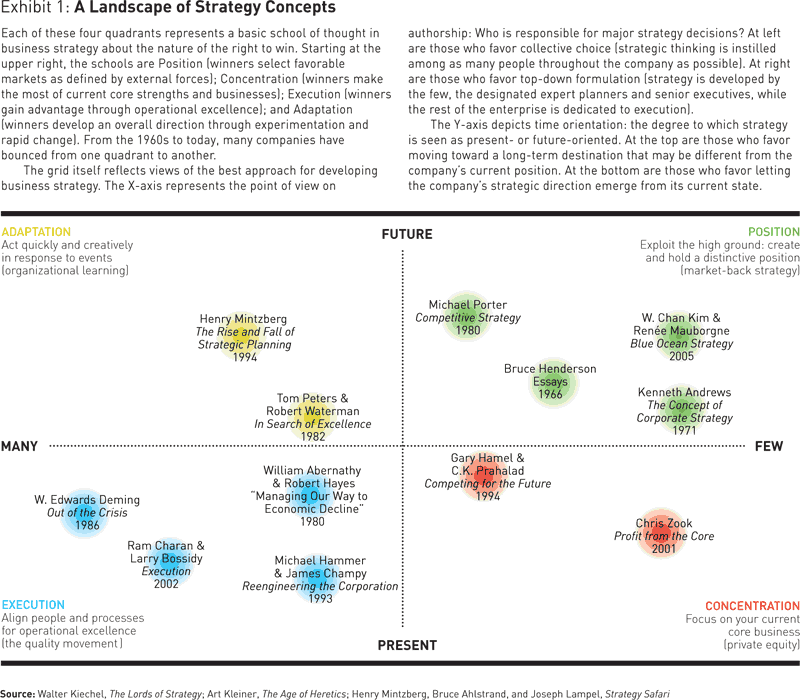
All corporate strategies are at heart theories about the right to win. That is why, for those trying to understand the nature of business success, the history of strategy is both helpful and fascinating. One valuable recent source is The Lords of Strategy: The Secret Intellectual History of the New Corporate World (Harvard Business Press, 2010), in which former Fortune managing editor Walter Kiechel recounts the prevailing theories of business strategy over the past 50 years, and the stories of the people who developed them. Drawing on Kiechel’s history and those of others, such as Henry Mintzberg, Bruce Ahlstrand, and Joseph Lampel in Strategy Safari: The Complete Guide through the Wilds of Strategic Management (2nd ed., FT Prentice Hall, 2009), we have created a map of this conceptual landscape, organized on the basic principles underlying theories of the right to win. (See Exhibit 1.) The map depicts four broad schools of strategy; each represents a hypothesis about the nature of long-term success in a competitive world.
The Basic Tension in Strategy

Business strategy, as we know it today, has a relatively short history. The word strategy was first applied in print to mainstream business in 1962, with the publication of Alfred Chandler’s book Strategy and Structure: Chapters in the History of the Industrial Enterprise (MIT Press). Since then, at least a dozen major trends and ideas have appeared under the rubric of business strategy, often in great conflict with one another, often drawing companies in very different directions. Despite their differences, all four schools of strategy represent attempts to resolve the same basic underlying problem: the tension between two conflicting business realities.
The first reality is that advantage is transient. Even the most formidable market position can be vulnerable to technological disruptions, upstart competition, shifting capital flows, new regulatory regimes, political changes, and other facets of a chaotic and unpredictable business environment. As William P. Barnett showed in The Red Queen among Organizations: How Competitiveness Evolves (Princeton University Press, 2008), this turbulence can never level off into stability; as companies copy and outdo one another’s proficiencies, the game of business continually becomes more challenging. Rapid economic growth in emerging markets has made advantage even more transient, bringing billions of people into the global economy, along with hundreds of energetic new business competitors.
One might assume that the answer is to become completely resilient, morphing to match the changing demands of the market. But companies can’t, because of the second reality: Corporate identity is slow to change. The innate qualities of an organization that distinguish it from all others — its operational processes, culture, relationships, and distinctive capabilities — are built up gradually, decision by decision, and continually reinforced through organizational practices and conversations. Very few companies have thoroughly reinvented themselves, and those that have managed it have typically had to force many people out, including top executives, and to replace them with new recruits chosen for a different set of attitudes and skills. Even when leaders recognize the need for change or know that the company’s survival is at stake, this identity is difficult to shift; if no deliberate effort is made to refresh it, it can stagnate to the point where it erodes advantage from within. As writers such as Jim Collins, Clayton Christensen, and Donald Sull have noted, it’s all too easy for established companies to fall prey to complacency and hubris (Collins), entrenched customer relationships and disruptive technologies (Christensen), or inertia (Sull).
Yet although the “stickiness” of a company’s identity is typically regarded as a weakness, it’s also a great source of strength. No company can survive long, let alone distinguish itself, without a rich body of capabilities and a resonant corporate culture. Indeed, the fundamental enabler of strategy — the source of competitive advantage — is a distinctive, coherent corporate identity. This is the quality that attracts customers, investors, employees, and suppliers. It is grounded in internal capabilities (that is, the things your company can do with distinction) and in market realities (that is, the games in which your company chooses to play).
The yin and yang of strategic fad and fashion — the movement of business leadership from one trend to another over the past 50 years — has often led companies to make incoherent and ineffective moves. The answer is not to keep adopting new theories in hopes of finding the right answer, but to develop your own capabilities-driven strategy: your own theory of coherence for your business. How do you capture value, now and in the future, for your chosen customers? What are your most important capabilities, and how do they fit together? How do you align them with your portfolio of products and services? The more clearly and strongly you make these choices, the better your chances of creating a corporate identity that gives you the right to win in the long run. Not surprisingly, each of the four basic schools of thought in Exhibit 1 (position, execution, adaptation, and concentration) has something significant to offer business strategists, so long as they are adopted in an appropriately balanced way.

The Value of Position

According to Walter Kiechel, strategy became relatively formal in the 1960s for two reasons. The first was an increasing amount of available data on business costs, prices, and operational performance. The second reason was uncertainty, and the anxiety that went with it. The economic stability of the early 1960s dissolved into the turbulence of the 1970s and ’80s, striking different components of society with different degrees of prosperity and calamity. No company could ever be sure it would remain on top (even in established industries such as steel and automobiles), global economies were highly interconnected (although it wasn’t always quite clear how they might interact), and corporate decision making was increasingly constrained by fiercer capital markets and upstart technologies.
When intuitively obvious decisions fail, people yearn for better guidance. Thus, starting in the mid-1960s, the idea of strategic planning, with echoes of Napoleon, Carl von Clausewitz, and Sun Tzu, evolved into an irresistible business management fashion. In its pure form — as delineated by Kenneth Andrews and Igor Ansoff, the premier authorities on business strategy at that time — a strategy was an overarching plan for growth, usually written up in a formal document and endorsed by the CEO, aimed at creating an unassailable position for the company in the marketplace.
These early efforts by the position (or positioning) school assumed that the right to win would be held by companies that comprehensively analyzed all critical factors: external markets, internal capabilities, and the needs of society. Although Andrews said the goal should be a simple “informing idea” about the direction of the business, it inevitably became a complex checklist of strengths, weaknesses, opportunities, and threats (the origin of the SWOT analysis still prevalent today). This was long before the invention of the spreadsheet program, so big companies hired armies of planning staffers to compile all this data into elaborate documents, which were debated in annual strategy sessions that became exercises in bureaucratic complexity. Only gradually did it become clear that the plans did not correlate with real-world performance or issues.
A breakthrough in the position school occurred in 1966 when Bruce Henderson, founder of the Boston Consulting Group (BCG), began to market services based on what he called the “experience curve.” Analyzing cost and price data across companies and industries, Henderson showed that as experience with operations led to greater proficiency, the capacity to produce increased and costs dropped. The phenomenon was hardly noticeable month by month, but every few years, capacity doubled and costs dropped 10 to 30 percent, so reliably that many companies could plan their investment cycles and competitive marketing accordingly. For example, Texas Instruments Inc. (TI) cut the prices of its semiconductor chips and electronic calculators every few months. Sales rose as customers switched to TI from competitors, and production costs then fell further, which allowed TI to drop prices even more. Even the billing procedures and advertising budgets became more efficient as those departments managed greater volumes.
To Henderson, the right to win went to companies that made the best use of the experience curve by holding the leading position in market share for their sectors. This meant emphasizing the value of some divisions over others, basing those judgments on the dynamics of each business’s customer base (Henderson was an early proponent of market segmentation) and on its competitive position. The famous growth-share matrix divided a company’s businesses into “stars” (high growth and market share), “dogs” (low growth and share), “question marks” (high growth, low share) and “cash cows” (low growth, high share), thus providing a clear rationale for reallocating investment. For instance, it was worth borrowing money to keep a star shining, because a star might end up dominating its market niche.
The experience curve and growth-share matrix rapidly became popular because they worked powerfully well — at first. But in practice, these tools had a serious flaw: As retroactive analyses of a company’s past success, they made it irresistible to continue that same behavior into the future, even when circumstances changed (for example, when competitors began to apply the same approach). This led many companies into counterproductive strategies. Some, including Texas Instruments, got caught up in ruthless price wars that contributed to the commoditization of their own products.
More generally, many business leaders became disenchanted with the idea of formal strategic planning. It was expensive, and it didn’t necessarily make companies profitable. For example, Ford and General Motors experienced losses of more than US$500 million in 1979 and 1980 — their first such losses in decades. In the aftermath of these and other sharp reversals, mainstream business leaders began to question the wisdom of the position school, and its claim on the right to win.

Execution Strikes Back

Those most annoyed by the position school tended to be in production and operations. No wonder, then, that the first great contrary reaction came from operations; specifically, from the Harvard Business School’s (HBS) operations management department, which had been gradually losing status to finance. Two members of the faculty found themselves in Vevey, Switzerland, during the summer of 1979: William Abernathy, the HBS expert on auto manufacturing, and Robert Hayes, known for his studies of assembly lines. Researching the differences between European and U.S. multinationals, Hayes visited a small machine tool manufacturer in southern Germany. Sophisticated Americans barely understood computer-aided manufacturing software, but this firm of 40 people was using it on a daily basis, and producing custom-made tools. Other plants in Germany, Switzerland, France, and even eastern Europe were using machine tools in ways that the Americans couldn’t match.
At a seminar that summer, a European businessman asked Hayes why American productivity had declined so much during the past 10 years. Hayes hauled out the standard answers: organized labor, government regulations, the oil crisis, and the attitudes of the younger generation (which, at the time, meant the baby boomers). The attendees looked at him with polite amusement. “We have all those factors here,” one said, “and our productivity is increasing.”
Confused and shaken, Hayes began taking regular hikes and having long conversations with Abernathy, who had just arrived in Vevey and saw similar stagnation in the U.S. auto industry. Only one explanation made sense to them: The reliance on market share and financial growth as strategic objectives was crippling U.S. industry. For example, many companies had cut back any initiative that didn’t seem to guarantee rapid returns, and the entire U.S. economy was suffering as a result.
Abernathy and Hayes wrote up this conclusion in an article for the Harvard Business Review (HBR) called “Managing Our Way to Economic Decline,” published in July/August 1980. It is still one of the magazine’s most requested reprints, and one of the most controversial articles in its history. They had introduced another school of strategic thought, based on the idea that the right to win came from execution and operational excellence: the development and deployment of better practices, processes, technologies, and products.
The execution message was bolstered by companies such as General Electric and Motorola, which provided influential examples of operations-oriented strategies with their reliance on executive training and such practices as Six Sigma.
Operational excellence was also a basic tenet of the quality movement — the continuous improvement practices that were developed at the Toyota Motor Corporation and a few other Japanese companies in the 1950s and ’60s and are now generally known as lean management. Of the many people associated with the quality movement, including Toyota’s influential chief scientist Taiichi Ohno, the most significant for corporate strategy was W. Edwards Deming. Deming was an American statistician born in 1900. He began consulting regularly in Japan just after World War II, helping Japanese companies develop their production systems. Ignored in the West at first, he became prominent in the United States after 1980, and actively taught and consulted with many of the world’s leading companies until his death in 1993. Deming saw his methods as critical for escaping economic malaise (his most prominent book was titled Out of the Crisis [MIT Press, 1986]). In his view, the right to win was held by companies that honed and refined their day-to-day processes and practices, eliminating waste, training people throughout the company to use statistical methods, and cultivating the intrinsic “joy in work” that people feel when they are truly engaged in their jobs.
Although the execution school would be frequently challenged, it continued to gain influence through the early 1990s — especially after it was adapted by Michael Hammer, an MIT computer science professor, into an approach called “reengineering.” According to Hammer, the right to win went to companies that looked freshly at all their processes, as if redesigning them from scratch. Unfortunately, many companies used reengineering as a launching pad for across-the-board layoffs that left them weaker, and operational excellence couldn’t compete with the exuberance of the high-tech bubble. By the end of the 1990s, execution-based strategy had been largely relegated to the production side of the business.
The idea of building value through managerial methods returned to strategic relevance after the dot-com bubble burst. Its return was symbolized by the business bestseller Execution: The Discipline of Getting Things Done, by strategy expert Ram Charan and then Honeywell CEO Larry Bossidy, a well-known GE alumnus (with Charles Burck; Crown Business, 2002). Many leaders now understood, through experience, both the value of improving execution and its challenges. It generally required major changes in managerial and employee behavior. As BCG strategist George Stalk complained to Walter Kiechel, “That was a lot more difficult than just ‘buying a concept off a shelf.’”

Michael Porter’s Advantage

The other major limit of the execution school was best articulated by HBS professor Michael Porter — probably the most influential thinker on corporate strategy in the institution’s history, and a source of new vitality for the position school. In his early publications, from the late 1970s to the early 1990s, Porter brought positioning to a level of unprecedented sophistication. He recast the turbulence of a company’s business environment into a “value chain” and “five forces” (competitors, customers, suppliers, aspiring entrants, and substitute offerings): two frameworks that could be used to analyze the value potential and competitive intensity of any business.
Then, in his flagship HBR article called “What Is Strategy?” (November/December 1996) Porter pointed out that operational excellence could guarantee competitive advantage for only a limited time. After that, it too would lead to diminishing returns as other companies caught up. (Indeed, most observers believe that Ford, GM, and other Western automobile manufacturers have done exactly that between 1980 and 2010; it may have taken them 30 years, but the quality and resale value of their motor vehicles is, as a whole, rising to meet that of Toyota and Honda.)
To Porter, execution-oriented ideas like reengineering, benchmarking, outsourcing, and change management all had the same strategic limit. They all led to better operations, but ignored the question of which businesses to operate in the first place. Porter argued for picking industries or markets where either overall conditions were favorable — where most companies were relatively weak, suppliers had relatively little clout, and aspiring entrants were few — or where a company could differentiate itself. In “What Is Strategy?” Porter used Southwest Airlines Company as an example of differentiation in a relatively unattractive industry. Southwest’s market power came from the choice not to follow the spoke-and-hub routing model of other airlines, but to offer “a unique and valuable strategic position” — flying only direct routes, with one type of aircraft, using automated ticketing and limited services (for example, no assigned seats). These and other strategic choices allowed the airline to operate a different type of flying business, one that could offer attractive prices and convenience even when compared with travel by bus, train, or car. Sure, operational excellence was involved: Southwest had perfected fast turnarounds and friendly customer service. But the core strategic decision was the pursuit of simplicity through a clear market strategy.
The position school became a major driver of the resurgence of corporate competitiveness in the West during the 1980s and ’90s. W. Chan Kim and Renée Mauborgne took the position argument to its extreme with Blue Ocean Strategy: How to Create Uncontested Market Space and Make the Competition Irrelevant (Harvard Business School Press, 2005). Big companies, they advised, should look for new upstart positions themselves, in places where there were no competitors already, breaking out of conventional ways of looking at their industry. The popularity of that approach demonstrated the pressure that business leaders felt to break free of established practices and find a niche that they could dominate with first-mover advantage.
The limits of the position school became evident in the 1990s and 2000s. Although Michael Porter took pains to explain that industry structures can change and can be shaped by the actions of leading companies, he was interpreted as saying that some industries are innately good and others are irredeemably bad. To many corporate leaders in tough businesses, or in highly regulated industries like electric power generation, there was no real advantage to developing distinctive capabilities or facility with execution. Some companies tried to escape by entering new businesses where they had no distinctive capabilities, “blue oceans” where they didn’t know how to swim. These efforts generally failed. And as the 2000s unfolded, companies with enviable market positions, such as Microsoft, also saw their advantage fade when new competitors, such as Google, emerged. This didn’t disprove Porter’s hypothesis, but it gave others an opening to criticize his thinking.

Adaptation and Experimentation

Starting in the 1990s, another group of strategy thinkers provided an alternative to the position and execution schools. This was the idea of strategy as perpetual adaptation, best represented by Henry Mintzberg, professor of management studies at McGill University. In his history The Rise and Fall of Strategic Planning: Reconceiving Roles for Planning, Plans, Planners (Free Press, 1994), Mintzberg dismissed the position school (which he called the design school) as formulaic. He acknowledged that execution was important, and much of his work was dedicated to analyzing what managers did in practice, but, like Porter, he felt execution was insufficient for success. His strategic approach centered on finding a more creative, experimental approach to executive decision making.
Thus, instead of analysis and planning, executives in the adaptation school (or, as Mintzberg called it, the learning school) sought to gain the right to win by experimenting with new directions. In Mintzberg’s words, they “let a thousand strategic flowers bloom…[using] an insightful style, to detect the patterns of success in these gardens of strategic flowers, rather than a cerebral style that favors analytical techniques to develop strategies in a hothouse.”
Adaptation has helped many companies; it’s been the source, for example, of the vitality of the Chinese manufacturing industry. It’s also been the most central guiding theme of Tom Peters’s work. The companies applauded by Peters — starting with his seminal business bestseller, In Search of Excellence: Lessons from America’s Best-Run Companies (with Robert Waterman; Harper & Row, 1982) — have varied enormously in their industries, approaches, and philosophies, but they all share a willingness to experiment with new ideas and directions, discard those that won’t work, and adjust their efforts to meet new challenges.
But the adaptation school is also seriously limited, because its freewheeling nature tends to lead to incoherence. A multitude of products and services that all have different capability needs and different market positions cannot possibly be brought into sync. The more diverse a company’s efforts become, the more it costs to develop and apply the advantaged capabilities they need. Letting a thousand flowers bloom can lead to a field full of weeds — and to businesses that can’t match the expertise and resources of more focused, coherent competitors.

Concentration at the Core

Hence the appeal of the fourth group of strategy thinkers — the concentration school. Its forerunners were Gary Hamel and C.K. Prahalad, authors of Competing for the Future (Harvard Business School Press, 1994), who argued that the most effective companies owed their success to a select set of “core competencies”: These were the bedrock skills and technological capabilities (such as new forms of hardware, software, systems, biotechnology, and financial engineering) that allowed companies to compete in distinctive ways. Companies that focused on these, and used them to develop a long-range “strategic intent,” would claim the right to win.
Chris Zook of Bain & Company, drawing on his firm’s experience with private equity, has been the most prominent recent exponent of this school. In his book Profit from the Core: A Return to Growth in Turbulent Times (2001, with James Allen; Harvard Business Press, 2010), he argues that the right to win tends to accrue to companies that stick to their core businesses and find new ways to exploit them for growth and value. This means differentiating a company by starting with its central capabilities: Enterprise, Dollar/Thrifty, and Avis all prospered by focusing on, respectively, rentals for people with car repairs, vacationers, and business travelers.
However, in practice, the concentration strategy often becomes a way of holding on to old approaches, even when they become outdated. Many companies (and private equity firms) translate this strategy into slash-and-burn retrenchment. They cut costs and minimize investments in R&D and marketing to create a pared-down company that produces more profits at first, but that can’t sustain the growth required for a healthy bottom line. When they seek to grow, it’s through “adjacencies”: products or services that seem related to their existing core businesses. But many adjacencies are less profitable than they were expected to be, in part because they may require very different capabilities — and in part because the truly successful game-changing leaps, like Apple’s into consumer media or Tata’s into the inexpensive Nano automobile, can’t be managed from a concentration strategy alone.

Strategy as a Way of Life

It’s important to note that most of the thinkers who introduced these strategies to business leaders saw the challenges and limits of their approaches, and even warned against misapplying them. But businesspeople misapplied them nonetheless. Each theory thus backfired, and created opportunities for the next.
How can your company gain the most from considering all these theories of the right to win? Only by stepping back, away from any particular answer, to look at your company’s identity as a whole, encompassing the way you expect to compete, the capabilities with which you will compete, and the portfolio decisions that fit. In fact, that’s exactly what happens with the packaged-foods company described at the beginning of this article.
The CEO’s question about the right to win has sparked many levels of discussion. For several more days, spread over a few weeks, the executive team talks through its three proposed strategies in detail: the estimated market value of each, the risks involved, and the capabilities required. All three strategies have roughly the same potential for increasing enterprise value, but the differences among them become clear when the functional leaders speak.
For example, the head of operations explains that the three strategies would require completely different investments. Becoming an innovator would mean configuring a flexible value chain to launch new products rapidly and economically. The closer-to-customers option would mean selling more food at different temperatures: some frozen, some fresh. It would also mean building a more direct, collaborative relationship between operations and R&D. And the category transformation strategy would require new process technologies, economies of scale, and deftly managed acquisitions.
The head of marketing and sales has a similar presentation. As an innovator, the company would focus advertising and promotion on new products, while ensuring rapid, widespread retail distribution. Being a solutions provider would move the company directly into engagement with consumers, through websites, social media, and better in-store displays. As a category leader, the company would seek to own the grocery shelf through “sharp pencil” tactics (in other words, tactics tailored to each brand and geographic region) for pricing, promotion, and merchandising.
The company executives ultimately settle on the category leader strategy. It fits best with the capabilities that they already have. Another company, even with the same market dynamics, might choose differently — appropriately so, because of very different capabilities and customs.
A capabilities-driven strategy process, like this one, takes into account “market back” aspirations (the position the leaders want to hold) and “capabilities forward” concerns (the company’s ability to deliver). In the course of discussion, ideas from all four schools of thought come forward: ideas about holding an unassailable position, executing with new capabilities, adapting rapidly to competitive pressures, and focusing on the core business as a platform for growth. It takes time to complete this process, and it is very difficult and stressful at times, but the company gains, in the end, from a far higher level of coherence.
It’s taken 50 years for the field of business strategy to reach the point at which many companies can conduct this kind of conversation effectively. Most companies have relied on business strategists for strategic answers. But now we see that we have to generate our own answers — our own theory of the right to win for each company, with its unique identity and circumstances — and that we have the tools to do so. Given the pressures that business continues to face, this leap in knowledge is coming just in time. 

The Sirens of CPG Strategy
by Steffen Lauster

Some strategic concepts, if they’re held as sacrosanct, can lead an entire industry in the wrong direction. Something of that sort has happened during the past two decades in the consumer packaged goods (CPG) industry. Two of the most influential strategy ideas are so widely held, so intuitively appealing, and so apparently true in practice that they are very hard to give up. Yet they can also be quite dangerous to follow.
The first of these misleading ideas is that “bigger is better.” Since the 1980s, CPG companies have tried hard to expand. The conventional wisdom said that the best shareholder returns would accrue to companies with huge brands and the scale to compete in developing markets. The second idea is that “consolidation is inevitable.” For years, experts have predicted that most consumer packaged goods segments would end up like carbonated beverages, shaving products, and disposable diapers — dominated by just two or three big players that took advantage of their scale to acquire or crowd out rivals, while a handful of niche players battled over the scraps.
Recent studies conducted by Booz & Company of total shareholder return among CPG companies show that both of these ideas are, at best, incomplete. Companies that follow them end up sacrificing performance. To be sure, there are categories where scale matters, where one or two players dominate. But many food and consumer products sectors are fragmenting instead, with room for many profitable entrants. In coffee, ready-to-eat meals, shampoos, and pasta sauces, for example, there are more small companies than there used to be; mass and price don’t matter as much as perceived quality. In the New York area, jars of Rao’s Homemade marinara sauce (the same sauce served in the famous Rao’s restaurant of East Harlem) are flying off the shelves.
These days, the best-performing consumer products companies — whether large or small — are those with the greatest coherence. Their market strategy, capabilities system, and product lineup all fit together. They invest their capital and attention in just three to six differentiated capabilities, supporting all the products they offer. This gives them a level of efficiency and effectiveness that most of their competitors can’t match.
In the end, the problem with strategy concepts is not that they’re wrong; they are, in fact, often right. But they are not universal. Beware any strategic idea that most other companies find beguiling. The right strategic destination is different for every company, even in a mature industry like consumer packaged goods.

Steffen Lauster is a partner with Booz & Company based in Cleveland.

Reprint No. 10407

strategy and business

Author Profiles:

  • Cesare Mainardi is the managing director of Booz & Company’s North American business and a member of the firm’s executive committee. He is coauthor, with Paul Leinwand, of The Essential Advantage: How to Win with a Capabilities-Driven Strategy (Harvard Business Press, 2010).
  • Art Kleiner is the editor-in-chief of strategy+business and the author of The Age of Heretics: A History of the Radical Thinkers Who Reinvented Corporate Management (2nd ed., Jossey-Bass, 2008).
  • Disclosure: At least four people named in this article have been contributors to s+b: Ram Charan, Walter Kiechel, Henry Mintzberg, and C.K. Prahalad. Others named in the article have had associations with s+b staff members, with Booz & Company, or with its competitors. Where we assess individuals’ contributions and impact, we have tried to do so independent of any such associations.

Culture Change: Best Practice Thought Leadership

0

 
This is the result of an extensive set of discussions among a group of organization development consultants and internal HR staff under the auspices of the Change Affinity Group of the New Jersey Human Resource Planning Society.

Key Questions for Discussion:

    1. What is culture change?
    2. What are the major models?
    3. What is the role of executive management in culture change?
    4. What is the role of HR in culture change?
    5. What works and doesn’t work in culture change?

      Summary of Key Thinkers’ Ideas
    1. John Kotter’s perspective.
      1. Definitions
        1. “Culture” refers to norms of behavior and shared values among a group of people.
        2. “Norms of behavior” are ways of acting that persist because they are rewarded and the group teaches these behaviors to new people, sanctioning those who do not conform.
        3. “Shared values” are important concerns and goals held by most people in the group: they shape group behavior.
      2. In Kotter’s model, changing the culture is the last of eight steps, not the first.
        1. “Even when there is no personality incompatibility with a new vision, if shared values are the product of many years of experience in a firm, years of a different kind of experience are often needed to create any change. That is why culture change comes at the end of a transformation, not the beginning.”
        2. Culture is not something you can directly manipulate, as if by decree. Culture change occurs after you have successfully altered people’s actions and their new behavior has produced success, which can be traced back to the new actions and behaviors.
        3. This is not to say that culture issues don’t arise in the early stages of a transformation. But to try to change the culture as a first step is a bad idea what proof do you have to offer that it’s the right way to go?
        4. Remember, you are always trying to engender an adaptive culture, one that benefits the four main constituents: shareholders, employees, customers and management. This type of culture values good leadership and management. It also encourages teamwork at the top, while minimizing layers of management and bureaucracy, as well as counterproductive interdependencies.
      3. Anchoring change in a culture.
        1. Culture change comes last, not first.
        2. Lasting change depends on results. You must show new approaches work and that it’s worthwhile to change.
        3. Requires a lot of dialog.
        4. May involve turnover of key people who block change.
        5. Promotion practices need to be changed to be compatible with the new practices. New leaders should be compatible with the new culture and champions of it.
      4. Shallow roots require constant watering.
        1. Kotter uses an example of a technology-oriented company to illustrate the point. As long as the new general manager was around to focus the organization constantly on speed to market and the customer, progress was made substantial progress. When the GM retired, because the underlying cultural belief that “good technology will solve all our problems” had not changed, the company quickly regressed over two years.
      5. In an organization, the less visible shared values and group norms are, the harder they are to change.
      6. Culture is powerful for three reasons.
        1. Individuals are selected and indoctrinated to support the existing culture.
        2. Culture propagation occurs through the actions of hundreds or thousands of people in the organization.
        3. This reinforcement happens without much conscious intent and is therefore difficult to challenge or even discuss.
      7. There are different culture-change scenarios, some much harder to accomplish. For example:
        1. The core of the old culture is not incompatible with the new vision. The challenge is to graft new practices onto old roots, while eliminating inconsistent practices. This is least difficult to do.
        2. The core of the old culture is incompatible with the new vision. This is a much more difficult situation to cope with.
    2. Kotter and Heskett in Corporate Culture and Performance.
      1. Alan Wilkins’ study reflects the beliefs of many academics that culture is very hard to change. In 22 cases Wilkins studied, even the managers admitted failure in 16 instances.
      2. Kotter and Heskett studied 10 cases of major culture change that seemed to be successful. The companies were Bankers Trust, British Airways, ConAgra, First Chicago, General Electric, ICI, Nissan, SAS, American Express TRS, and Xerox. They found:
        1. “The single most important factor that distinguishes major culture changes that succeed from those that fail is competent leadership at the top.”
          1. All ten cases of major change occurred after an individual with a track record for leadership was appointed head of the organization. Each had a track record of producing change.
          2. In their new jobs they created change on a grander scale.
          3. These leaders demonstrated the close interrelationship of competition, leadership, change, strategy and culture.
          4. All of these leaders either:
            1. Came from the outside.
            2. Came to their firms after an early career somewhere else.
            3. “Grew up” outside the core of the company.
          5. While a limited sample, one can theorize that an outsider’s perspective is important to change.
            1. In all four very large companies in our study, the change leader had spent considerable time in the company before taking over, thereby developing a good sense of the resources in the company.
            2. Complete outsiders tended to be successful at smaller companies.
        2. Why you can’t change culture from the bottom up.
          1. The sheer resistance to change in an organization requires great power to overcome, and that power resides at the top.
          2. Interdependence in organizations makes it very difficult to change anything important, without changing everything. Only people at the top can do that.
    3. Delta Consulting’s (David Nadler) perspective: Discontinuous Change.
      1. Definitions:
        1. “Organizational culture” is a set of commonly shared values and beliefs. It influences the behavior of people and is reflected in work practices, i.e., how we do things here.
        2. “Values” are the fundamental axioms or established feelings about the desirability of some quality, like innovation or individualism.
        3. “Beliefs” are perceptions about the connections of things such as events and outcomes, for example: “Hard work will be rewarded,” or “challenging the boss will get you shot.”
      2. Culture is reflexive: Beliefs shape behavior, but behavior also shapes beliefs. Values affect beliefs and behavior, but beliefs and behavior also affect values.
      3. Often espoused beliefs and values are not consistent with the beliefs and values that can be inferred from observed behavior. This lack of alignment can cause great dysfunction.
      4. Most organizations are a mixture of many cultures: one in R&D, another in Sales, etc.
      5. External forces, historical forces and internal forces all shape behavior. Managers can most affect internal forces giving them a lever to change culture.
      6. In changing culture, there are three critical areas to address.
        1. Content of the change (vision of the new culture).
          1. Do a culture audit: What is the culture like, what needs to be changed?
          2. Leadership is essential for successful culture change.
          3. Key champions at all levels are required.
        2. Leverage points for change (what and how to change).
          1. Full-blown culture change requires change in all the key elements of organizational context: structure, business processes, measurement, appraisal and rewards. If, in fact, you do all these things, Nadler argues that culture change will be the ultimate outcome.
          2. Values must be articulated in terms of expected behavior. Establishing one value as more important than others is important to give people a set of priorities.
            1. Good technique used at AT&T, where Senior Executives interviewed people lower in the organization about the new values and how they saw them being implemented. This is a good check on implementation, and helps senior executives understand the issues involved in the effective transformation of a culture.
            2. A key test of culture change is who is getting promoted, the good guys or the bad guys
            3. What happens to someone delivering good results but not living the new values? This is a critical dilemma for leadership. Support and coaching for change must be offered; if a person refuses or does not change, then they must be removed. GE under Jack Welch was very strongly committed to having executives both get results and live the values. If they did not live the values, and did not improve, they were out.
        3. Tactical choices (when and where to change).
          1. Culture and values are the very foundation upon which the overall change agenda rests.
          2. Interventions into culture should be sequenced separately from the hardware changes. One effective sequence is to have culture initiatives occur sometime after the announcements of structural and work-process changes.
          3. Use bottom-up interventions also, e.g., education and training, meetings, forums, etc.
          4. Migrate change laterally from one organization to another. Use beta sites and skunk works to try out changes and work out the kinks. Transfer that learning to the next site. Customer visits can be a very powerful tool in this change. Customer needs get the attention of almost any level in the organization.
    4. Built to Last. By Collins and Porras.
      1. They do not talk about changing culture, but about what great companies do to maintain their cultures, which they describe as cult-like. This is useful to consider once you decide what you want to change the culture to.
      2. The cultures in visionary companies are not soft or undisciplined:

“Because visionary companies have such clarity about who they are, what they’re all about, and what they are trying to achieve, they tend not to have much room for people unwilling or unsuited to their demanding standards.”

    1. Visionary companies are not great places to work, at least not for everyone. If you can’t embrace their ideology, they expel you like a virus. If you do not fit their practices, they will weed you out in the hiring process or shortly thereafter.
    2. Cult-like cultures are key to preserving the core ideology of a company.
    3. Visionary companies have these characteristics about their culture that are cult-like:
      1. Fervently held ideology
      2. Indoctrination
      3. Tightness of fit
      4. Elitism
    4. Visionary companies create these cultures through practical, concrete things:
      1. Orientation and training programs
      2. Internal universities
      3. On-the-job socialization with peers and immediate supervisors
      4. Rigorous up-through-the-ranks policies such as promoting from within, and hiring young people and shaping their minds from the start.
      5. Exposure to pervasive myths of heroic deeds
      6. Corporate songs, cheers, etc.
      7. Tight screening practices; hiring and removal in first few years
      8. Incentives and advancement are closely linked to core ideology
      9. Awards, contests and public recognition are closely linked to core ideology
      10. Tolerance for honest mistakes, but severe penalties or termination for breaching core ideology
    5. These cult-like cultures succeed because they are balanced by mechanisms to stimulate progress, e.g., taking on challenging tasks (Big Hairy Audacious Goals or BHAGs).
    6. Adhering to a small set of core beliefs allows these companies to grant a good deal of operational autonomy.
    7. The authors conclude: “It means that companies seeking an ’empowered’ or decentralized work environment should first and foremost impose a tight ideology screen and indoctrinate people into that ideology, eject the viruses, and give those that remain the tremendous sense of responsibility that comes with being a member of an elite organization. It means getting the right actors on the stage, putting them in the right frame of mind, and then giving them the freedom to ad lib as they see fit.”
  1. The Last Word on Power: Executive Re-invention for Leaders Who Must Make the Impossible Happen. By Tracy Goss.
    1. The power to make the impossible happen.
      1. As a leader your source of success in the past is probably preventing you from making the impossible happen now. You must re-invent yourself, put past success at risk to make the impossible happen.
      2. “I define this advanced level of power as the ability to take something that you believe could never come to pass, declare it possible, and then move that possibility into a tangible reality.”
      3. She claims there is a set of theories and methods for learning to make the impossible happen, and that these can be taught.
      4. Reinventing yourself does not imply that something is wrong with you; it’s a process that takes you to a new place, to unfamiliar and unknown territory.
      5. Executive re-invention is primarily an ontological journey. Ontology is a branch of philosophy concerning the nature of reality and different ways of being.
      6. If you are going to re-invent your organization, then in order to succeed, you must first re-invent yourself. (Note: This is an alternate strategy to Kotter, where re-invention occurs when a different type leader takes over. None of Kotter’s success stories seems to have re-invented themselves.)
      7. Goss uses the analogy of a Navy SEAL and corporate leaders. The green recruit, despite being among the top 1% of officers in Navy, needs considerable training to take on the impossible missions assigned the SEALs. Similarly, the top 1% of leaders in organizations when they get to the top are not prepared to take on the impossible; they need training.
      8. Transformational change is an oxymoron. “Transformation” is a function of altering the way your being, to create something that is currently not possible in your reality. “Change” is a function of altering what you are doing, to improve something that is already possible in your reality.
        1. To transform yourself, you must transform your context, that is, the way you think, talk and act.
        2. “Language is the only leverage for changing the context of the world around you. This is because people apprehend and construct reality through the way they speak and listen.”
        3. “By learning to uncover the concealed aspects of your current conversations and learning to engage in different types of conversations, you can alter the way you are being, which, in turn, alters what’s possible.”
    2. The seven stages of leadership re-invention. First four have to do with freeing yourself from the past; last three, with building your capacity to make the impossible happen.
      1. Uncovering your winning strategy: learning to understand what has really created your current level of success.
      2. Experiencing the limits of the universal human paradigm at work in your actions. The universal human paradigm colors all choices, decisions and actions. Simply stated, it says: “There is a way that things should be, and when they are that way, things are right. When they’re not that way, there is something wrong with me, with them, or with it.” This paradigm is inherited simply by being brought into a group or culture.
      3. Learning to put everything at risk: becoming willing to operate with no guarantee you will succeed, with your eyes wide open to the high odds of failure and the accompanying consequences.
      4. Inventing a new master paradigm that provides you with a new source of power: making a series of declarations that constitute a new master paradigm (Similar to personal vision).
      5. Inventing an impossible game to play: making bold promises in a game you have chosen to play
      6. Breaking the addiction to interpretation: every problem and dilemma is seen through the way it contributes to your invented future, rather than through filters from the past.
      7. Operating beyond the limits of your winning strategy: building the capacity to bring about your “impossible future.”
  2. “The Reinvention Roller Coaster: Risking the Present for a Powerful Future.”  By Tracy Goss, Richard Pascale and Anthony Athos.
    1. Incremental change is not enough for many companies today. These companies need to re-invent themselves. Re-invention is not changing what is, but creating what isn’t. A butterfly is not more or a better caterpillar, it is a completely different animal.
    2. “When a company reinvents itself, it must alter the underlying assumptions and invisible premises on which its decisions and actions are based.” In other words, it must change its context.
      1. The first step is for a company to uncover its hidden context. A company is only going to do this when it is threatened, losing momentum or eager to break new ground.
      2. “The journey to reinvent yourself and your company is not as scary as they say it is; it’s worse,” says Mort Meyerson, chairman of Perot Systems. You do it only out of the conviction that the only way to compete in the future is to be a totally different company.
      3. Shifts in context can only occur when there is a shift in being. Nordstrom’s is used as an example. Their way of being is summarized as “Respond to Unreasonable Customer Requests.” Those that have tried to copy Nordstrom’s have not understood their fundamental way of being and have failed.
      4. A declaration from a leader, like Sir Colin Marshall’s pronouncement that British Airways would be “the world’s favorite airline” (when, at the time, it was one of the worst), does a couple of things:
          1. Creates possibility
          2. Stimulates interest and commitment
      5. A declaration is different from a vision statement, which provides a more elaborate description of the desired state and the criteria against which success will be measured.
      6. Key to re-invention is the re-invention of the leader (see Goss notes).
    3. Managing the present from the future
      1. Assemble a critical mass of key stakeholders.
        1. Many more than just the top 8 to 10 leaders.
        2. Should include key technologists and leading process engineers.
        3. Group should be sufficiently diverse to ensure conflict, which will get issues on the table so they can be resolved.
        4. Have to decide how it’s going to happen.
      2. Do an organizational audit to generate a complete picture of how the organization really works.
        1. Understand the competitive situation.
        2. Reveal barriers to moving from “as is” to the future.
        3. Core values.
        4. Key systems.
        5. Strategic assumptions.
        6. Core competencies, etc.
      3. Create urgency. Discuss the undiscussable.
        1. A threat that everyone perceives, but no one is willing to talk about, is most debilitating to an organization
        2. Book of Five Rings Japanese guide for samurai warriors. Written four centuries ago, directs the samurai to visualize his own death in the most graphic detail before going into battle. Idea being, once you have experienced death, there is not a lot left to fear: one can then fight with abandon.
        3. This helps explain the value of discussion about not changing and the dire consequences to a company in a difficult business situation.
      4. Harnessing contention.
        1. Conflict jump-starts the creative process.
        2. Most companies suppress contention.
        3. Control kills invention, learning and commitment.
        4. Emotions often accompany creative tension, and they are often unpleasant.
        5. Intel plays rugby; your ability at Intel to take direct, hard-hitting disagreement is a sign of fitness.
        6. Many excellent companies build conflict into their designs.
      5. Engineering organizational breakdowns.
        1. Breakdowns should happen by design, not accident.
        2. In trying to manage back from the future, concrete tasks will have to be undertaken; continuing on the current path will not get you there. Often you don’t know how to make these tasks occur. This will generate breakdowns, which can generate out-of-the-box thinking and solutions, if the situation is managed/lead correctly. Continuous open dialogue is key to working through breakdowns.
        3. Setting impossible deadlines is another way to encourage breakdowns and out-of-the-box thinking.
  3. Organizational Culture. By Edgar Schein, MIT (He, Kotter and Heskett are in similar places.)
    1. “Let me begin bluntly there is no such thing as the “right” culture and culture can not be fostered or installed.”
    2. Success of the company creates organizational culture. If the founders had a wrong set of assumptions about how things are, they would have failed. The right set of assumptions is relative to the business environment. The longer the company is successful, the more stable the culture becomes.
    3. Pronouncements that we must change our culture either will be denied or cause levels of anxiety that trigger intense resistance to change. Therefore, you will fail if you take culture head on.
    4. If the present culture is dysfunctional, or out of line with current environmental realities, then take these steps:
      1. Start with what the business problem is. The issue is not about culture, but about the mission of the organization and whether it is being fulfilled.
      2. Figure out what needs to be done strategically and tactically to solve the business problem. What does the organization need to do concretely to solve its survival or growth problems?
      3. When there is clear consensus on what needs to be done, examine the existing culture to find out how present tacit assumptions would aid or hinder that. Some parts of the culture may be fine, or certain subcultures within the organization maybe fine.
      4. Focus on those cultural elements that will help you get to where you need to go. It is easier to build up the strengths of a culture than to change dysfunctional elements. The diversity of a culture and its subcultures almost always have strengths to leverage.
      5. Identify the culture carriers who see the new direction and feel comfortable moving in that direction. This helps create role models, these people are often found in subcultures or in marginal roles in the organization.
      6. Build change teams around the new culture carriers. Different parts of the organization, because of environmental needs, may have to go in a different directions to produce the desired changes in thinking and acting.
      7. Top management must adjust the reward, incentive and control systems to be aligned with the new strategy.
      8. Ultimately the structures and routine processes of the organization must also be brought into alignment with the desired new directions.
    5. All of this takes a great deal of time and energy across many layers of management and many task forces and change teams. It is fueled by the need for a solution to a clear business problem. Culture change occurs as a by-product of fixing fundamental problems.
    6. If the culture prevents correcting the business strategy, that culture will be broken by destroying the group that carries the culture. That means firing a lot of people, or the organization will die.
    7. Culture is not a suit of clothes to be changed at will. The residue of past success, it is the most stable element in an organization.
  4. “Organizational Change.” Consortium Benchmarking Study conducted by the American Productivity and Quality Center.
    1. Overview of findings.
      1. Successful organizations believe the organization’s culture must be changed.
      2. Organization change requires vision, tenacity and a long-term horizon.
      3. Organization change requires commitment from top management.
      4. Organization change requires extensive communication with all stakeholders. Employees must be empowered and educated so they can exploit their new power.
      5. It is necessary to systematically measure progress and results.
    2. Key elements of success.
      1. Leadership
      2. Culture change
      3. Work force involvement
      4. Communication and measurement
      5. Education
      6. Supportive Human Resource systems
      7. A shared sense of urgency for change
    3. Triggers for change.
      1. Organizations on the brink of disaster that had engaged in change efforts consistently rated triggers higher than organizations not currently in dire circumstances.
      2. Highest ranking triggers
        1. Changing regulatory or legal environment
        2. Competition
        3. Customer dissatisfaction
        4. Declining or increasing profits
      3. Second ranked triggers
        1. Declining or increasing market share
        2. Declining or increasing revenue
        3. Rising costs
        4. Technology change
      4. Third ranked triggers
        1. Employee morale
        2. Merger or acquisition
        3. Public Image
        4. Quality
      1. Organizational Development and Change. By Thomas Cummings and Christopher Worley.
        1. Definition: Examination of different definitions suggests that organizational culture is the pattern of basic assumptions, values, norms and artifacts shared by organizational members. These shared meanings help members to make sense out of the organization. The meanings signal how work is to be done and evaluated, and how employees are to relate to each other and to constituencies such as customers, suppliers and government agencies.
        2. Corporate culture is the product of long-term social learning and reflects what has worked in the past.
        3. Diagnosing organizational culture culture change efforts begin with diagnoses.
          1. Behavioral approach
            1. Assesses key work behaviors that can be observed.
            2. Describes how specific relationships are managed and tasks performed (see example, pg. 483).
          2. Competing values approach
            1. Culture can be understood by how an organization handles dilemmas around four contradictory values. (see model, pg. 484).
            2. Four sets of competing values: Participation vs. goal achievement; internal focus vs. external focus; stability vs. creativity and innovation; organic processes vs. mechanistic processes.
          3. Deep assumptions approach
            1. Very difficult and time consuming to do.
            2. See pg. 485 for details.
        4. Culture change.
          1. There is considerable debate over whether it can be done or not.
          2. Given the problems with cultural change, most practitioners in this area suggest that changes in corporate culture should be considered only after other, less difficult and less costly solutions have either been applied or ruled out.
          3. Knowledge about culture change is in its formative stages; however, here is some practical advice if you embark on the journey:
            1. Start with a clear vision of the firm’s strategy and the shared values and behaviors needed to make it work.
            2. Have top management commitment, because culture change must be managed from the top.
            3. Symbolic leadership is critical: leaders must walk the talk. In successful cases of culture change, leaders almost always demonstrate a missionary zeal for new values and behaviors.
            4. Support organizational changes in structure, reward systems, HR systems, information systems and leadership style.
            5. Pay careful attention to the selection and socialization of new-comers, as well as the termination of deviants. This is particularly important for key leadership roles. Jan Carlzon of SAS replaced 13 of 15 top executives.
            6. Manage ethical and legal issues effectively. Don’t promise values for culture change that the organization can not deliver on.
      2. Corporate Culture: Removing the Hidden Barriers to Team Success. By Jacalyn Sherriton and James Stern.
        1. They believe that corporate culture change is needed for successful implementation of formal teams.
          1. Senior managers trying to implement teams continue to act individually: they are concerned about control over the teams and concerned that consensus decision making is too time consuming. They often set a very bad example, for example, by protecting their turf.
          2. Team members are typically not used to working in teams. They often are uncomfortable and lack the communication skills to make the teams work effectively.
          3. Introduction of teams while downsizing or facing threats of downsizing creates forces that are antithetical to teams.
        2. Corporate culture is defined by four elements.
          1. Ritualized patterns of beliefs, values and behaviors.
          2. Management environment created by management styles, philosophies, what is said, done and rewarded.
          3. Management environment created by systems and procedures.
          4. Written and unwritten norms and procedures.
        3. They believe that you can make a direct assault on culture change differing with Kotter, Heskett and Schein.
        4. Their book describes successful change in subcultures when top-level support was either absent or sporadic.
          1. They feel that each major functional organization such as marketing or R&D has its own subculture, as do divisions and other large units of the organization.
          2. Subcultures are influenced by the overall corporate culture, but subcultures are never the same as the overall culture.
          3. There is much more freedom to change a subculture than is commonly realized or acted upon
        5. “There is nothing more difficult to take in hand, more perilous to conduct, or more uncertain in its success than to take the lead in the introduction of a new order of things.” Niccolo Machiavelli
        6. How pervasive is the issue of culture and change? They did a survey of 100 companies and found that recently:
          1. 15% had been involved with a merger.
          2. 22% had been acquired.
          3. 41% had formed alliances.
          4. 78% were increasing the utilization of teams.
          5. 95% were involved in at least one of these initiatives that culture impacts significantly.
          6. Only 51% of respondents felt that their organization understood the need to address culture issues in making these changes.
          7. Only 31% of respondents felt their organization had the skills and knowledge to address organizational culture issues.
          8. Only 36% had assessed the culture and identified changes needed.
          9. But 56% (highest) had plans for training to address culture change.
        7. Gives a good detailed approach to what needs to be done to change culture. They also describe in some detail the culture needed to support teams. A lot of how-to’s. Very practical, particularly, if you need to work around some organizational constraints.
        8. Model does not put as much emphasis on the external environment, vision and strategy as other models.

Content Sponsor

Learning to Lead

0

Herminia Ibarra , Professor of Organizational Behavior, and Faculty Director of the INSEAD Leadership Initiative, contests that we learn to lead in relationship, by becoming a part of a community and network of leaders, but what we preach, however, is very different.

Let’s draw some inferences by considering a few schools of thought:

Situational leadership, — originally conceived as the antidote to the great man theories of leadership. The situational school brought us the notion of “fit:” person to situation and leader to follower. The original version said the situation makes the leader. The simpler version we retained says something else altogether, that good leaders choose among the leadership styles or change strategies in their repertoire the one that best matches their current situation.

Discover your strengths — another great example of a one-sided and static focus on personal attributes that make people effective leaders. According to this theory, we can categorize ourselves according to a number of themes and clusters of themes that describe our strengths; once identified, they help us make decisions about what situation best match us.

Practice — From Malcolm Gladwell’s Outliers to Geoff Colvin’s Talent is Overrated we learn about the magic rule of 10,000 hours. Bill Gates, we are told, became a computer wiz because he had access to an early computer and was able to clock the requisite number of hours. Putting in the hours, not innate talent, makes the leader.

Prof. Ibarra’s research on how effective managers make the transition to bigger, broader leadership roles and cements their contribution to the growth and transformation of their organization, incorporates 4 key enablers:

o    Motivate the transition to leadership. When asked to do things that don’t come naturally, we implicitly ask ourselves “am I the sort of person who behaves this way?” “Do I want to be that sort of person?”. When managers’ identification is rooted in functional groups or expert communities, the answers are negative when it comes to leadership, and thus it is no surprise that they do not sustain the arduous practice it takes to develop as leaders. On the other hand, when they identify with recognized leaders, learning to lead is motivated by the desire to become a member of a valued group.

o    Make the “competencies” come alive. One of the difficult things about learning to lead is distinguishing between “what” (content knowledge) and “how to” (process knowledge). We may know, for example, that “sensing external trends” is a critical competency in forging a strategic direction, and we may also want to become more like the leaders we know who are very good at that. But, how does one actually learn to strategize? In a successful learning cycle, role models, peer groups and communities of practice motivate change by changing our reference point on what is desirable and possible, and then once motivated, providing tacit knowledge on how to do it.

o    Experiment from the outside in. Many aspiring leaders struggle to stretch their leadership within their current organization and roles. Caught in between delivery pressures and outdated views of their capacities, they more quickly or easily find roles outside the organization that allow them to lead. Their new activities, in professional organizations, clubs, informal advisory and so on, create external identities that they eventually internalize.

o    Build external support & networks to sustain change. Often it is hard to get support for change from old mentors, bosses or trusted colleagues. They may have good intentions but maintain of what we can and should do that are based in the past and not the future. People and groups, on the fringe of our existing networks help us push off in new directions while providing the secure base in which change can take hold, one of the reasons why learning methods like peer coaching are so powerful.