
Blog Masonry Boxed

 Built To Last – Summary of Key Points Written by James Collins & Jerry Porras
 About this book:
Rather than seek increased revenues and profits by expanding products and markets, companies should follow a seven-step strategy for achieving more with less.

Illustration by Philippe Lardy
Faced with economic headwinds, many global corporations are struggling to grow their businesses profitably. In the consumer packaged goods business, for example, the worldwide recession has hurt premium brands as consumers have traded down to cheaper brands, private labels, or generics. In the retailing business, same-store sales are flat or declining for numerous companies. Meanwhile, many business leaders continue to seek growth by extending their existing product lines and brands, as well as by entering new geographic regions. After all, growth is supposed to be about “more” — more products on the shelf, more categories, more brands, and more markets.
However, this approach is exactly the opposite of what business leaders should do to drive increased revenues and profits. A typical “growth through more” strategy diffuses the organization’s efforts. It increases the complexity of the organization and its operations. We have found that “growth through less,” or more precisely “growth through focus,” is the best prescription for growth, regardless of the economic environment. This conclusion is based on our own experience in three well-known companies — Kraft Foods, Unilever, and Fonterra Brands (a dairy products business based in New Zealand) — on three continents over 10 years. In all three cases, a deliberate strategy of focusing on a few markets, brands, and categories produced impressive revenue and profit expansion. We have learned that seemingly mature businesses can be energized by making fewer but larger bets and by focusing relentlessly on executing a simple but powerful vision.
Growth through focus is not as easy as choosing what strategic bets to make. Rather, it requires the leadership team to follow a systematic approach that spans everything from strategy and vision to execution and measurement. We propose a framework that consists of seven steps that an organization must go through in its quest for growth through focus. Our framework is grounded in three key ideas: focus in strategy, simplicity in communication, and empowerment in execution………
Growth and the Winemaker’s Logic
To understand the logic behind growth through focus, consider what winemakers know about getting the best out of grapevines. Grapevines are very vigorous. With abundant water and nutrients in the soil, they tend to grow into large, leafy plants. However, overly vigorous vines produce lower-quality wine and smaller crops. When growing conditions are too rich, grapevines grow more leaves and become tangled. Leaves take nutrients away from grapes, which contain the seeds for future growth, and create shade, which inhibits ripening. To improve the quality of grapes, winemakers carefully prune grapevines and remove excess bunches of grapes to reduce yields. The remaining bunches ripen more fully and ultimately produce more concentrated wine.

Many companies, in effect, behave like inattentive vintners. Growth initiatives are often overstimulated with money and leadership attention. The result is lots of activity and a large number of growth projects, and this activity often does not correlate with outcomes. Quantity does not mean quality. To improve the quality of growth, business leaders need to cut back on marginal products, brands, and markets so that they have a better chance of winning in their chosen areas of focus.
Following the winemaker’s logic, company leaders must overturn conventional thinking about how to manage the organization, processes, and people for growth. (See the exhibit.) For example, a conventional core belief about growth is that companies need to extend their product lines and brands and to expand their categories and markets. Leaders hope that the more arrows they have in their quiver and the more targets they have to shoot at, the more bull’s-eyes they will score. But in reality, growth often comes from fewer but stronger arrows aimed at fewer targets. The engines of growth are focus (fewer brands, fewer categories, and fewer markets) and simplicity (simple vision, simplified execution, and simpler organizational designs). Conventional thinking also assumes that although complexity adds cost and makes the organization less agile, it is inevitable in a large global company. But complexity is an avoidable enemy of growth if you know what you are doing.
The logic of growth through focus also suggests a very different view on planning and leadership. Many companies tend to make long-term strategic plans, but they often have a short attention span in execution. CEOs and business leaders get seduced by doing something new and different well before the strategy has had time to play out. We recommend the reverse: Plan quickly and then stay the course for a long time, as long as five years. Leaders should resist the temptation to change strategies too often.
Seven Steps in Growth through Focus
Our experience suggests that growth through focus requires the organization to progress systematically through a set of seven steps: discovery, strategy, vision, people, execution, organization, and metrics. Taken together, they represent a powerful formula for driving profitable growth.
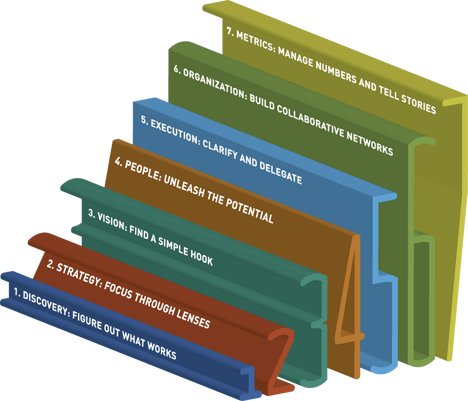
1. Discovery: Figure Out What Works
Science fiction author William Gibson observed, “The future is already here. It’s just not very evenly distributed.” And so it is with excellence. All large companies have pockets of excellent growth performance. The first step in the growth journey is to discover what is working well and where the company is already winning. These pockets of excellence help identify focus areas for growth. An effective way to uncover what works is to conduct a series of workshops with the top leaders from the company.
At Unilever’s Lipton beverages business, the process began at Colworth House, the company’s R&D center in the United Kingdom. The top 100 leaders of Unilever beverages from around the world were invited to a workshop in 2000, whose agenda was to build upon what was working well in specific markets and to scale the success across other geographies. One year later, this was followed by a “10 in 10” workshop in Brussels to discuss how to achieve sales of US$10 billion within 10 years in these markets and to imagine the future of Lipton as seen through the eyes of Unilever’s major competitors.
In Kraft Foods’ international business, the growth process kicked off in 2007 with seven workshops in six locations around the world, each including about 20 of the company’s regional business leaders. The agenda was open-ended, with the top leaders taking a backseat to prevent their rank from impeding the flow of ideas and insights. An external facilitator ensured that collective experience was gathered objectively. The workshops focused on what worked rather than on what did not work, because it is easier to build on what is working than to fix what isn’t working. To ensure a customer focus, workshops included extensive immersion with consumers and customers to provide insights into behavior, needs, and problems. This kind of immersion generates insights in ways that quantitative market research never can.
A few themes began to emerge from the workshops. Kraft Foods had excellent people, but their insights and ideas had been getting lost because of geographic dispersion, and their potential was not being fully realized. The company’s iconic brands had been built over many years, but several were underperforming. The planning process had tended to focus internally instead of externally, and had looked backward rather than forward. There was a lot of emphasis on analyzing what happened instead of figuring out what needed to be done. The conclusion was clear. The company urgently needed to establish clear priorities and accountability at a global, regional, and local level.
At the outset, the discovery process should be inclusive and democratic. It is important to involve key stakeholders within the company, particularly those who can make a valuable contribution and those who have the influence to get the masses of employees behind them. In addition, great insights often come from engaging with suppliers, creative and media agencies, and consultants who have worked with the company for a long time. On the other end of the spectrum, it is also important to listen to people who push back — and to manage dissent. As the process goes on and the framework and vision are agreed upon, debate on the strategic framework should cease and the emphasis should switch to execution.
2. Strategy: Focus through Lenses
The discovery process produces a set of success themes. In the second step, these themes need to be clustered and prioritized to define the focused bets that the company should make. Narrowing the focus is essential in order to concentrate resources on areas where the company has the best chances of winning. To take an analogy from photography, sharpening the focus on an object requires a telephoto lens that homes in on the subject while de-emphasizing background objects. Similarly, we have found that strategic focus requires lenses through which a company can look at its businesses. Lenses can be categories that the company is doing well in, brands that are performing well, geographies that are doing a stellar job, and platforms (like wellness or bone health in healthcare) that can serve to unify the company’s products and brands.
Consider the experience at Fonterra Brands. Through the discovery process, the company used two lenses — a product platform and a distribution channel. Using the platform lens, Fonterra identified osteoporosis as a key platform to bet on, based on its expertise in bone-health products. To pursue leadership on this platform, Fonterra entered into a partnership with GE Healthcare’s Lunar business to tackle the growing global health problem of osteoporosis using Fonterra’s Anlene bone-health products and GE Healthcare’s bone density technology. The partnership’s first initiative was the Anlene Bone Health Check, which provided free bone density screenings to millions of people in nine countries in Asia.
Using the second lens, Fonterra bet on the food-service channel as a key to its future growth. The outcome was a focused business called Fonterra Foodservices, which offers a complete suite of dairy products and tailored solutions for food-service professionals. Focusing through the distribution channel lens led to the strategy of creating a single “cow to customer” integrated business.
During the focusing process, each lens may produce several possible opportunities. These opportunities should be prioritized according to two criteria: the expected impact of the initiatives and the effort required. This exercise should result in a one-page preliminary plan that lists priorities for each lens. This preliminary plan should then go through several rounds of iteration with the input of key stakeholders. To improve the framework’s odds of adoption, it is important to involve as many of these stakeholders as possible in “owning” the outcome.
Once you find out what works, you can focus on it and scale the success to other markets, products, and brands. In the Unilever workshops, the company discovered that Lipton Portugal and Lipton Arabia were performing consistently well over time. Diving deeper into the reasons for this standout performance, the company found an interesting theme. In both markets, Lipton had been successful because it competed in the broad beverages market rather than limiting itself to the tea category. Further, in these markets, Lipton had done an excellent job of adapting its products to local tastes. For instance, Portugal had a successful iced tea business, whereas Arabia represented a successful hot tea market, despite the fact that Arabian countries have hot climates. The idea of taking a broader view of the business while remaining relevant to local tastes could be applied to Lipton’s other markets and categories.
3. Vision: Find a Simple Hook
Once the focus areas have been defined, the findings need to be summarized in a compelling yet simple vision. The vision serves as a rallying cry for the organization to align its efforts behind a clearly understood goal. Too frequently, the business strategies of large corporations are poorly understood outside the corporate headquarters and beyond the senior leadership of the company. To get everyone in the organization behind the strategy, it is vital to communicate the strategy across all levels and functions in the organization. This is the role that the vision plays.
To make the vision compelling yet easy to understand, we recommend creating a “hook.” The hook should be kept consistent over time and across customer touch points. It can be a color, a number, an acronym, a phrase, or a symbol. At Fonterra, the rallying cries were “Winning through Brands” and “Dairy for Life.” The vision embodied two themes: farmers’ pride (Fonterra is a cooperative owned by farmers) and the company’s emphasis on natural products, captured through the blue and green color of the company’s logo and merchandising. At Kraft International, the vision was expressed in numbers — “the 5-10-10 strategy,” which meant winning by focusing on five categories, 10 brands, and 10 markets. At Lipton, the vision was “Paint the World Yellow with Lipton.” The brand’s characteristic color signified brightness and sunshine, and stood for a broader Lipton beverage experience than just a cup of tea.
Once a vision is chosen, it needs to be launched with a bang through a seminal event designed to inspire the team. For Kraft Foods’ international business, the top 100 leaders were brought together on the 99th floor of the Willis (formerly Sears) Tower in Chicago in May 2007. The event kicked off with awards for teams around the world that recognized great work in various categories. Awards can set a positive tone, instill a can-do attitude, and make people feel like winners. At Lipton, the kickoff event was held at Colworth House, the 18th-century mansion at Colworth Science Park, where everything was painted yellow — including the lawn in front of the building. The theme “Paint the World Yellow with Lipton” was brought to life through winning stories from successful markets.
In communicating the vision, pictures are often worth a thousand words or PowerPoint slides. Simple visuals that depict the “from–to” journey can serve as powerful communication tools. Lipton used two visuals to bring the transformation journey to life — a picture of Audrey Hepburn, representing the Lipton brand as it was (classic, aristocratic, reserved), and a picture of Cameron Diaz, representing the new Lipton (bright, sunny, vibrant).
4. People: Unleash the Potential
Once the vision and strategy have been defined and powerfully communicated, the next step is to find the right people and to place disproportionate resources in their hands. The right people need to be placed in all functions — supply chain, R&D, marketing and sales — to ensure that you have the skills to win. Selecting those people requires a rigorous process of matching skills with the needs of the business. For instance, if the strategy involves focusing on a specific channel or set of brands, you need to find people who have expertise in the relevant channels and brands and put them in charge.
In Kraft Foods’ international business, significant changes were made in the top leadership. Less than two years after launching the transformation initiative, two-thirds of the top 30 leaders were new to their roles. Many of the new leaders came from within Kraft Foods. Some were hired externally, and some came from the successful acquisition of Groupe Danone’s biscuit business in November 2007. Similarly, at Lipton, a number of managers were hired from leading companies in the beverage industry (Coke, Pepsi, Schweppes) to augment the traditional grocery skills within Unilever.
Once new leaders are appointed, they need to be given the freedom to operate within the strategic framework so that their potential can be truly unleashed. Leaders should be challenged to act as entrepreneurs within large companies that have traditionally been perceived as process-driven and bureaucratic. In our experience, the biggest enemy of creativity and imagination in large companies is the budget. Resource constraints, real or perceived, limit the imagination of business leaders and prevent them from thinking creatively. To liberate people from these constraints, we recommend a counterintuitive approach: Give people huge targets and empower them with virtually unlimited resources. The targets should represent a quantum leap from historical results. Although it may seem that unlimited resources would encourage profligate spending, business leaders have a strong incentive to spend wisely, because they do need to deliver profits and margins, not just revenue increases. When leaders are asked to act like owners, they behave with an amazing sense of responsibility and often arrive at sensible trade-offs among risks, rewards, and resources. It is important that leaders not be penalized for failure unless they consistently fail to learn from experience.
Unleashing the potential of people also involves identifying and nurturing tomorrow’s growth leaders. During Kraft Foods’ transformation journey, a formal program called the Winners’ Circle was created to recognize and reward performance and potential in the international business. This program was designed after benchmarking against some of the world’s best companies. Rising stars from around the globe were nominated through a rigorous selection process, and the Winners’ Circle members were inducted into a leadership program designed to build their capabilities. Today, their career progress is carefully monitored and they are selected for challenging growth assignments across the company. The program has generated tremendous buzz within Kraft Foods because of its richness and depth.
5. Execution: Clarify and Delegate
With the discovery, strategy, vision, and people in place, the next challenge is execution. This is the most important step in the journey, and it is also the most difficult. Execution has two key elements. First, everyone needs to be clear about who will do what, to avoid ambiguity about roles and responsibilities. Second, decision making needs to be moved closer to customers and consumers so that the people responsible for results have the operating freedom they need. Most organizations have a mistaken conviction that the leadership team has superior knowledge on every subject. This belief conditions managers to assume that success lies in pleasing the leadership team rather than in winning in the market.
Kraft Foods found that the organization had become such a complex matrix that accountability was fragmented across functions, markets, and business units, yet decision making had become highly centralized. Decisions such as product pricing were being made at corporate headquarters, which took longer and excluded the rich knowledge and context of local markets. Even such routine decisions as the pricing of coffee in Germany were made at the corporate headquarters in Northfield, Ill.! This was changed to give business leaders the freedom to make decisions that would allow them to compete effectively in their markets. The role of corporate headquarters was made more strategic and less operational. Certain decisions involving food safety and purchasing were still kept centralized because they had to be made on a large scale, as opposed to those that demanded intimacy with local consumers and customers. These changes have had a profound effect in making the organization more nimble.
To accelerate execution, we recommend a strong bias for action. Business leaders should demand a dramatic reduction in internal documents and meetings. In our experience, too many meetings and documents foster analysis paralysis, promote internal focus versus external focus, and emphasize the past over the future. Much of the documentation is generated to please senior management, with endless hours spent on “wordsmithing” and editing. For the most part, we suggest a “no PowerPoint” policy in presentations; meetings are often far more productive if they focus on discussion based on pre-reading. Numbers may help tell the story, but too often, we find that numbers become the story and the big picture gets lost.
6. Organization: Build Collaborative Networks
Growth initiatives rarely fit within organizational silos of function, geography, and business unit. Rather, they need to be managed by creating communities and networks across the company, formal as well as informal. At Kraft Foods, certain networks, such as R&D, have always been strong. However, as business units were pushed to take P&L responsibility, it was important to set up collaborative networks to ensure that the best people with the best ideas were connected to leverage expertise and scale. Kraft Foods set up global category teams consisting of executives drawn from different functions and geographies to manage global brands, innovation, and supply chains across markets. Each team follows the approach that works best for its brand or category in terms of what needs to be done by whom, globally or locally.
Consider the example of Oreo cookies, one of Kraft Foods’ billion-dollar brands. Oreo was a strong brand in the United States but had historically been weak in the rest of the world. One reason was the assumption that what was good for Oreo in the U.S. was also good in China, the U.K., and elsewhere. The company learned from experience that this was not the case. To grow the brand in China, Oreo cookies were made less sweet to suit local consumer tastes. Oreo packages were made smaller, and new forms, like wafers, were introduced. Heavy emphasis was placed on local promotions and on-the-ground marketing activities unique to China. This localization, however, was carried out within the global brand positioning for Oreo. After implementation of the new strategy, Oreo became the market leader in China, and the Oreo business outside the U.S. began growing about 30 percent per year. Through the global category teams, Kraft Foods now has an energized, highly motivated community of employees around the world who sleep and dream Oreo.
This approach of matching skills with priorities and connecting communities to get the best mix of global and local ideas, within a clearly defined strategy, has a powerful effect in leveraging scale and expertise.
7. Metrics: Manage Numbers and Tell Stories
As the execution and organization processes get under way, it is important to keep score. Scorecards should be objective, and they should be kept simple. Overly complex metrics take attention away from the measures that really matter and can obfuscate execution priorities. At Kraft Foods, Chairman and CEO Irene Rosenfeld asked that the businesses create a one-page scorecard system that included three key measures — sales, profits, and cash flow. These three measures were made the basis for bonuses to all employees. This simple scorecard dramatically reduced reporting complexity and created clear accountability for results. Kraft Foods’ international business also uses a single-page scorecard to monitor the progress of the 5-10-10 strategy. Simplicity begets focus, because everyone knows what numbers the executives are looking at.
Managing growth requires a focus on numbers, but numbers alone are not enough. Storytelling is a powerful tool for propagating the culture of winning in the organization. A conscious effort should be made to write up and disseminate success stories from around the world. Leadership should make it a point at every large internal meeting to put successful people on the stage to share their stories with their colleagues. Success stories become part of the culture, and successful people become heroes in the eyes of their peers and managers. Moreover, highlighting the achievements of successful teams creates “positive shame”; the teams that are not on the stage feel strong peer pressure. This positive pressure is far more effective than the “negative shame” that would be created if the less-successful teams were berated in reviews.
Avoiding the Traps
With any transformation initiative, there are pitfalls to avoid and hurdles to overcome on the way to success. Here are a few to keep in mind in implementing growth through focus.
One common pitfall is to seek to build scale before fixing underlying problems. In choosing the markets and categories to focus on, for example, it is easy to get seduced by the size of the opportunity. Most large companies covet the hundreds of millions of consumers in emerging markets such as China, India, and Brazil. And they quote the minuscule per capita consumption of their products as an indicator of vast untapped potential. To convert potential into actual revenues and profits, however, you first need a business model that works. You must have the distribution reach, the supply chain, the manufacturing capabilities, and the right products before you can scale the business. Kraft Foods was in China for many years and had set ambitious targets that it did not achieve. In reality, the model was not working and the business was losing money. Scaling up the model simply made things worse. To fix this problem, Kraft Foods redesigned its business model, integrated its business with the acquired Danone biscuits unit, and got the appropriate talent on the ground. Only then did Kraft Foods’ business in China begin to grow and make money.
Another potential trap in implementing growth through focus is neglecting or mismanaging the parts of the business that do not fall within the core focus areas. This is the “tail” of your business — products, brands, categories, and markets that do not make it to the priority list. Consider, for example, the brand portfolio. Most large companies have hundreds of brands, but only a few will make it to the priority list. So what should you do with the rest? Simply cutting off the tail can be disastrous, because the decline of the tail is often faster than the growth of the core. Further, the non-core businesses often have fixed costs that are linked to the core businesses. Finally, cutting and divesting can have a huge demoralizing effect, because people often have strong emotional ties to some of these businesses.
What you need is a clear plan to manage the tail. We find it helpful to cluster the non-core businesses into two buckets — “milk or divest” and “local jewels.” The two buckets need very different management approaches. The first category includes businesses that do not make money and have no hope of making money, despite repeated promises of future turnarounds. These need to be divested over a defined time frame. Fonterra Brands exited markets such as Mexico and Egypt where the business had not performed well for some time, which freed valuable resources that could be redeployed to grow the core businesses. Local jewels are successful local businesses that can be retained in the portfolio but managed at arm’s length by local teams, leaving the global teams to focus on the core businesses. At Kraft Foods, the company found a number of such jewels that are now managed locally, but still help to provide scale in manufacturing and distribution. These businesses should be left to determine their own destiny but should be held accountable for revenues, margins, and cash flow.
Too often, when companies rationalize and focus, they slash expenses across the board. Two areas that take the brunt of cost cutting are people-related expenses (recruitment, training, travel) and brand advertising. However, talent and brands are the two most valuable assets for driving growth. We recommend increasing investments in hiring and developing talent, even ahead of the company’s needs. We also recommend increasing investments in building brands. The good news is that the growth-through-focus approach yields significant cost savings through elimination of management layers, reduction of overhead, and elimination of marginal businesses. Focus frees up resources that can be used to invest in the future.
Once a strategic direction has been established, it is important to stay the course until the strategy has been fully implemented. We find that large companies suffer from “corporate attention deficit disorder” — they tend to search for new strategies every few years, particularly after a change in leadership. But growth through focus requires patience and perseverance. In our experience, the transformation process takes as long as five years to play out. Leaders should resist the temptation to go for the “next big thing” in strategy peddled by management consulting firms and management gurus. Change for the sake of change merely produces a loss of momentum.
Finally, keeping a positive tone is vital to the success of growth through focus. It is very easy to slip into a negative spiral that can destroy morale and derail the transformation initiative. Although you do need to face the facts and make the difficult decisions, it is important to keep a positive tone and to promote a can-do attitude among employees. The energy that comes from winning is infectious. It inspires people to achieve goals that they have never before considered possible. Leaders should act as evangelists and cheerleaders, spreading the positive energy and making sure the teams are having fun at winning.
The sun generates a tremendous amount of energy, but it gives us only a warm glow. By contrast, a laser beam that uses a few kilowatts of energy can cut through metal. Such is the power of focus. If you are running a large global business with a big portfolio of brands, products, and markets, adding to your portfolio is likely to create more complexity than growth. To win in your businesses, you must harness the power of focus. By following the seven steps in our blueprint, business leaders can drive profitable growth even in difficult economic times. 
Building Scale for Focus: A Tale of Two Acquisitions
Growth through focus involves a reduction in the number of products, categories, brands, and markets that the company should focus on. But it also demands an increase in the scale of the businesses that the company chooses to focus on. Scale can be generated by building on the brand and product assets that the company has in its portfolio through organic growth. However, organic growth may not be enough to get to the required scale, particularly when the company is betting on markets or categories in which it is not a market leader. Further, in some emerging markets, building distribution networks from scratch is a Herculean task. This is where acquisitions play an important role in the growth-through-focus approach. They can help the company acquire scale in its chosen domains. The acquisition strategy should be driven by the focus strategy, and a clear logic should link the acquisition to the strategic framework for growth.
Consider Kraft Foods. The company had chosen biscuits and chocolates as two of the categories it wanted to focus on. It had also determined that markets like India, China, Brazil, Russia, and Mexico would be important for the company in the future. However, it lacked the scale, the brands, and the distribution networks it needed to compete globally in these categories and these markets.
Using this focus strategy, Kraft Foods identified two key acquisitions — the global biscuit business of Groupe Danone and Cadbury PLC, the U.K.-based confectionery company. In November 2007, Kraft Foods acquired the global biscuit business of Groupe Danone for US$7.8 billion. After this acquisition, Kraft Foods’ biscuits business accounted for 20 percent of the company’s revenue and catapulted Kraft Foods into the leading position in this category across the world. More importantly, it gave Kraft Foods an engine for faster growth in emerging markets. And in February 2010, Kraft Foods completed the acquisition of Cadbury for $19.5 billion, which has made the company a global powerhouse in snacks, confectionery, and quick meals. Kraft Foods now has access to Cadbury’s strong international distribution networks, which will allow it to penetrate deeper into emerging markets.
The focus lenses chosen in the second step of our approach can be used to identify and prioritize acquisition targets. In the case of Kraft Foods, the Danone biscuits and Cadbury business were attractive targets because they represented a triple win on the 5-10-10 scorecard — priority categories, strong brands, and strong presence in the key markets that Kraft Foods had decided to focus on. Further, these acquisitions brought in talent and a diversity of culture that will be a powerful asset for Kraft Foods as it grows its international business.

Author Profiles:
- Sanjay Khosla is president of Developing Markets and Global Categories for Kraft Foods. He has more than three decades of leadership experience in global consumer packaged goods companies and has lived and worked around the world.
- Mohanbir Sawhney is the Robert R. McCormick Tribune Foundation Clinical Professor of Technology and director of the Center for Research in Technology and Innovation at Northwestern University’s Kellogg School of Management. He has coauthored five books and many articles on marketing, technology, and innovation.

There are many theories on how to correctly “onboard” someone to an organization or a team. Most focus on how to provide the new hire with the information and skills she needs to succeed. But that can only take her so far. She will need connections and an understanding of the inner workings and culture of your company to be truly successful. Whether she is transitioning from another part of the organization or is brand new, you can get her up to speed more quickly by going beyond the basics and explaining how things actually get done.
What the Experts Say…
According to Michael Watkins, the Chairman of Genesis Advisers and author of The First 90 Days and Your Next Move, there are four domains that new hires need to master: business orientation, expectations alignment, political connection, and cultural adaptation. The last two are often the hardest for managers to convey, and yet the most critical for the new person to understand. Watkins’ research shows that lack of cultural adaptation is the most common reason newly-hired managers fail. “It’s also the hardest area for managers to provide good advice, in part because they are embedded in the culture and not necessarily reflective about it,” he says. Jon Katzenbach, Senior Partner of Booz & Company, author of The Wisdom of Teams, and co-author of the forthcoming Leading Outside the Lines, notes that “a lot of onboarding focuses on the formal side of the organization and is programmatic.” But helping new hires understand the informal side of the organization will accelerate their acclimation. Follow these three steps to get your new employee productive faster.
1. Start early
Onboarding really begins with hiring. Start as early as possible in the process to expose your new hire to the organization’s or unit’s culture and to explain how work gets done. While selling your organization in the interview process is key to recruiting the right person, don’t risk his eventual success by not being upfront about how things truly work. “The starting point is to recognize that the best onboarding process can’t compensate for the sins of recruiting,” Watkins says. Be honest and don’t allow your vision of how you wish your company operated to confuse your communication of the reality of the situation.
Always recruit for cultural fit as well as skills and experience and identify transition risks, such as capability gaps or tenuous relationships, before the new hire starts. If he is transitioning from another part of the organization, don’t assume that he knows the culture. Companies, even small ones, often have different ways of doing things across units or functions.
2. Get them the right network
“The first thing a manager can do is ensure that the new hire understands how important the informal or ‘shadow’ organization is in getting things done,” Watkins says. It is your responsibility to explain this, but she will only truly experience it by meeting her colleagues. As soon as she starts — or even before — introduce her to the right people. “If the informal organization is really important, then the manager can accelerate the new hire’s political learning process by identifying key stakeholders and helping to establish connections,” Watkins says. Katzenbach suggests creating an “indoctrination inventory that includes meeting the people recognized as valuable resources for understanding how to make the organization work for you.”
You also need to be sure early in her new job she meets with “nodes” or “culture carriers” — people who others go to for different kinds of information and insight. These won’t necessarily be the people who have the highest rank or best title; instead they may be may be particularly connected middle managers or administrative assistants who decide when key meetings are held and who gets invited. “One simple way to do this is to identify ten people that the new hire really needs to know, explain to the new hire why they are important, and send messages to these stakeholders asking them to meet with the new hire,” Watkins says. If you don’t know who these people are, ask around or create a network map that helps you identify the “go to” people in your organization.
3. Get them working
This may seem like a no-brainer for bringing new people on board. Yet many companies start off new hires with a stack of reading and a series of trainings. Giving them real work immerses them in the way things function at the organization. This doesn’t mean you should let them “sink or swim”; definitely provide the support they need. Katzenbach recommends putting them on a real team where they can work on a real business problem. “Get them in working mode rather than a training or student mode,” he says. Doing this instead of busy work exposes them to the company culture, introduces them to the ways things get done, and helps them to begin making the critical connections they need to productively contribute.
Principles to Remember
Do:
- Hire for cultural fit as much as for capabilities and skill
- Introduce your new hire to “culture carriers” and “nodes”
- Explain how work actually gets done at your organization
Don’t:
- Let a new hire stay in “learning” mode for too long
- Assume your new hire can’t be productive from the start
- Rely on the org chart to help explain lines of communication
Case Study #1: Working within the first five minutes on the job
Michelle Pomorksi, started her job as a contract programmer at the software design and development company Menlo Innovations after an intensive hiring process. Within five minutes of walking into the office in Ann Arbor, Michigan, Michelle was working on a project. This wasn’t an “onboarding project” but a real one for clients. She was “tripled” (that’s company lingo for teamed with two other people) and sent off to a client site to do interviews. Rather than observing, Michelle actively participated and was expected to contribute by asking questions.
Rich Sheridan, founder and CEO of Menlo, thinks he has created a unique process to get new people productive faster than at other software companies. Every new hire is immediately paired with a current employee to do design and development work, in what the company calls “paired programming.” Pairs are switched every week so by the end of the first three weeks, a new person has three mentors to rely on for advice and help. Even better, after the initial three weeks, she is ready to mentor someone new. “The real power is in the pairing,” Michelle says. “There isn’t one day I’ve gone to work that I haven’t learned and taught at least one thing.”
The process is facilitated by an open work space: Menlo doesn’t have offices, cubes or doors. Rich thinks his hiring and onboarding strategy gives him an advantage over competitors because he can seamlessly expand and contract his work force according to client demand. It also makes employees enjoy a task they might otherwise dread. He acknowledges that onboarding this way requires careful attention to how pairs are put together and a good deal of orchestration. But he does not see it as a loss to productivity. “I probably get four times as much work done with two people pairs than most people get with two individuals,” he says.
Case Study #2: Start early and see the whole picture
Pat Lee, a top Marketing Director at Johnson & Johnson Asia, happily received a promotion to Vice President of Marketing. But, she was not fully prepared for the suddenness of the promotion and all that it entailed, including relocating to a different country. She immediately began planning the logistics of the move: deciding which town to live in, exploring job prospects for her spouse, investigating schools for her children. She expected to have all these details worked out in advance so that she could “hit the ground running” on her first day in the new job.
However, Joe, her HR business partner, urged her to begin the transition to the actual job before she made the move. He suggested she take a “transition risk assessment” to help her better understand the challenges she faced in the new role. This helped Pat to fully see the situation she was getting into and better understand herself. It uncovered several issues: she had never worked in another country before; she had never taken on a regional role; she had minimal understanding of how her company did business in other countries; and she had little knowledge of the people on her new staff, the office politics, and how things got done. She also didn’t know what her new boss expected of her and what phase of operation her businesses were in — start-up, turnaround, downsizing, optimizing on-going, etc. She realized she needed to address these problems and so with Joe, developed a Transition Acceleration Plan and started working with a coach, who helped her by interviewing her boss, direct reports, and colleagues to get honest feedback about their expectations. seo data . Doug Soo Hoo, former Director of Learning and Development at J&J, explains that this intense process is “a good way to get out of ‘sink or swim mode’ and an investment in the company that also shows a caring for the success of the individual.”
After three months on the job, Pat’s boss and her peers gave her rave reviews on how quickly she had mastered the “ins and outs” of the new situation and taken actions to address them. One of her new reports said it was almost as if she had been in the division for years.
